
What Is the Opioid Conversion Calculator?
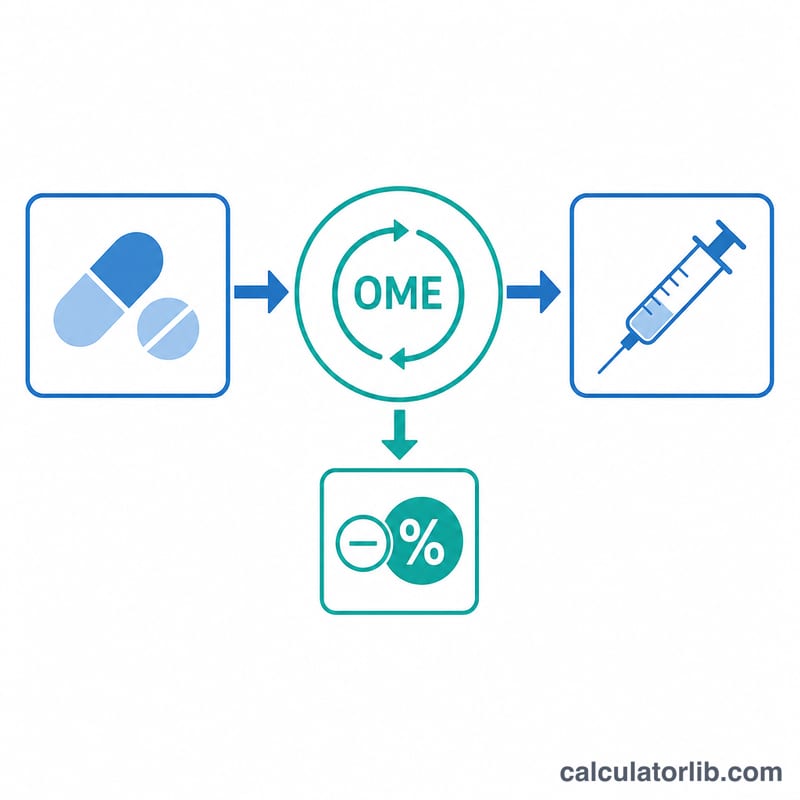
This calculator estimates an equivalent ("equianalgesic") dose when switching a patient from one opioid to another. It first converts the current opioid to oral morphine equivalents (OME) using standard conversion factors, then converts that morphine equivalent into the chosen target opioid. Because patients are usually not fully cross-tolerant to a new opioid, a safety reduction is applied. This is an educational tool and is not a substitute for clinical judgement or local prescribing guidance.
How to Use It
Select the opioid you are converting from, enter the total current daily dose in mg/day, select the opioid you are converting to, and choose a cross-tolerance reduction (commonly 25–50%). The calculator returns the OME, the raw equianalgesic dose, and the recommended new daily dose after reduction.
The Formula Explained
Each opioid has a conversion factor (CF) expressed relative to oral morphine, where oral morphine = 1. The current dose is multiplied by its CF to get the OME. Dividing OME by the target opioid's CF gives the equianalgesic dose. Finally we multiply by \((1 - r/100)\) to account for incomplete cross-tolerance:
$$\text{New Dose} = \frac{\text{Dose} \cdot CF_{from}}{CF_{to}} \left(1 - \frac{\text{Reduction}}{100}\right)$$$$\text{where}\quad \left\{ \begin{aligned} CF_{from} &= \text{Convert-From factor} \\ CF_{to} &= \text{Convert-To factor} \end{aligned} \right.$$
Worked Example
A patient takes 60 mg/day of oral morphine (CF = 1). Converting to oral oxycodone (CF = 1.5) with a 25% reduction: \(\text{OME} = 60 \times 1 = 60\) mg. Equianalgesic oxycodone \(= 60 / 1.5 = 40\) mg. After 25% reduction \(= 40 \times 0.75 =\) 30 mg/day of oral oxycodone.
FAQ
Why apply a cross-tolerance reduction? Tolerance to one opioid does not transfer completely to another, so reducing the calculated dose lowers overdose risk when rotating.
What reduction should I use? Many guidelines suggest 25–50%; use larger reductions for higher doses, frail patients, or uncertain prior intake.
Are these conversion factors exact? No. Published equianalgesic ratios vary between references and are approximate. Always confirm with a trusted source and titrate to effect.