
What this calculator does
This tool converts a mass concentration in milligrams per liter (mg/L) into parts per million (ppm), and also reports the equivalent in parts per billion (ppb). It is intended for dilute aqueous (water-based) solutions, which is the most common context in water quality, environmental testing, and laboratory work.
Why mg/L often equals ppm
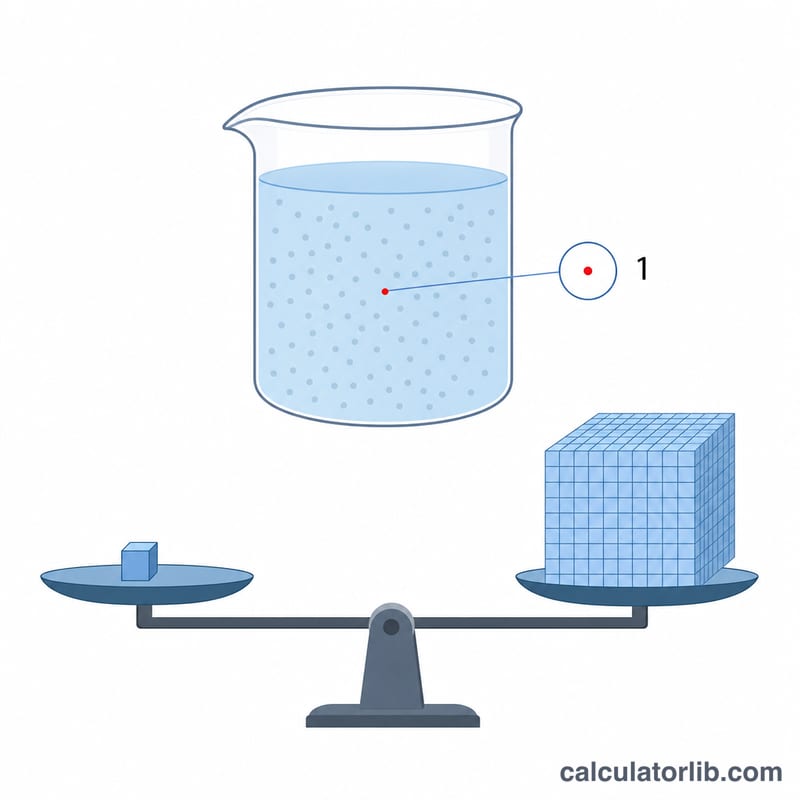
ppm is a mass ratio: milligrams of solute per kilogram of solution (mg/kg). mg/L is milligrams of solute per liter of solution. To convert between them you divide by the solution density in g/mL (which equals kg/L). For dilute water solutions the density is very close to 1 g/mL, so 1 mg/L is essentially 1 ppm. For concentrated brines, syrups, or solvents where density differs from 1, the density correction matters.
How to use it
Enter your concentration in mg/L and the solution density in g/mL (leave it at 1 for typical fresh water). The calculator returns the concentration in ppm and ppb.
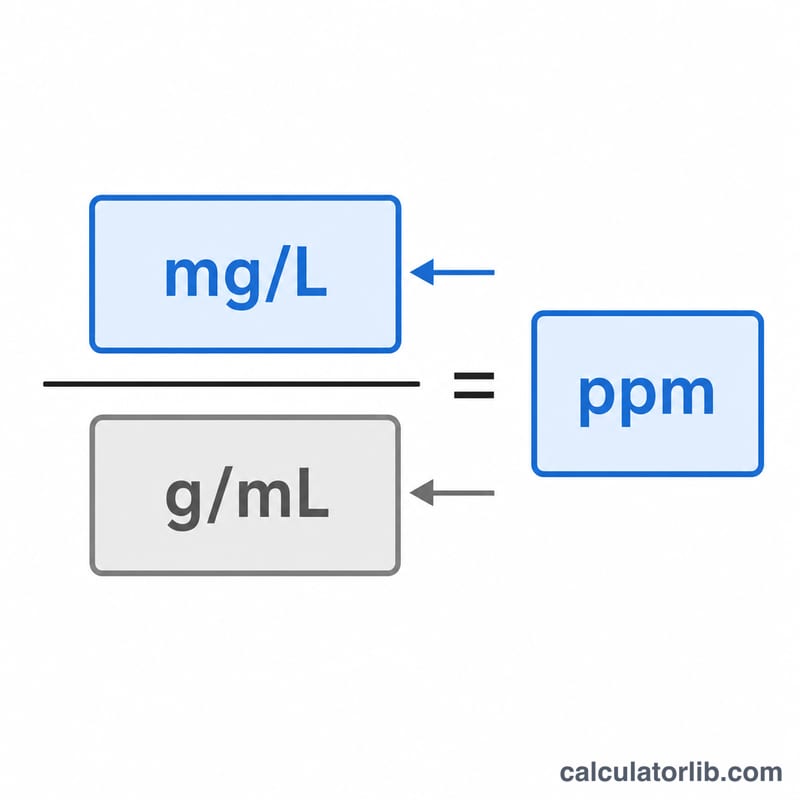
The formula
$$\text{ppm} = \frac{\text{Concentration (mg/L)}}{\text{Density (g/mL)}}$$ and \(\text{ppb} = \text{ppm} \times 1000\).
Worked example
A water sample contains 25 mg/L of nitrate with density 1 g/mL. $$\text{ppm} = \frac{25}{1} = 25 \text{ ppm}$$ In ppb that is \(25 \times 1000 = 25{,}000\) ppb. If the same 25 mg/L were in a brine with density 1.2 g/mL, \(\text{ppm} = \frac{25}{1.2} \approx 20.83\) ppm.
FAQ
Is mg/L always the same as ppm? Only when the solution density is 1 g/mL. For dilute water this is an excellent approximation.
What density should I use? Use 1 g/mL for dilute fresh water at room temperature. Use the measured density for concentrated or non-aqueous solutions.
What is the relationship to ppb? 1 ppm equals 1000 ppb, so multiply ppm by 1000 to get ppb.