
What Is a Percent to PPM Calculator?
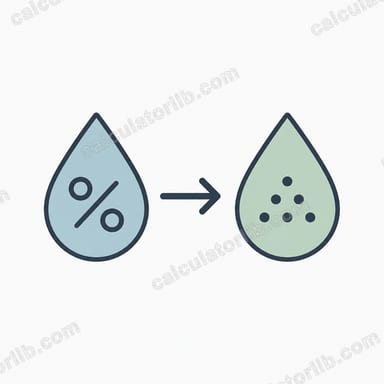
This calculator converts a concentration expressed as a percentage (%) into parts per million (ppm). Both are dimensionless ways of describing how much of one substance is present in a mixture, but ppm is used for very small concentrations where percentages would be awkward fractions. The conversion is universal and applies to any field — chemistry, water treatment, agriculture, food science and air quality monitoring.
How to Use It
Enter the concentration in percent and the tool instantly returns the equivalent value in parts per million. For example, a cleaning solution labeled "0.5%" can be re-expressed as 5,000 ppm, which is often the unit used on safety data sheets and lab protocols.
The Formula Explained
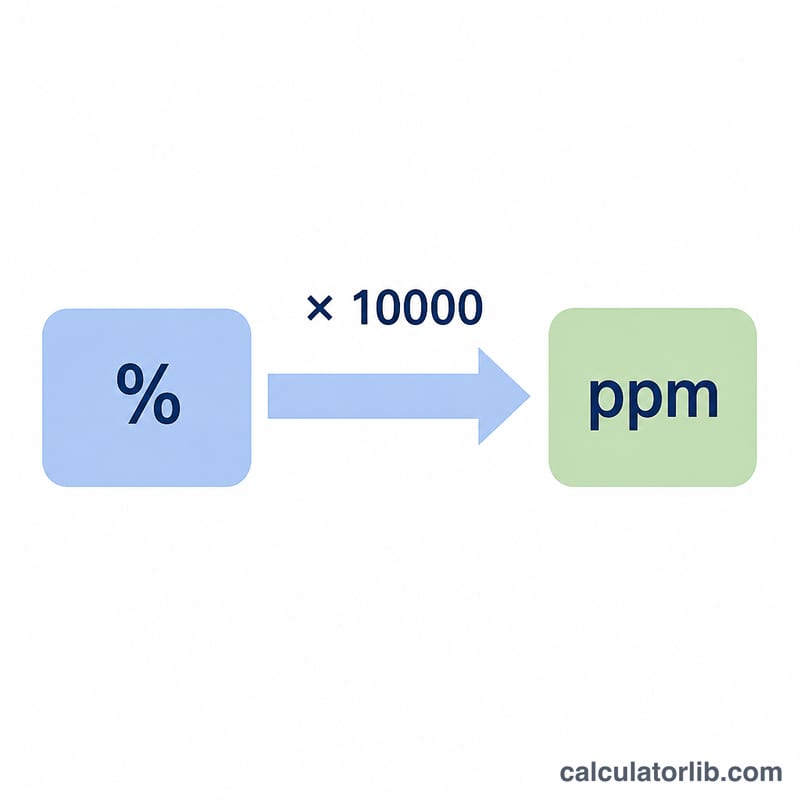
Percent means "parts per hundred," while ppm means "parts per million." Since one million is 10,000 times one hundred, you simply multiply by 10,000:
$$\text{ppm} = \text{percent} \times 10{,}000$$
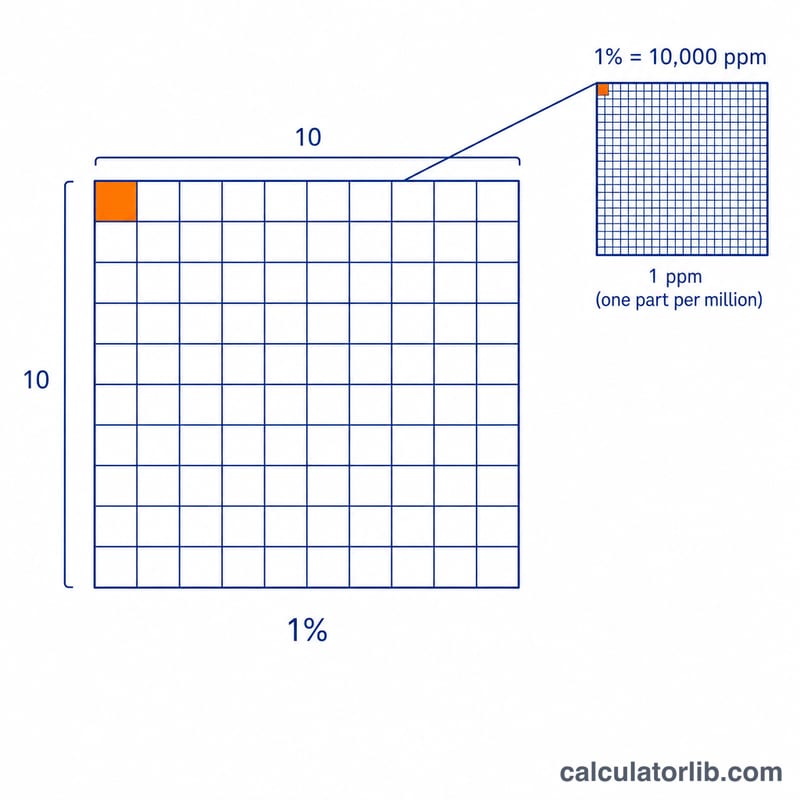
This works because \(1\% = 10{,}000\ \text{ppm}\). To go the other direction, divide ppm by 10,000 to recover the percentage.
Worked Example
Suppose a solution is 2.5% by mass. Multiply by 10,000: $$2.5 \times 10{,}000 = 25{,}000\ \text{ppm}$$ So a 2.5% concentration equals 25,000 parts per million.
FAQ
Is this conversion the same for mass and volume? Yes — the numerical factor of 10,000 is the same whether you are working with mass percent (% w/w) and mg/kg, or volume percent. Just keep your basis consistent.
How do I convert ppm back to percent? Divide the ppm value by 10,000. For instance, \(3{,}000\ \text{ppm} \div 10{,}000 = 0.3\%\).
What is 1 ppm in percent? 1 ppm equals 0.0001%, since \(1 \div 10{,}000 = 0.0001\).