
What This Calculator Does
This tool finds the percent abundance of two naturally occurring isotopes of an element when you know the element's average atomic mass and the exact mass of each isotope. The average atomic mass listed on the periodic table is a weighted average of the isotope masses, weighted by how common each isotope is. By rearranging that weighted-average equation, you can recover the relative abundances.
How to Use It
Enter three values: the average atomic mass (\(M_{avg}\)), the mass of isotope 1 (\(m_1\)), and the mass of isotope 2 (\(m_2\)), all in atomic mass units (amu). The calculator returns the percent abundance of each isotope. The two results always sum to 100%.
The Formula Explained
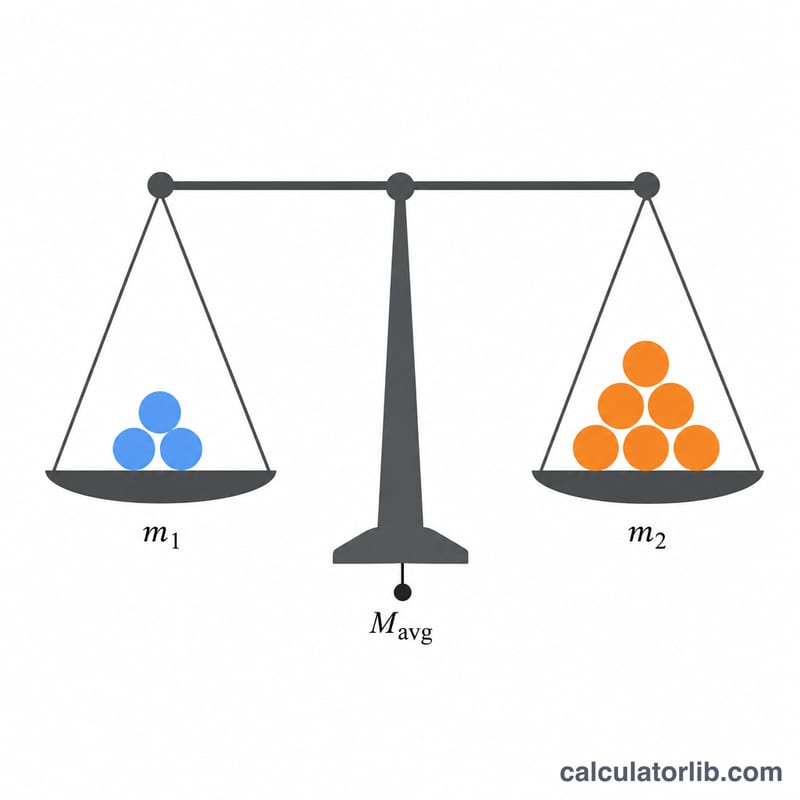
For two isotopes the average mass is $$M_{avg} = x \cdot m_1 + (1 - x) \cdot m_2,$$ where \(x\) is the fraction of isotope 1. Solving for \(x\) gives $$x = \frac{M_{avg} - m_2}{m_1 - m_2}.$$ The percent abundance of isotope 1 is \(100x\) and of isotope 2 is \(100(1 - x)\).
Worked Example: Chlorine
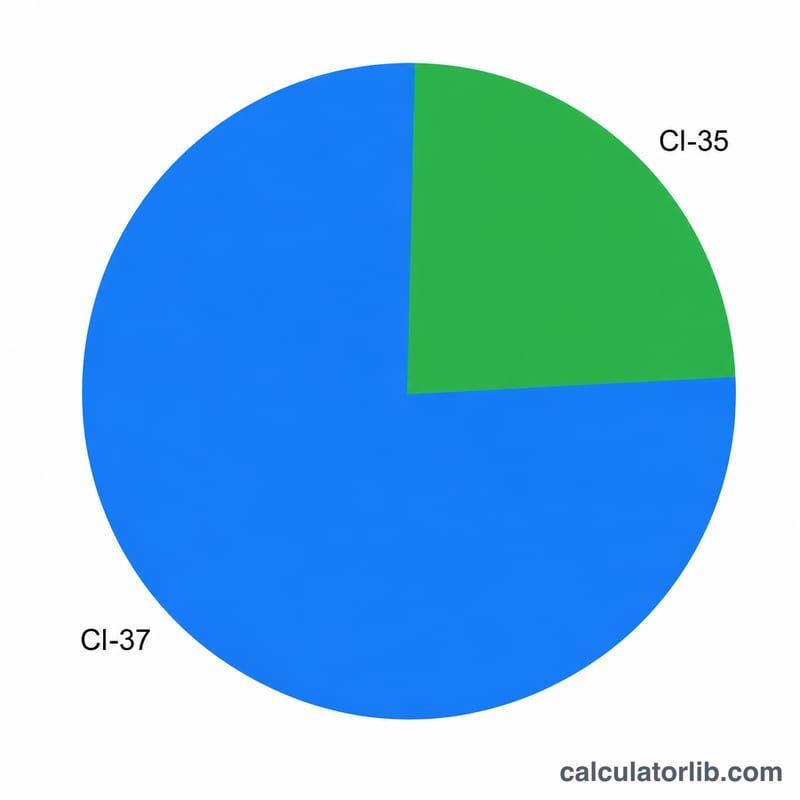
Chlorine has two stable isotopes, Cl-35 (mass 34.969 amu) and Cl-37 (mass 36.966 amu), with an average atomic mass of 35.453 amu. Then $$x = \frac{35.453 - 36.966}{34.969 - 36.966} = \frac{-1.513}{-1.997} \approx 0.7576.$$ So Cl-35 is about 75.76% abundant and Cl-37 is about 24.24% abundant, matching textbook values.
FAQ
Can I use it for more than two isotopes? No — this calculator assumes exactly two isotopes. With three or more, the problem has multiple unknowns and needs additional information.
Why does the order of \(m_1\) and \(m_2\) matter? The result labeled "Isotope 1" corresponds to the mass you enter as \(m_1\). Swapping the two masses simply swaps which abundance is reported first.
What units should I use? Use atomic mass units (amu) consistently for all three inputs. Because the formula is a ratio of mass differences, the result is unitless and reported as a percentage.