
What Is Percent Recovery?
Percent recovery measures how much of a substance you successfully recover after a purification step such as recrystallization, filtration, extraction, or chromatography. It compares the mass of purified material you collected to the mass you started with, expressed as a percentage. A high percent recovery means your process was efficient and you lost little material; a low value signals losses to side reactions, mechanical handling, or solubility in the mother liquor.
How to Use This Calculator
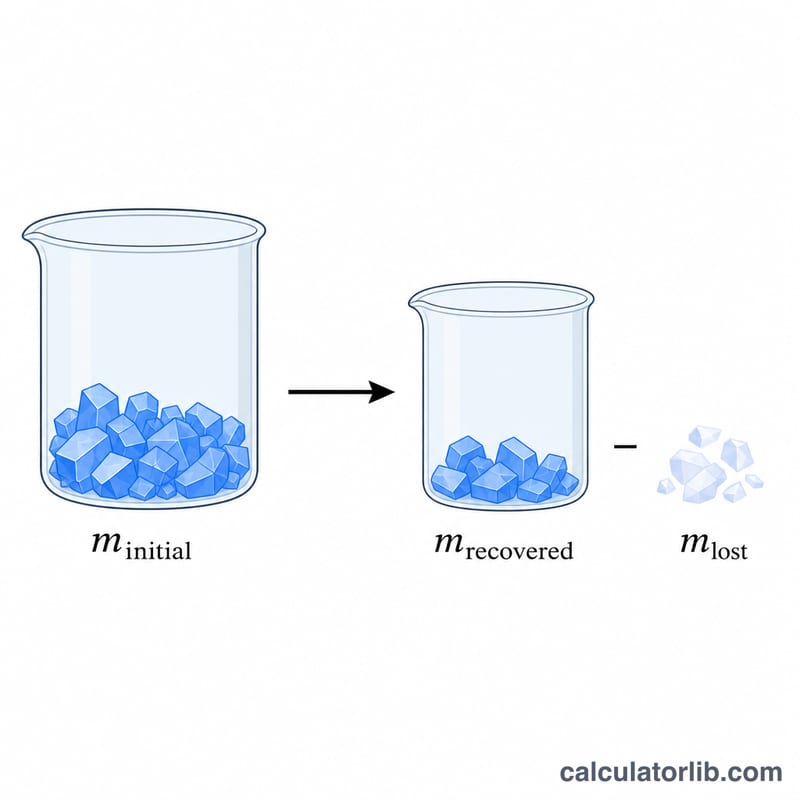
Enter two values: the mass you recovered after the procedure and the initial mass you began with, both in the same unit (grams here, but any consistent unit works). The calculator divides recovered mass by initial mass, multiplies by 100, and also reports the mass lost during the process.
The Formula Explained
The core equation is $$\text{Recovery} = \frac{\text{Mass Recovered (g)}}{\text{Initial Mass (g)}} \times 100\%$$. Because it is a ratio of like quantities, the units cancel, so you can use grams, milligrams, or moles as long as both numbers share the same unit. Values above 100% usually indicate residual solvent, impurities, or a weighing error rather than a true gain in product.
Worked Example
Suppose you start a recrystallization with 1.50 g of crude product and recover 1.20 g of purified crystals. Percent recovery $$= \left(\frac{1.20}{1.50}\right) \times 100 = \mathbf{80\%}$$ with 0.30 g lost. This is a typical, respectable recovery for a single recrystallization.
FAQ
Is percent recovery the same as percent yield? No. Percent yield compares actual product to the theoretical maximum from a reaction. Percent recovery compares what you got back to what you put in during a purification — no chemical reaction is involved.
Can percent recovery exceed 100%? Mathematically yes, but in practice it points to incomplete drying, trapped solvent, or impurities. Dry the sample fully and reweigh.
What is a good percent recovery? It depends on the technique, but 60–90% is common for recrystallization. Multiple purification steps compound losses, lowering overall recovery.