
What Is Click-Through Rate (CTR)?
Click-through rate (CTR) measures how often people who see your ad, link, email, or search listing actually click on it. It is one of the most important performance metrics in digital marketing because it shows how compelling and relevant your message is to the audience that sees it. CTR is expressed as a percentage and applies universally across paid search (PPC), display ads, social media, email campaigns, and organic search results.
How to Use This Calculator
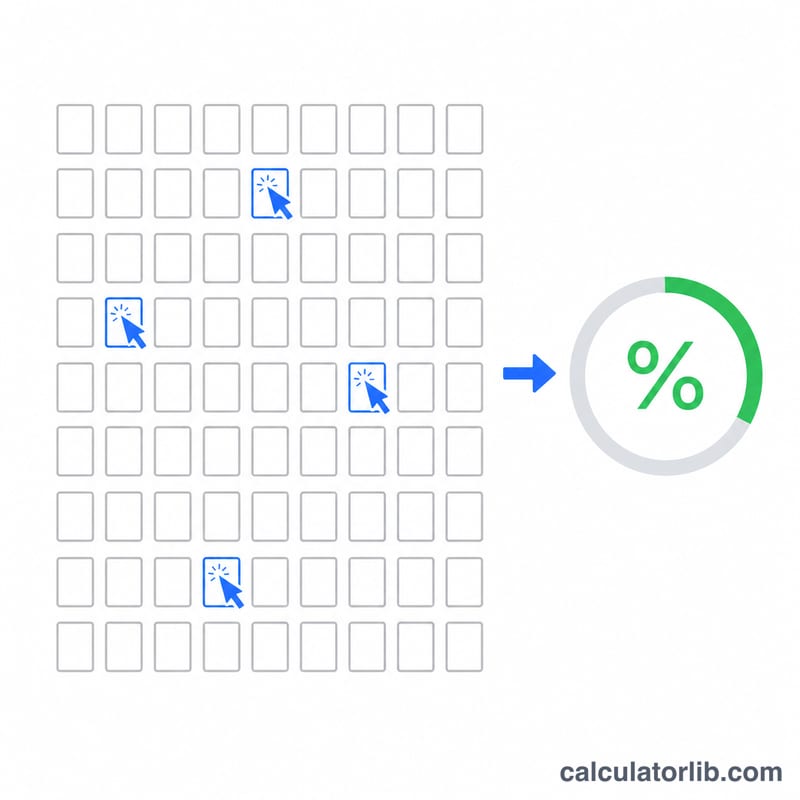
Enter the total number of clicks your ad or link received and the total number of impressions (how many times it was shown). The calculator divides clicks by impressions and multiplies by 100 to give your CTR as a percentage. Use it to compare campaigns, test new creatives, or set realistic performance benchmarks.
The Formula Explained
The calculation is simple:
$$\text{CTR} = \frac{\text{Clicks}}{\text{Impressions}} \times 100\%$$
Clicks is the number of times users clicked. Impressions is the number of times the ad or link was displayed. Multiplying by 100 converts the ratio into a percentage.
Worked Example
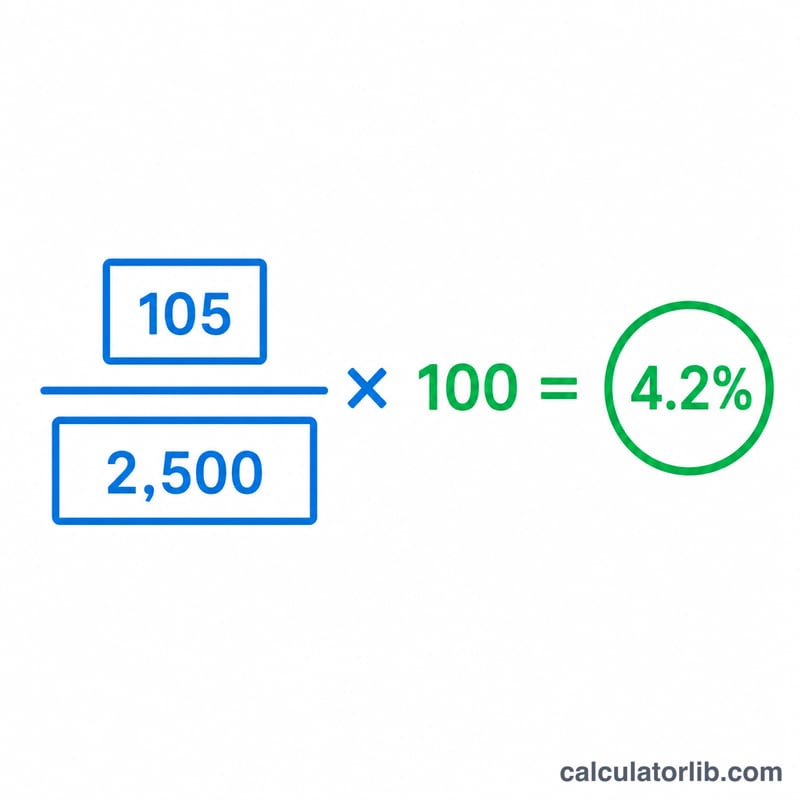
Suppose an ad received 250 clicks from 10,000 impressions. The CTR is $$\frac{250}{10{,}000} = 0.025,$$ then \(\times 100 = \mathbf{2.5\%}\). That means 2.5% of everyone who saw the ad clicked on it.
FAQ
What is a good CTR? It varies by channel: search ads often see 2–5%, display ads around 0.5%, and email campaigns 2–5%. Compare against your own historical data and industry benchmarks.
Can CTR be over 100%? Not normally — that would mean more clicks than impressions, which usually indicates tracking errors or bots.
Why is CTR important? A higher CTR signals more relevant, engaging content. In platforms like Google Ads it can also lower your cost-per-click and improve Quality Score.