
What is the Percent Dilution Calculator?
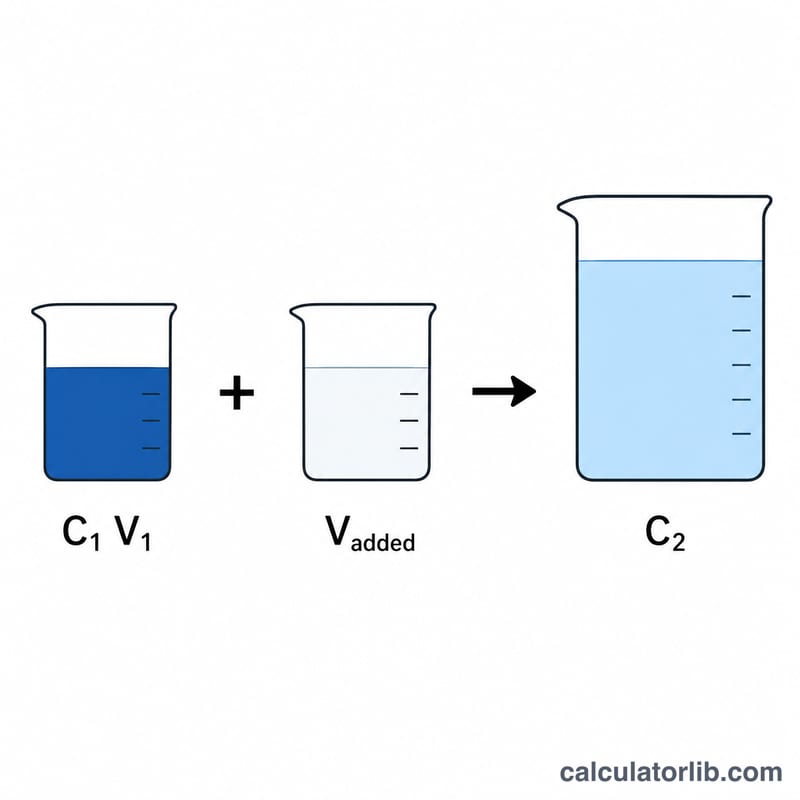
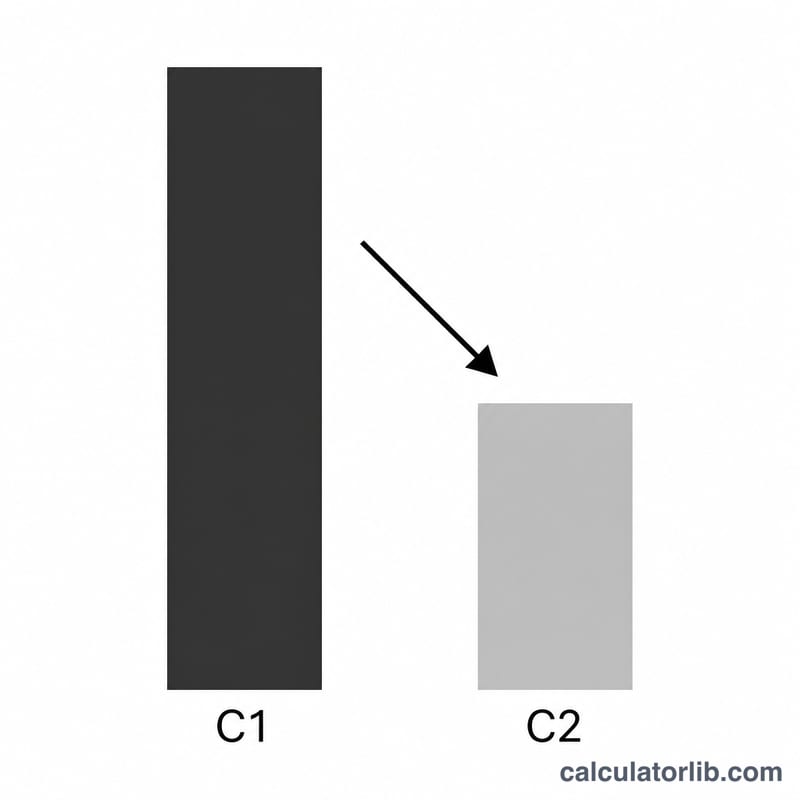
This calculator tells you the final concentration of a solution after you add more solvent (diluent) to it. You start with a solution of known concentration C1 and volume V1, then add a volume of pure diluent. Because the amount of solute stays the same but the total volume grows, the percentage strength drops. The tool also reports the new total volume and the dilution factor.
How to use it
Enter the initial concentration as a percentage, the initial volume, and the volume of diluent you are adding. Volume can be in any unit (mL, L, gallons) as long as you keep it consistent — the result for V1 and added volume just need to match. The calculator returns the diluted concentration C2 in the same percentage units.
The formula explained
The mass of solute is conserved: \(C1 \times V1 = C2 \times V2\), where V2 is the final total volume. Since the final volume equals the original plus what you added, \(V2 = V1 + V_{added}\). Solving for C2 gives:
$$C2 = \frac{C1 \times V1}{V1 + V_{added}}$$
The dilution factor, \(V2 / V1\), tells you how many times more dilute the new solution is.
Worked example
Suppose you have 100 mL of a 10% solution and add 100 mL of water. The final volume is 200 mL. Then $$C2 = \frac{10 \times 100}{200} = 5\%.$$ The dilution factor is \(200 / 100 = 2\times\), meaning the solution is twice as dilute.
FAQ
Does the unit of volume matter? No, as long as V1 and the added volume use the same unit. The concentration C2 comes out in the same percentage units as C1.
What is the difference between V_added and final volume? V_added is only the diluent you pour in. The final volume is \(V1 + V_{added}\).
Can I work out how much to add for a target concentration? Rearrange the formula: \(V_{added} = V1 \times (C1/C2 - 1)\). This calculator solves the forward direction (given the added volume).