
What Is a First-Order Half-Life?
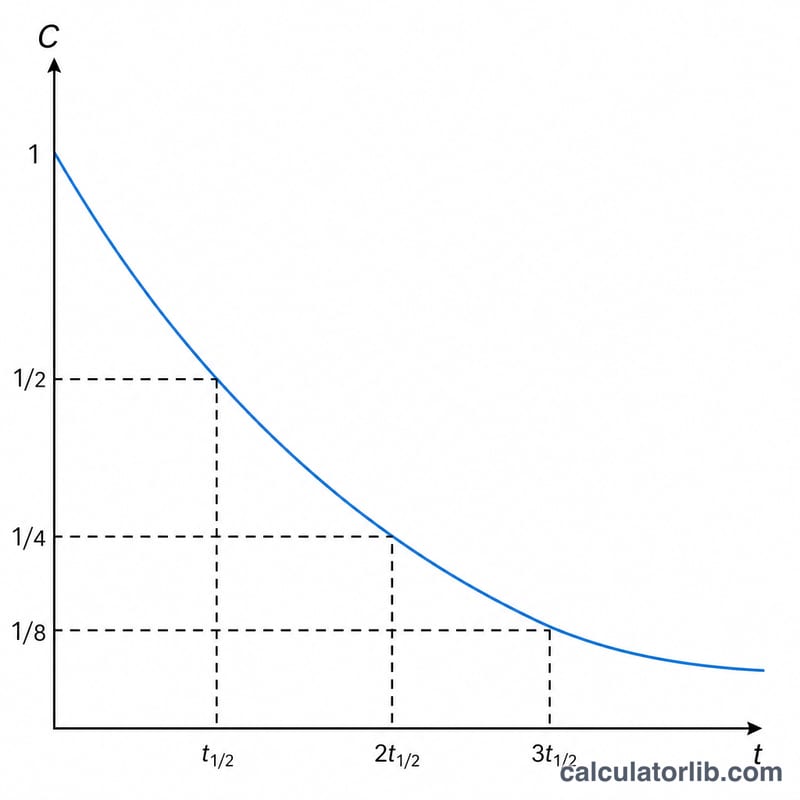
The half-life (t½) is the time required for the concentration of a reactant to fall to half its original value. For a first-order reaction, this half-life is constant throughout the reaction and depends only on the rate constant k — not on how much reactant you start with. This makes first-order kinetics especially predictable and is why it describes radioactive decay, many drug-elimination processes, and a wide range of chemical decompositions.
How to Use This Calculator
Enter the first-order rate constant k in reciprocal seconds (1/s) and the calculator returns the half-life in seconds. If your rate constant is in other units (1/min, 1/hr), the resulting half-life will be in the matching time unit (minutes, hours), since the formula is unit-agnostic as long as you stay consistent.
The Formula Explained
Starting from the integrated first-order rate law, \( \ln([A]/[A]_0) = -kt \), set \( [A] = \tfrac{1}{2}[A]_0 \). Solving gives:
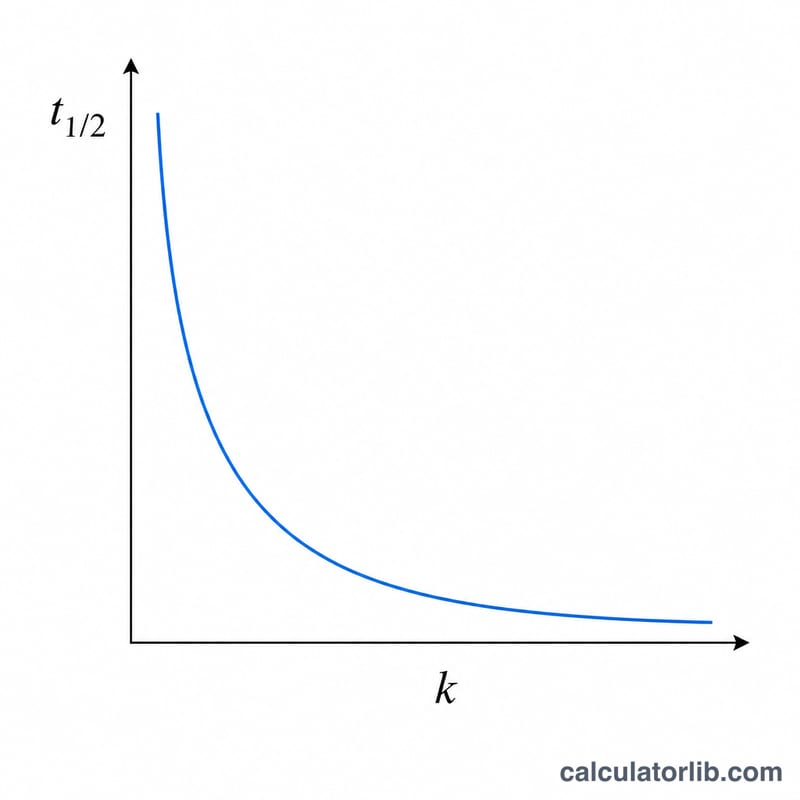
$$t_{1/2} = \frac{\ln 2}{k} = \frac{0.693}{k}$$The natural log of 2 (≈ 0.693) appears because we are halving the concentration. Notice the initial concentration cancels entirely — a defining feature of first-order behavior.
Worked Example
Suppose a reaction has a rate constant \( k = 0.0693\ \text{1/s} \). Then $$t_{1/2} = \frac{0.693}{0.0693} = 10 \text{ seconds}.$$ So every 10 seconds, the remaining reactant is cut in half: 100% → 50% → 25% → 12.5%, and so on.
FAQ
Does initial concentration affect first-order half-life? No. Unlike zero- or second-order reactions, a first-order half-life is independent of starting concentration.
Where does 0.693 come from? It is \( \ln 2 \), the natural logarithm of 2, which arises when solving the rate law for a 50% drop.
Can I use this for radioactive decay? Yes — radioactive decay is first order, with the decay constant λ playing the role of k, so \( t_{1/2} = \frac{0.693}{\lambda} \).