
What is the effective half-life?
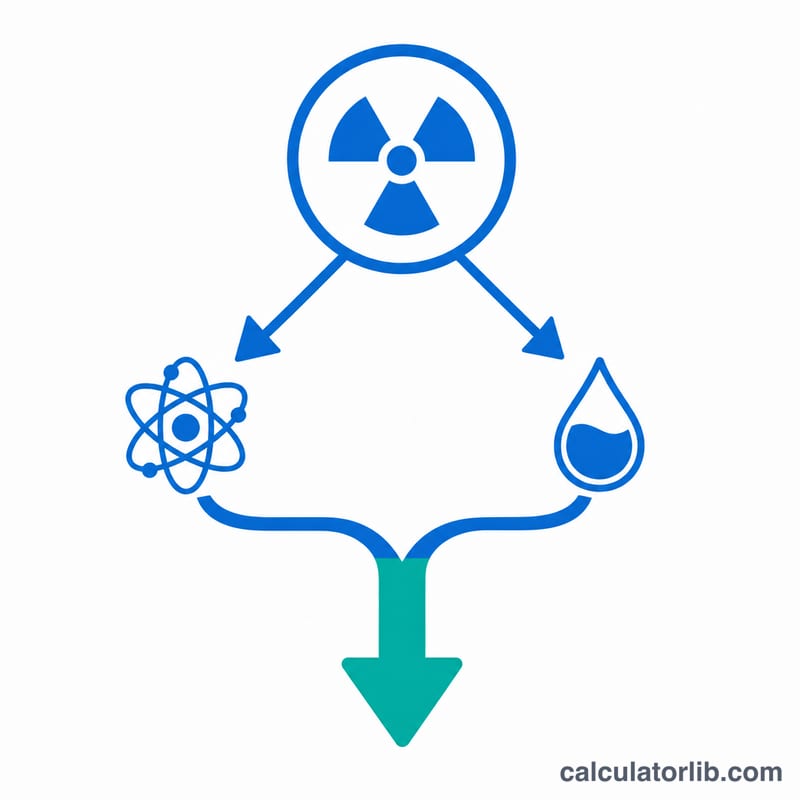
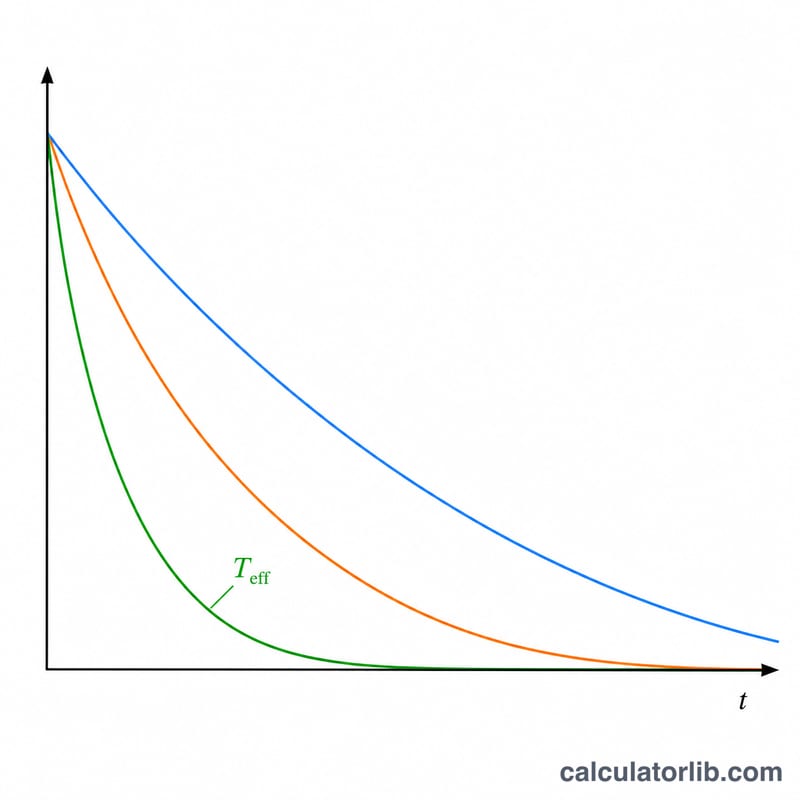
When a radioactive substance is taken into the body, it is removed by two independent processes acting at the same time. The first is physical radioactive decay, described by the physical half-life (\(T_{\text{physical}}\)). The second is biological elimination through metabolism and excretion, described by the biological half-life (\(T_{\text{biological}}\)) - the time the body needs to clear half of the amount. The effective half-life (\(T_{e}\)) is the time for the activity in the body to fall to half its value when both processes work together. It is always shorter than either individual half-life. This is universal health-physics and applies anywhere.
How to use the calculator
Pick an isotope from the dropdown to auto-fill typical reference values, or choose Custom and type your own. Enter the physical half-life and the biological half-life, each with its own time unit (seconds, minutes, hours, days or years). Choose the output unit, then read the effective half-life plus the effective removal rate constant and the value converted into several units.
The formula explained
The decay constant relates to half-life by \(\lambda = \frac{\ln(2)}{T}\). Because the two removal pathways are independent, their rate constants add: \(\lambda_{\text{eff}} = \lambda_{\text{physical}} + \lambda_{\text{biological}}\). Dividing through by \(\ln(2)\) gives the reciprocal-sum relation $$\frac{1}{T_{e}} = \frac{1}{T_{\text{physical}}} + \frac{1}{T_{\text{biological}}}$$ which rearranges to $$T_{e} = \frac{\text{T}_{\text{physical}} \cdot \text{T}_{\text{biological}}}{\text{T}_{\text{physical}} + \text{T}_{\text{biological}}}$$ Both half-lives must be in the same unit before applying the formula, so the calculator first converts everything to seconds.
Worked example
Iodine-131 has a physical half-life of 8.04 days and a biological half-life of 138 days. $$T_{e} = \frac{8.04 \times 138}{8.04 + 138} = \frac{1109.52}{146.04} = 7.60 \text{ days}$$ The result is shorter than the 8.04-day physical half-life, exactly as expected. The effective removal constant is \(\frac{\ln(2)}{7.60} = 0.0912\) per day.
FAQ
Why is the effective half-life shorter than both inputs? Because two removal mechanisms running in parallel clear the substance faster than either one alone.
What if there is no biological excretion (a gas or stable element)? Enter a very large biological half-life. That term then becomes negligible and the effective half-life approaches the physical half-life.
Where do the preset values come from? They are typical reference values (for example from the HyperPhysics tables) and vary slightly between sources, so you can always override them.