
What this calculator does
This tool tells you how much of a decaying substance is left after a period of time, based on its half-life. A half-life is the time it takes for exactly half of a quantity to decay. Whether you are working with a radioactive isotope, a medication clearing the body, or any process that decays exponentially, this calculator applies the universal half-life formula to give you the remaining amount, the number of half-lives elapsed, the amount lost, and the percentage that remains.
How to use it
Enter three values: the initial amount (N₀) in any unit you like (grams, milligrams, atoms, becquerels, doses), the elapsed time (t), and the half-life (T½). The time and half-life must be in the same unit — both in days, both in years, both in hours, and so on. Press calculate and the result updates instantly.
The formula explained
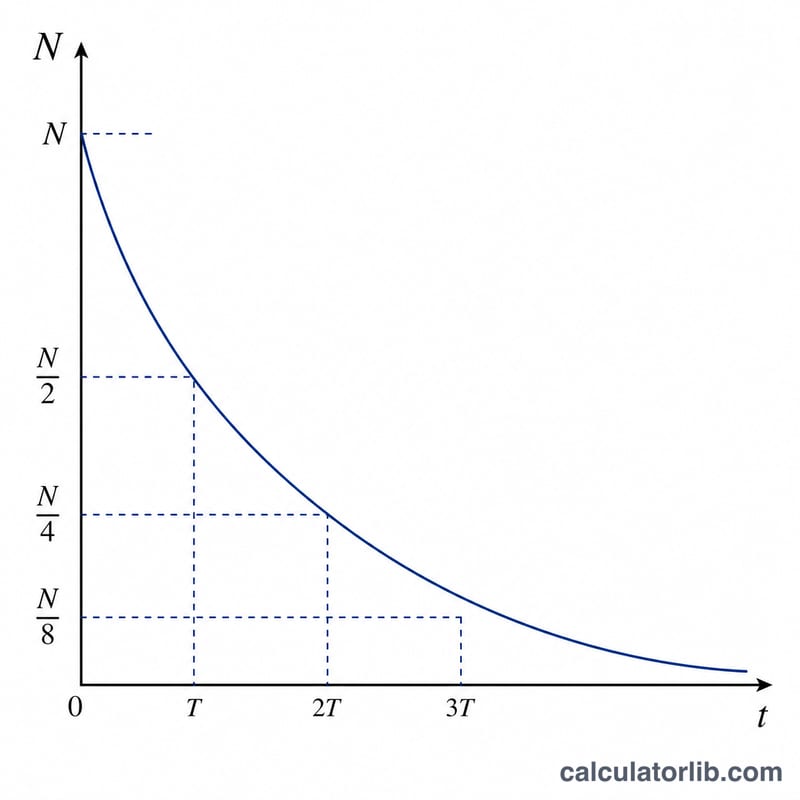
The decay follows $$N = \text{N}_0 \times \left(\frac{1}{2}\right)^{\frac{\text{Elapsed time}}{\text{Half-life}}}$$ The exponent \(t \div T½\) is the number of half-lives that have passed. Each whole half-life multiplies the remaining amount by \(\tfrac{1}{2}\): after 1 half-life you have 50% left, after 2 you have 25%, after 3 you have 12.5%, and so on. The formula works for fractional half-lives too, giving a smooth exponential decay curve rather than discrete steps.
Worked example
Suppose you start with 100 mg of a substance with a half-life of 5 days, and 10 days have passed. The number of half-lives is \(10 \div 5 = 2\). So $$N = 100 \times \left(\frac{1}{2}\right)^2 = 100 \times 0.25 = 25 \text{ mg}$$ remaining. The amount decayed is 75 mg, and 25% remains.
FAQ
Do the time units have to match? Yes. Elapsed time and half-life must use the same unit so that their ratio is dimensionless.
Can the elapsed time be longer than the half-life? Absolutely — that just means more than one half-life has passed, and the remaining amount keeps halving each period.
Does it work for non-integer half-lives? Yes. The exponential formula handles any positive value of \(t\), including fractions of a half-life.