
What this calculator does
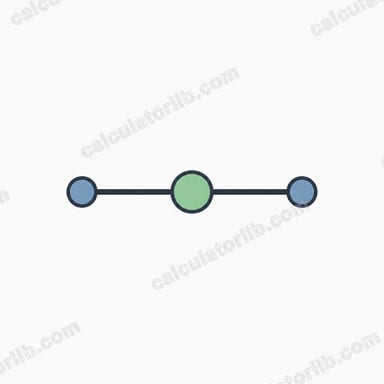
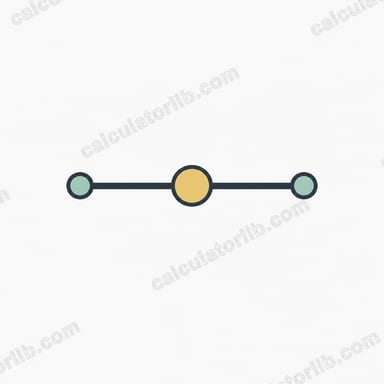
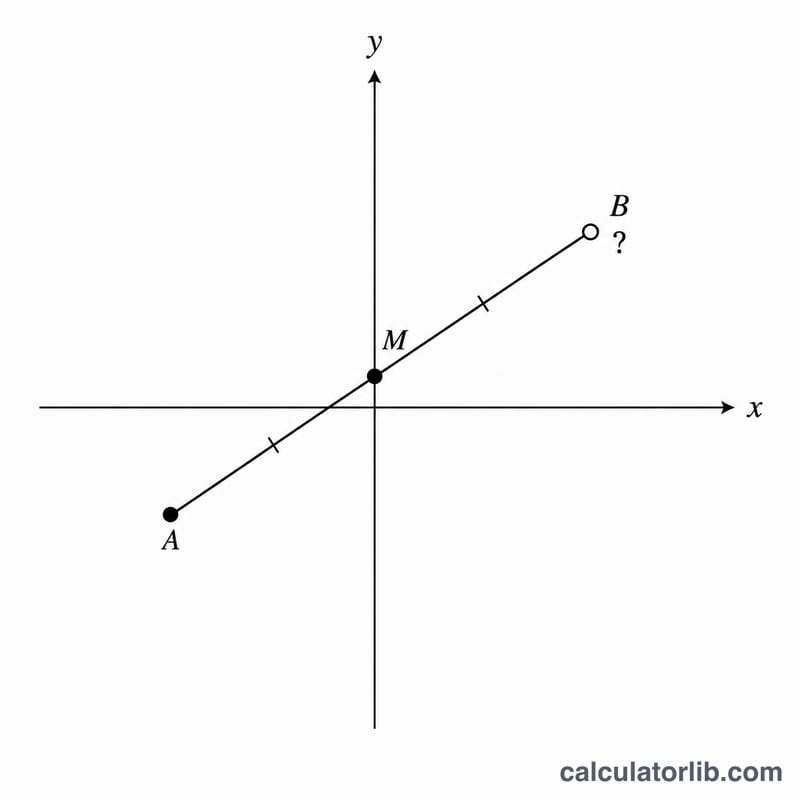
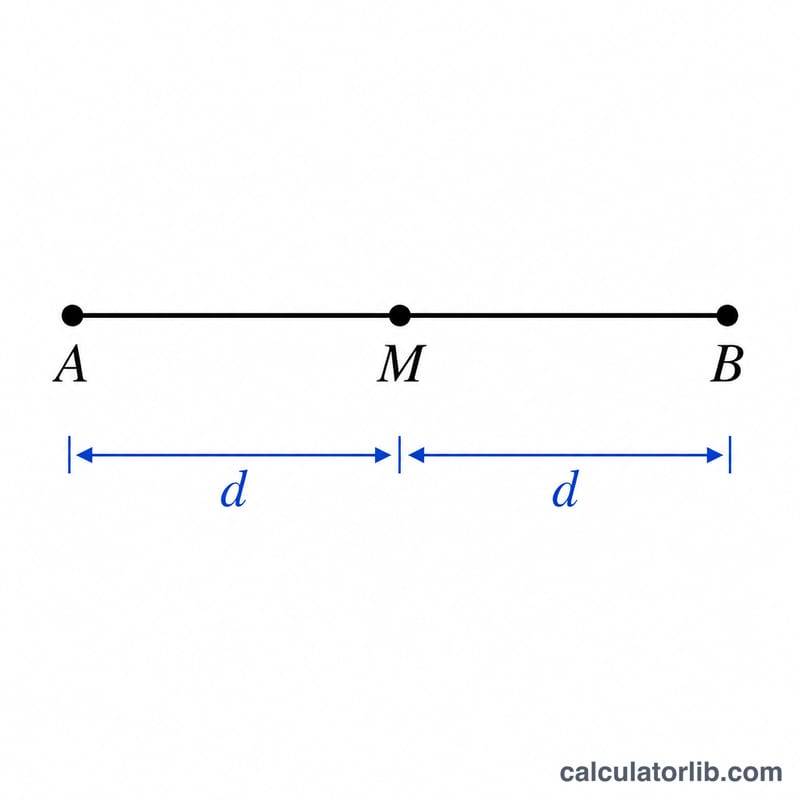
This tool finds the unknown endpoint of a line segment when you already know one endpoint and the midpoint. The midpoint of a segment is the point exactly halfway between its two endpoints, so if you know the halfway mark and one end, the other end is fully determined.
The formula explained
The standard midpoint formula says the midpoint M of a segment with endpoints \((x_1, y_1)\) and \((x_2, y_2)\) is the average of the coordinates: \(x_m = (x_1 + x_2) / 2\) and \(y_m = (y_1 + y_2) / 2\). Solving each equation for the unknown endpoint gives:
$$x_2 = 2\cdot x_m - x_1 \quad\text{and}\quad y_2 = 2\cdot y_m - y_1$$
In words: double each midpoint coordinate, then subtract the matching coordinate of the known endpoint.
How to use it
Enter the known endpoint coordinates \((x_1, y_1)\) and the midpoint coordinates \((x_m, y_m)\). Decimals and negative numbers are allowed. The calculator returns the missing endpoint \((x_2, y_2)\).
Worked example
Suppose one endpoint is \((2, 3)\) and the midpoint is \((5, 7)\). Then $$x_2 = 2\cdot 5 - 2 = 10 - 2 = 8 \quad\text{and}\quad y_2 = 2\cdot 7 - 3 = 14 - 3 = 11.$$ The missing endpoint is \((8, 11)\). You can verify: the midpoint of \((2, 3)\) and \((8, 11)\) is \(\left( (2+8)/2,\ (3+11)/2 \right) = (5, 7)\), which matches.
FAQ
Does it work with negative coordinates? Yes. The formula handles negative and decimal values without change.
What if the endpoint equals the midpoint? Then the segment has zero length and both endpoints are the same point.
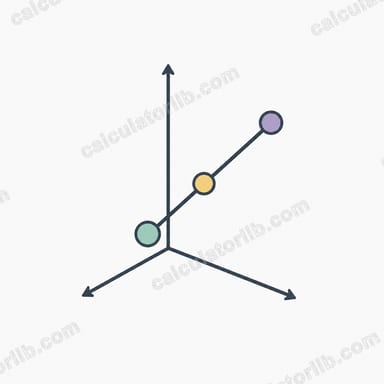
Can I use it in 3D? This version handles 2D points; for 3D, apply the same rule to the z-coordinate: \(z_2 = 2 z_m - z_1\).