
What is a perpendicular bisector?
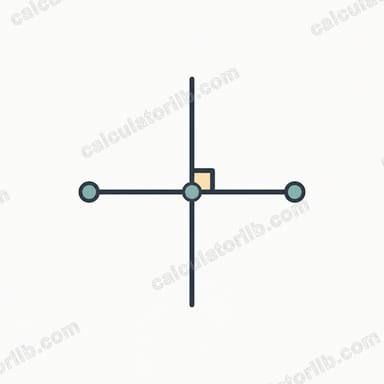
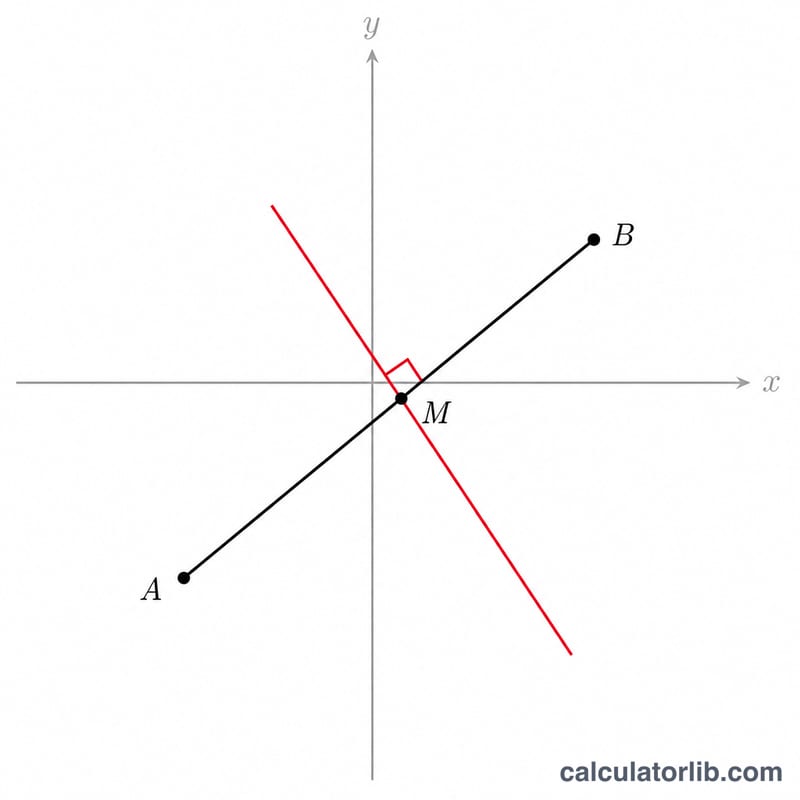
The perpendicular bisector of a line segment is the straight line that passes through the segment's midpoint and meets it at a right angle (90°). Every point on this line is equidistant from the two endpoints, which makes it essential in geometry, coordinate proofs, finding circle centers, and triangle constructions (it locates the circumcenter).
How to use this calculator
Enter the coordinates of the two endpoints of your segment, \((x_1, y_1)\) and \((x_2, y_2)\). The calculator returns the midpoint, the slope of the original segment, the perpendicular slope, the y-intercept, and the complete equation of the perpendicular bisector in slope-intercept form.
The formula explained
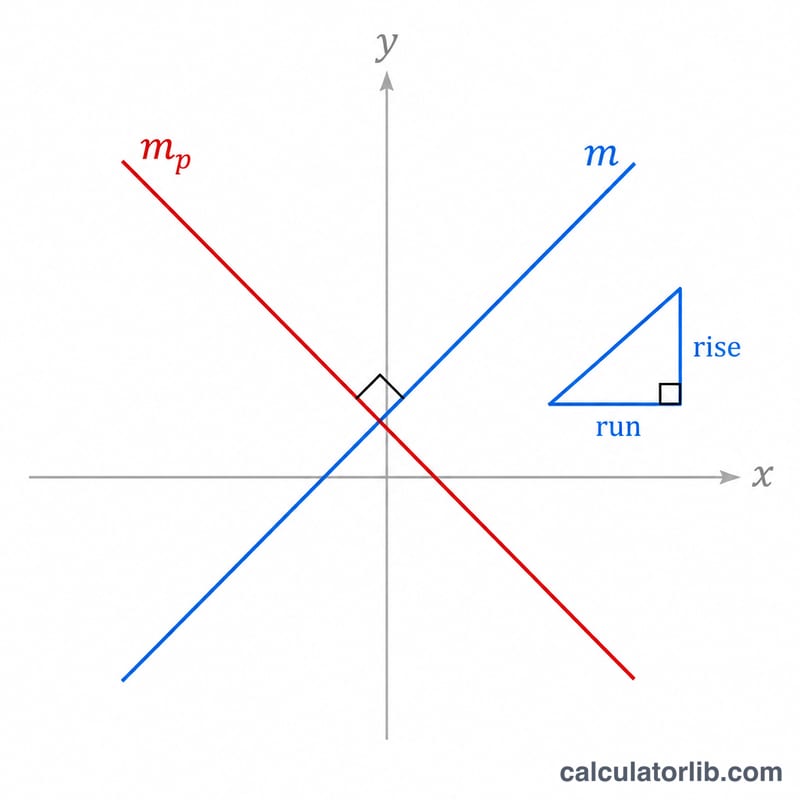
First find the midpoint \(M = \left(\dfrac{x_1+x_2}{2}, \dfrac{y_1+y_2}{2}\right)\). Next compute the segment slope \(m = \dfrac{y_2-y_1}{x_2-x_1}\). The perpendicular slope is the negative reciprocal \(m_p = -\dfrac{1}{m}\). Finally use point-slope form through the midpoint:
$$y - M_y = m_p\left(x - M_x\right)$$then rearrange to \(y = m_p x + b\). Special cases: if the segment is vertical (\(x_1=x_2\)) the bisector is horizontal (\(y = M_y\)); if the segment is horizontal (\(y_1=y_2\)) the bisector is vertical (\(x = M_x\)).
Worked example
Points \((1, 2)\) and \((5, 6)\). Midpoint = \((3, 4)\). Segment slope = \(\dfrac{6-2}{5-1} = 1\). Perpendicular slope = \(-1\). Equation:
$$y - 4 = -1(x - 3) \rightarrow y = -x + 7$$The y-intercept is 7.
FAQ
What if the two points are the same? A single point does not define a segment, so no unique bisector exists; enter two distinct points.
Why is the perpendicular slope the negative reciprocal? Two lines are perpendicular when the product of their slopes is −1, so \(m_p = -\dfrac{1}{m}\).
Can the answer be a vertical line? Yes. When the segment is horizontal, the bisector is vertical and is written as \(x = \text{constant}\) rather than \(y = mx + b\).