
What is the Logarithm Equation Calculator?
This tool solves the fundamental logarithm equation \(\log_{b}(x) = y\), which is equivalent to the exponential form \(x = b^{y}\). Given any two of the three quantities — the base b, the argument x, or the logarithm value y — it computes the missing one. It works for any positive base (except 1) and is useful for algebra, exponential growth/decay, pH chemistry, decibels, and computer-science complexity problems.
How to use it
Pick what you want to solve for using the radio buttons, then fill in the other two values. Leave the unknown field as it is. Press calculate to see the answer along with the full set of values that satisfy the equation.
The formula explained
The three rearrangements of \(\log_{b}(x) = y\) are:
Solve for y: $$y = \log_{b}(x) = \frac{\ln(x)}{\ln(b)}$$ (change-of-base rule).
Solve for x: $$x = b^{y}$$Solve for b: $$b = x^{\frac{1}{y}}$$
The change-of-base rule lets a calculator evaluate logs in any base using natural logarithms, since most hardware only provides \(\ln\) and \(\log_{10}\).
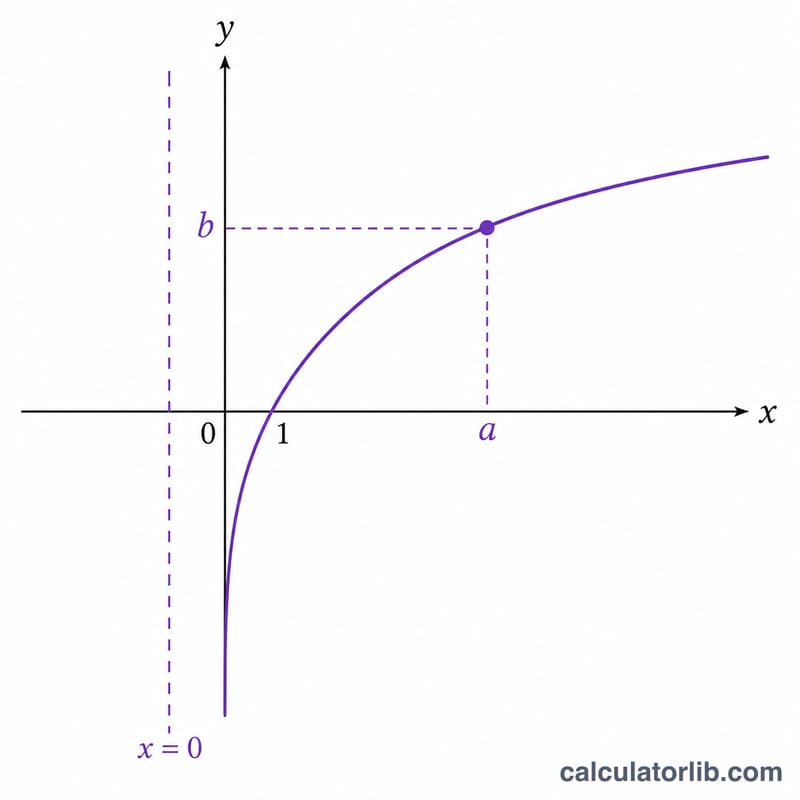
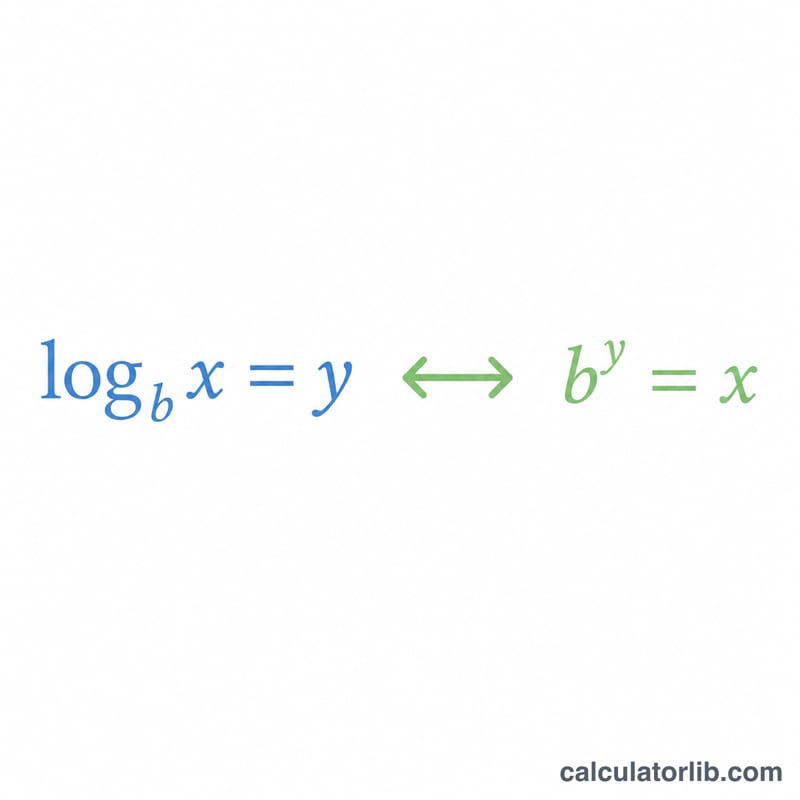
Worked example
Suppose \(b = 2\) and \(x = 8\), and you want y. Then $$y = \log_{2}(8) = \frac{\ln(8)}{\ln(2)} = \frac{2.0794}{0.6931} = 3$$ Checking: \(2^{3} = 8\). ✓ If instead you knew \(b = 2\) and \(y = 3\) and solved for x, you would get \(x = 2^{3} = 8\).
FAQ
Why must the base be positive and not 1? Logarithms are only defined for a positive base other than 1, and the argument x must be positive. A base of 1 would make \(b^{y}\) always equal 1, so no logarithm exists.
Can I compute natural or common logs? Yes — use base \(e\) (≈2.71828) for the natural log (ln) or base 10 for the common log (log).
What if y is 0 when solving for the base? Solving \(b = x^{\frac{1}{y}}\) requires \(y \neq 0\); if \(y = 0\) the base is undefined because \(b^{0} = 1\) for every base.