
What this calculator does
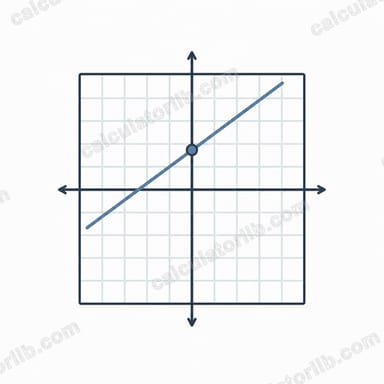
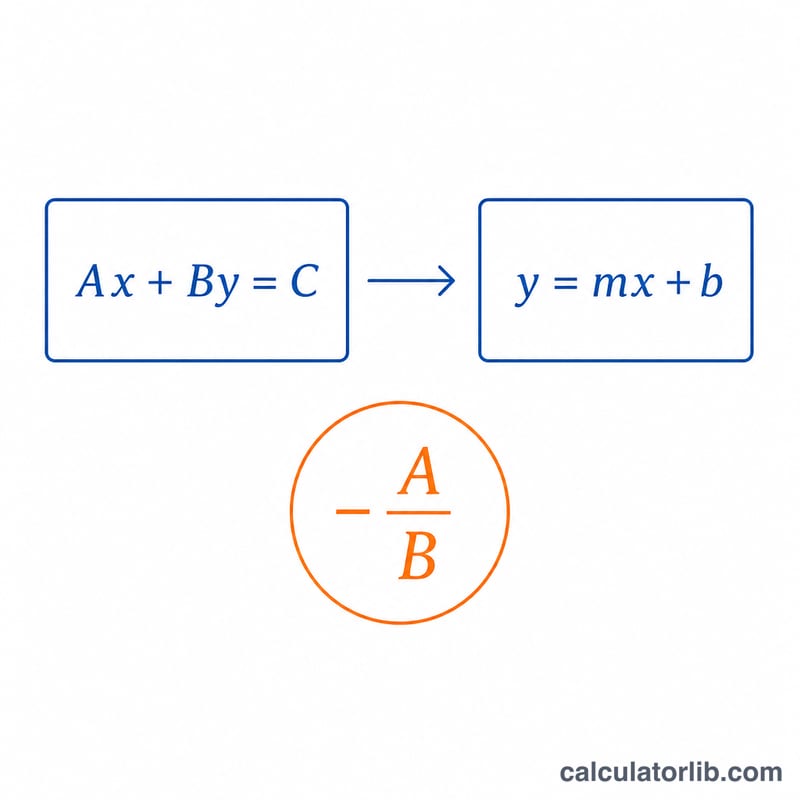
This tool finds the slope of a straight line written in standard form, Ax + By = C. Instead of rearranging the equation by hand into slope-intercept form, you simply enter the three coefficients A, B and C and the calculator returns the slope m and the y-intercept b.
How to use it
Identify the numbers A, B and C in your equation. For example, in 2x + 3y = 6 you have A = 2, B = 3 and C = 6. Type those values into the matching boxes and read off the slope. If B = 0 the line is vertical and its slope is undefined — the calculator reports this clearly.
The formula explained
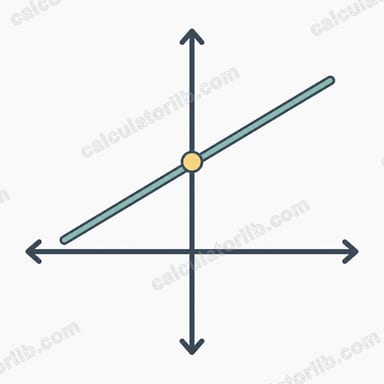
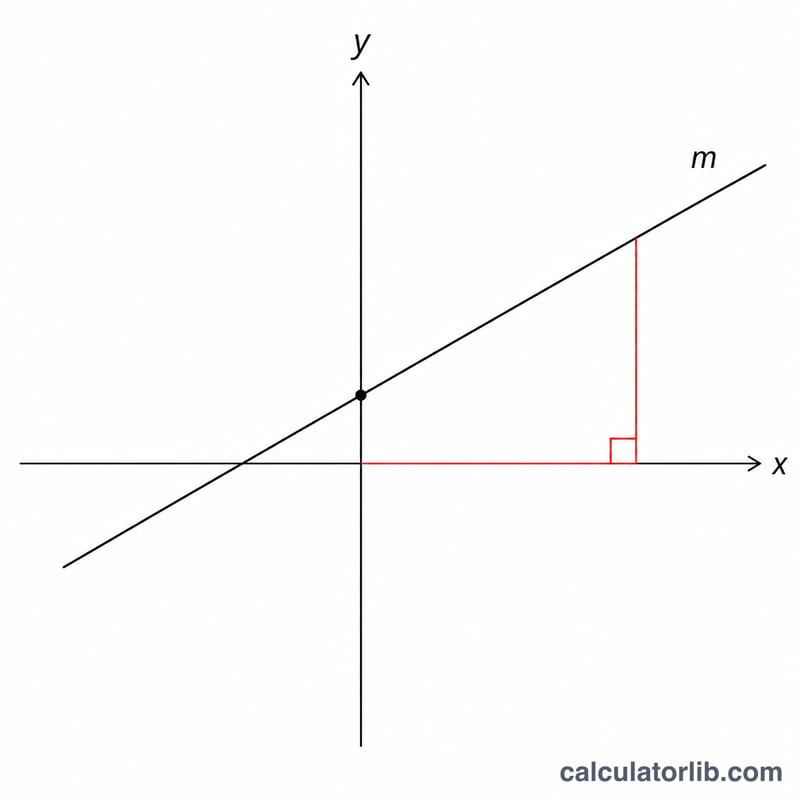
Starting from Ax + By = C, solve for y: \(By = -Ax + C\), so \(y = (-A/B)x + (C/B)\). Comparing with the slope-intercept form \(y = mx + b\) gives the slope $$\text{slope} = m = -\frac{\text{A}}{\text{B}}$$ and the y-intercept \(b = C/B\). Both require \(B \neq 0\); when \(B = 0\) the equation reduces to a vertical line \(x = C/A\).
Worked example
For 2x + 3y = 6: $$\text{slope} = m = -\frac{\text{A}}{\text{B}} = -\frac{2}{3} \approx -0.6667$$ and y-intercept \(b = C/B = 6/3 = 2\). So the line is \(y = -0.6667x + 2\).
FAQ
What if B is 0? The line is vertical (e.g. \(x = 4\)). A vertical line has an undefined slope, so the calculator shows "Undefined".
What if A is 0? Then \(m = 0\) and the line is horizontal (\(y = C/B\)).
Does the sign of C matter for the slope? No. The slope depends only on A and B; C only shifts the line and sets the y-intercept.