

What is the e^x Calculator?
This calculator evaluates the natural exponential function, written as \(e^x\) or \(\exp(x)\). Here e is Euler's number, an irrational mathematical constant approximately equal to 2.718281828. Raising e to a power x gives one of the most important functions in mathematics, appearing in calculus, compound growth, probability, physics, and finance.
How to use it
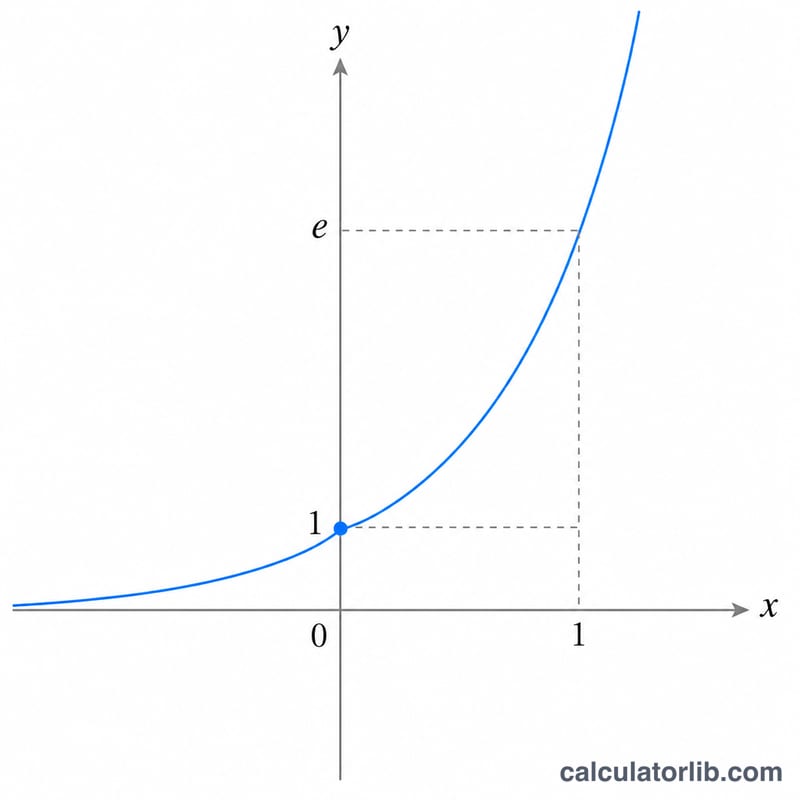
Simply type the value of the exponent x into the input box. It can be any real number — positive, negative, a fraction, or zero. The calculator returns \(y = e^x\) instantly. For example, x = 1 returns e itself (≈ 2.718), while x = 0 always returns 1.
The formula explained
The exponential function is defined by the limit and series:
$$y = e^x = 1 + x + \frac{x^2}{2!} + \frac{x^3}{3!} + \dots$$It is the unique function that equals its own derivative, which is why it models continuous growth and decay so naturally. A positive x produces a number greater than 1, a negative x produces a fraction between 0 and 1, and x = 0 gives exactly 1.
Worked example
Suppose x = 2. Then $$e^2 = 2.718281828\dots \times 2.718281828\dots \approx 7.389056099.$$ If x = -1, then $$e^{-1} = \frac{1}{e} \approx 0.367879441.$$
FAQ
What is e? Euler's number, ≈ 2.71828, the base of the natural logarithm.
What is e^0? Any nonzero number raised to the power 0 equals 1, so \(e^0 = 1\).
Can x be negative? Yes. A negative exponent gives the reciprocal: \(e^{-x} = \frac{1}{e^x}\), always a positive value between 0 and 1.