

What is a multifactorial?
A multifactorial generalizes the ordinary factorial by changing the step size between the factors in the product. Written with k exclamation marks, the k-multifactorial of a non-negative integer n multiplies n by successive terms that each decrease by k, continuing while the term stays at least 1. With one exclamation mark you get the familiar factorial \(n!\); two marks give the double factorial \(n!!\); three, four and five give the triple, quadruple and quintuple factorials.
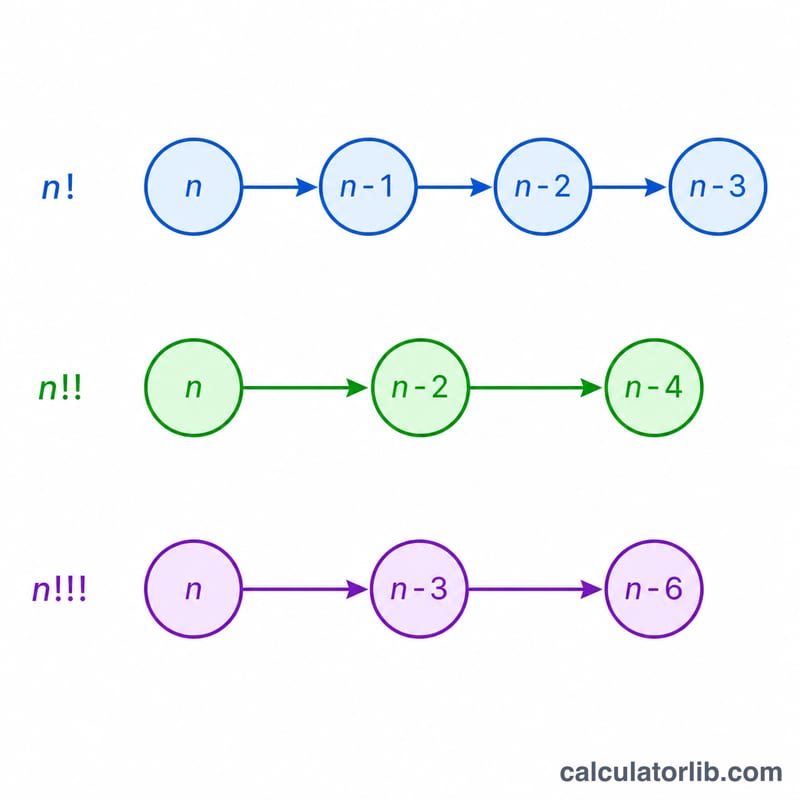
How to use this calculator
Pick which multifactorial you want from the "Calculate" dropdown (this sets the step size k from 1 to 5), enter a whole number n that is zero or greater, and read the exact answer. Because these values grow extremely fast, the calculator uses arbitrary-precision (BigInteger) arithmetic, so even large inputs return an exact integer rather than a rounded approximation. The result panel also shows how many digits the answer has and a full multiplied-out expansion.
The formula explained
For step size k the rule is $$n!^{(k)} = n \times (n - k) \times (n - 2k) \times \cdots$$ Equivalently it is the product of all positive integers not exceeding n that are congruent to n modulo k. The algorithm is simply: start with 1, then multiply by term \(= n, n-k, n-2k, \ldots\) as long as the term is at least 1.
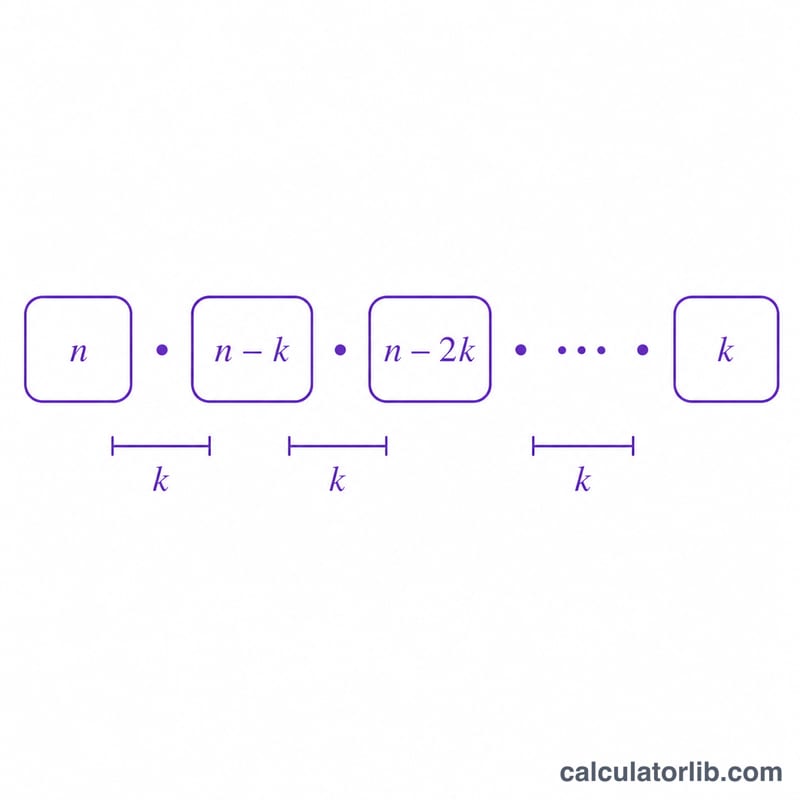
Worked example
For the double factorial (k = 2) of 10: $$10!! = 10 \times 8 \times 6 \times 4 \times 2 = 3{,}840.$$ Notice this is not the same as \((10!)!\), which would be astronomically larger. A double factorial is a single product with step 2.
FAQ
Is \(n!!\) the same as \((n!)!\)? No. The double factorial is one product with a step of 2; it is not the factorial applied twice. The same caution applies to all multifactorials.
What is \(0!\)? By the empty-product convention, 0 of any multifactorial equals 1, just like \(0! = 1\).
Why is the answer so long? Factorials and their relatives grow faster than exponentials, so even modest inputs can produce numbers with hundreds or thousands of digits. This tool keeps every digit exact.