
What this calculator does
The How Much More Percent Calculator tells you how many percent larger one number (A) is compared to a reference number (B). This is the everyday "A is X% more than B" question — useful for comparing prices, salaries, scores, populations, or any two quantities where you want the relative increase rather than the raw gap.
How to use it
Enter Value A — usually the larger or new number — and Value B, the base or original you are comparing against. The calculator returns the percentage A exceeds B by, plus the absolute difference. If the result is negative, A is actually smaller than B (i.e. A is that percent less than B).
The formula explained
The percentage more is calculated as:
$$\text{percent} = \frac{A - B}{B} \times 100$$
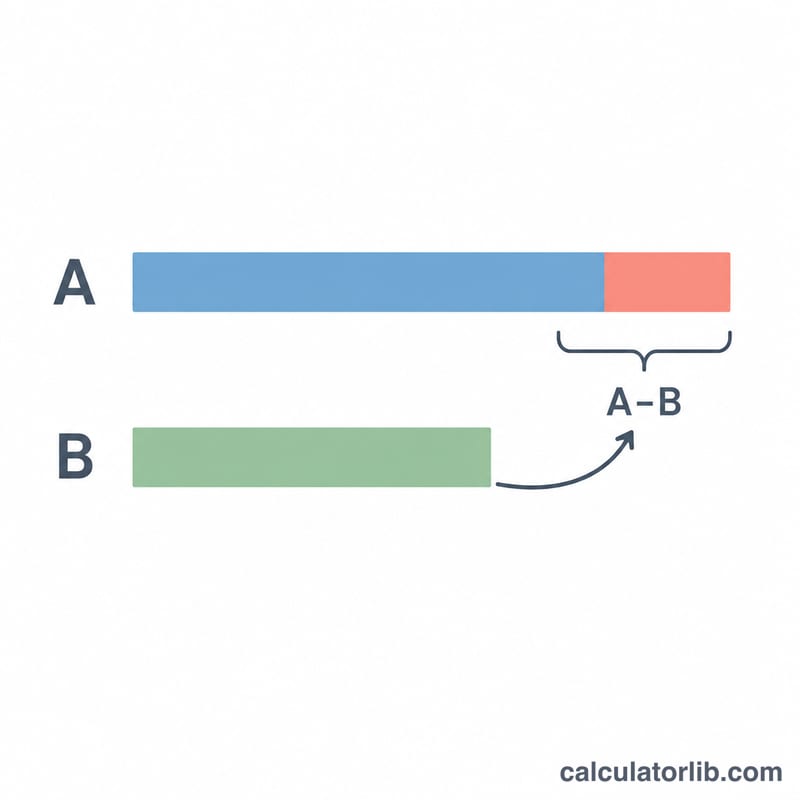
The numerator \((A - B)\) is how much bigger A is in absolute terms. Dividing by \(B\) expresses that gap relative to the base, and multiplying by 100 converts the ratio into a percentage. The base \(B\) always sits in the denominator — that is what makes it "more than B."
Worked example
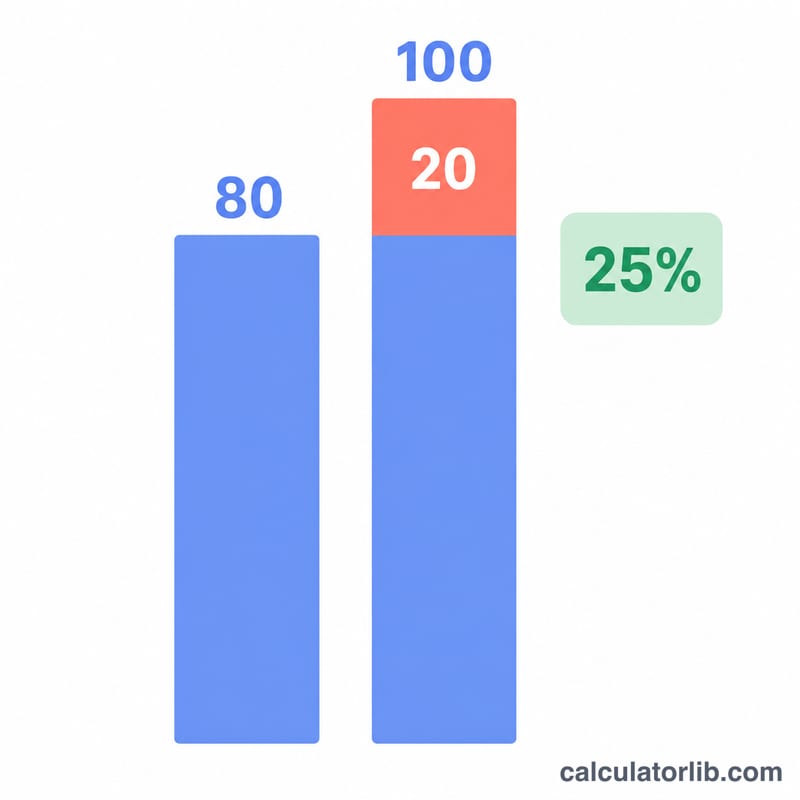
Suppose A = 150 and B = 100. Then $$\frac{150 - 100}{100} \times 100 = \frac{50}{100} \times 100 = 50\%$$ So 150 is 50% more than 100. As another check, if A = 120 and B = 80, then $$\frac{120 - 80}{80} \times 100 = \frac{40}{80} \times 100 = 50\%$$ meaning 120 is 50% more than 80.
FAQ
Is "A is X% more than B" the same as "B is X% less than A"? No. The base changes, so the percentages differ. 150 is 50% more than 100, but 100 is only about 33.3% less than 150.
What if I get a negative percent? A negative result means A is smaller than B, so A is that percent less than B rather than more.
Why can the base B not be zero? Division by zero is undefined, so a base of 0 has no meaningful percentage increase.