
What Is the Weight to Mass Calculator?
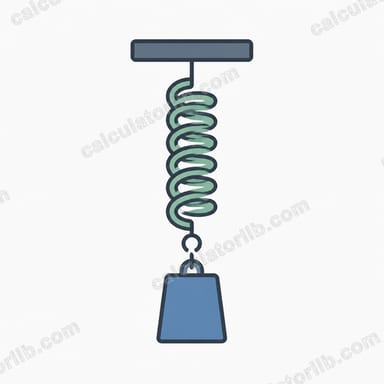
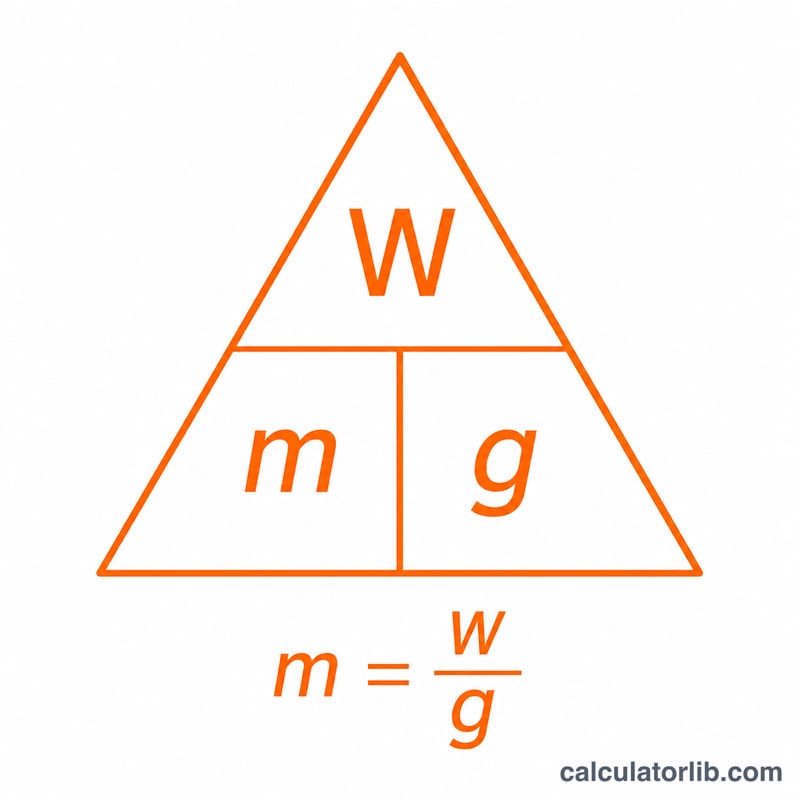
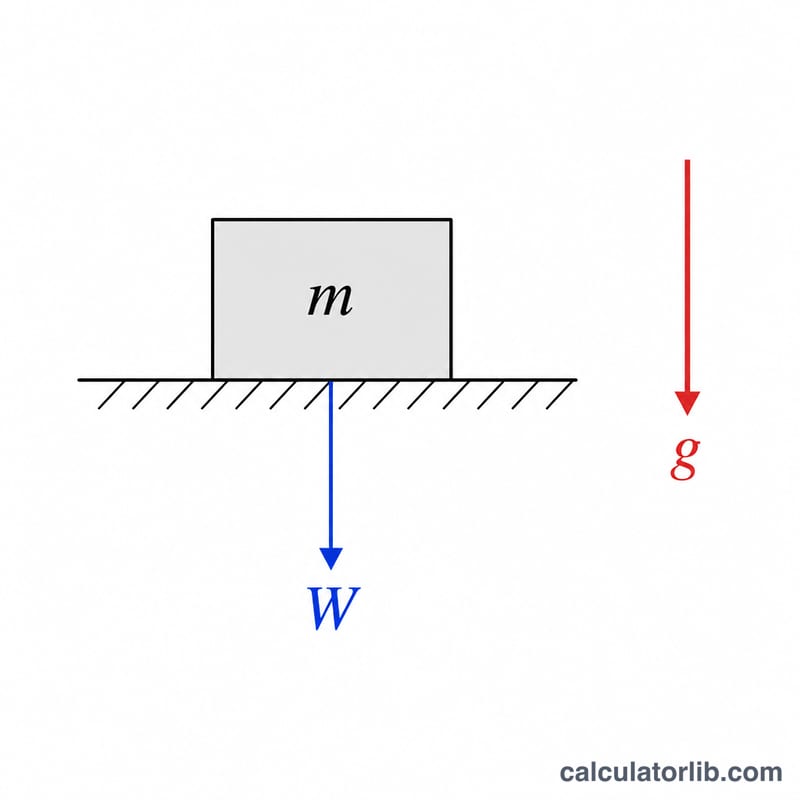
Weight and mass are often used interchangeably in everyday speech, but in physics they are distinct quantities. Mass is the amount of matter in an object and is measured in kilograms (kg). Weight is the gravitational force acting on that mass and is measured in newtons (N). This calculator converts a known weight into mass using the relationship \(m = W / g\).
How to Use It
Enter the weight (the force) in newtons and the local gravitational acceleration in metres per second squared. On Earth the standard value is 9.80665 m/s². The calculator divides the weight by gravity to return the mass in kilograms. You can change the gravity value to find mass on the Moon (about 1.62 m/s²), on Mars (about 3.71 m/s²), or anywhere else.
The Formula Explained
Newton second law gives weight as \(W = m \times g\), where \(W\) is force, \(m\) is mass, and \(g\) is gravitational acceleration. Rearranging for mass gives the following.
$$m = \frac{\text{Weight (N)}}{\text{Gravity (m/s}^2\text{)}}$$
Because mass is intrinsic to an object, it stays the same everywhere, while weight changes with the local gravity.
Worked Example
Suppose an object weighs 98.0665 N on Earth where \(g = 9.80665\) m/s². Then
$$m = \frac{98.0665}{9.80665} = 10 \text{ kg}$$
The same 10 kg object on the Moon (\(g = 1.62\) m/s²) would weigh only about 16.2 N, yet its mass is still 10 kg.
FAQ
Is weight the same as mass? No. Mass measures matter and never changes; weight is a force that depends on gravity.
What gravity value should I use? Use 9.80665 m/s² for standard Earth gravity, or the local value for other planets and altitudes.
Can I convert pounds to kg with this? This tool expects weight in newtons. If you have pounds-force, multiply by 4.44822 to get newtons first.