
What this calculator does
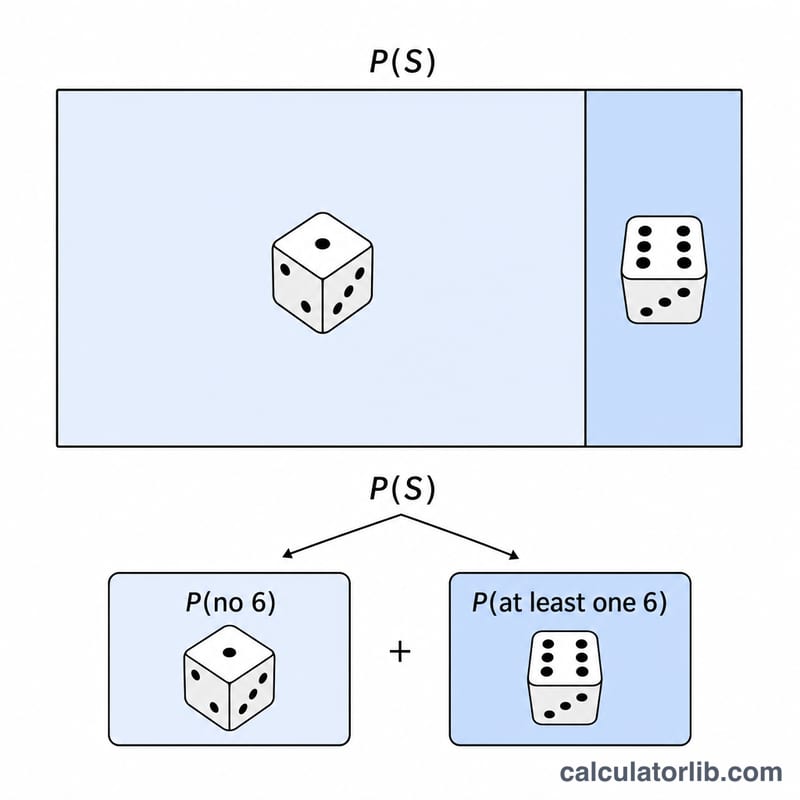
This tool finds the probability of rolling at least one six when you roll a fair six-sided die n times (or roll n dice once). Instead of summing the chances of getting exactly one, two, three... sixes, it uses the much simpler complement rule: the opposite of "at least one six" is "no sixes at all."
How to use it
Enter the number of rolls (or dice) n and read off the probability as both a percentage and a decimal. The result also shows the complementary chance of getting no six, which the two probabilities always add up to 1.
The formula explained
On a single fair die, the chance of not rolling a six is \(\frac{5}{6}\). Because rolls are independent, the chance of avoiding a six on all n rolls is \(\left(\frac{5}{6}\right)^{n}\). The chance of getting at least one six is therefore the complement:
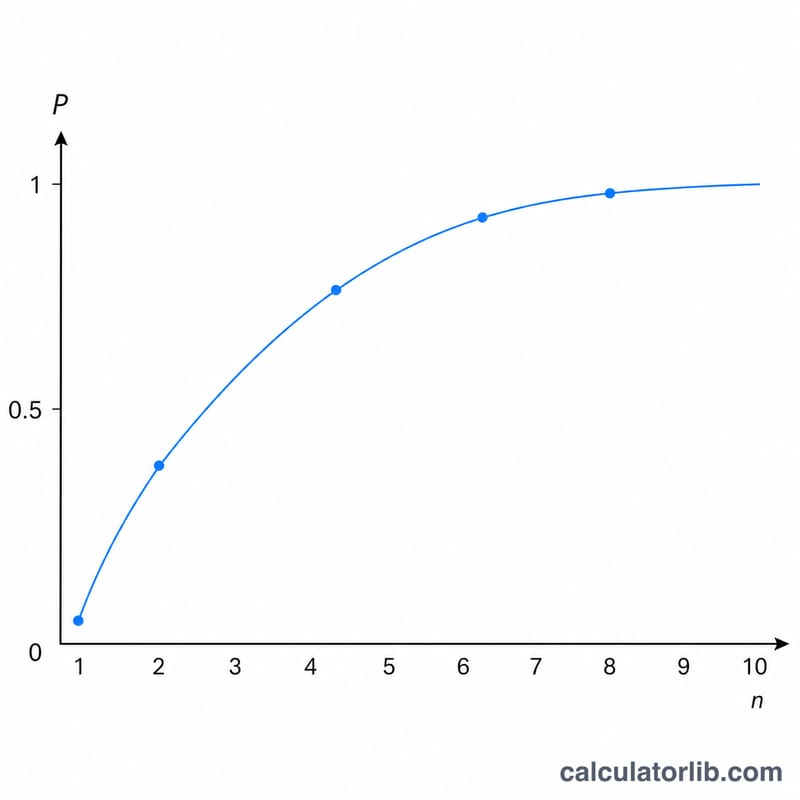
$$P = 1 - \left(\frac{5}{6}\right)^{n}$$
Worked example
For n = 4 rolls: \(\left(\frac{5}{6}\right)^{4} = \frac{625}{1296} \approx 0.482253\). So the probability of no six is about 48.23%, and the probability of at least one six is \(1 - 0.482253 = 0.517747\), or roughly 51.77%. This is the famous problem the gambler Chevalier de Méré bet on — a slight edge above 50%.
FAQ
How many rolls give a better-than-even chance of a six? Four rolls give about 51.8%, while three rolls give only about 42.1%. So four is the smallest n that exceeds 50%.
Does it matter if I roll one die n times or n dice once? No. As long as the dice are fair and independent, the probability is identical.
Can I use this for any face, not just six? Yes — the chance for any single specific face is the same, so \(P = 1 - \left(\frac{5}{6}\right)^{n}\) works for rolling at least one of any chosen number on a standard die.