

What this calculator does
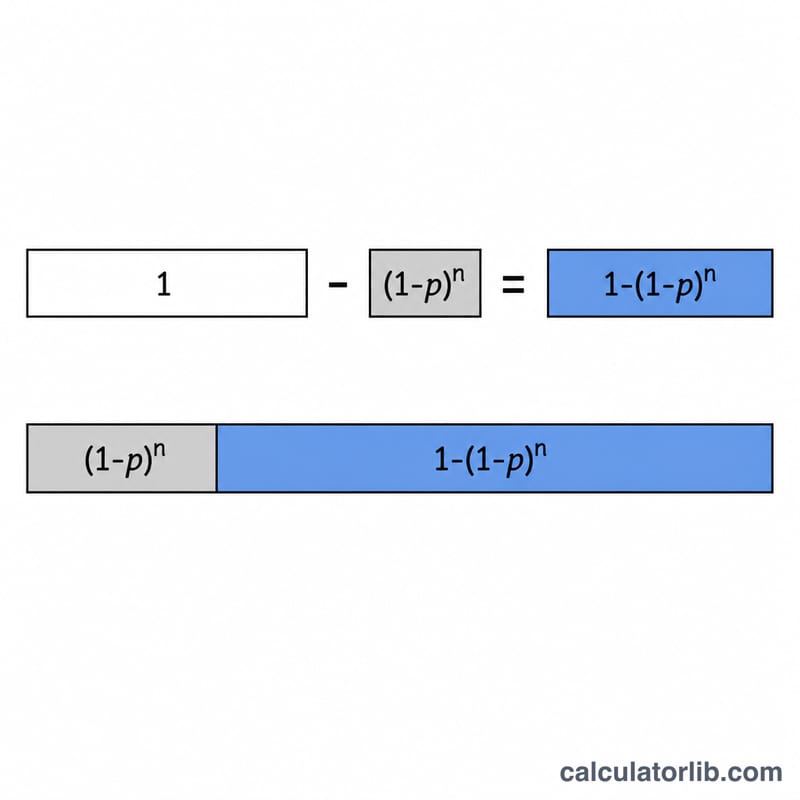
This tool computes the probability of getting at least one success when you repeat an independent trial n times, where each trial succeeds with probability p. It uses the complement rule: instead of summing the chances of exactly 1, 2, 3, ... successes, it is far easier to compute the chance of zero successes and subtract from 1.
How to use it
Enter the per-trial success probability p as a decimal between 0 and 1 (for example, 0.1 for a 10% chance), then enter the number of trials n. The calculator returns the probability of at least one success, the probability of no successes, and both as percentages.
The formula explained
If each trial fails with probability \((1-p)\), then all n independent trials fail with probability \((1-p)^{n}\). The event "at least one success" is the exact opposite of "no successes", so its probability is:
$$P(\geq 1) = 1 - \left(1 - p\right)^{n}$$
This assumes the trials are independent and the probability p stays constant across trials.
Worked example
Suppose a slot game wins with probability p = 0.1 on each spin, and you spin n = 10 times. The chance of never winning is $$(1-0.1)^{10} = 0.9^{10} \approx 0.3487.$$ So the chance of winning at least once is \(1 - 0.3487 \approx 0.6513\), or about 65.13%.
Key Terms and Variables
- p — per-trial success probability
- The probability that a single trial results in a success, expressed as a decimal between 0 and 1 (e.g. 0.25 for a 25% chance). It is assumed to be the same for every trial.
- n — number of trials
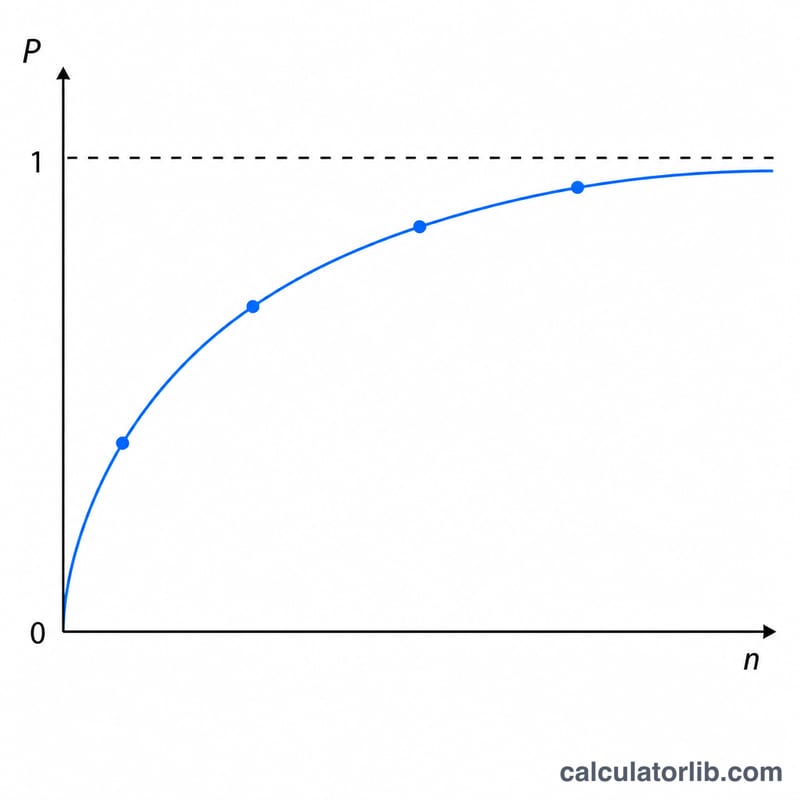
- The count of independent repetitions performed. As \(n\) increases, the probability of at least one success increases (or stays the same), approaching but never exactly reaching 1.
- Independent trials
- Trials whose outcomes do not influence one another; the result of one trial does not change the probability \(p\) on any other. Independence is what allows the failure probabilities to be multiplied as \((1-p)^n\).
- Complement rule
- The principle that \(P(\text{event}) = 1 - P(\text{not event})\). Here, "at least one success" is the complement of "no successes at all," which is why \(P(\ge 1) = 1 - P(\text{no successes})\).
- P(≥1) — probability of at least one success
- The quantity this calculator returns: the chance that one or more of the \(n\) trials succeeds, given by \(1 - (1-p)^n\).
- P(no successes)
- The probability that every trial fails, equal to \((1-p)^n\). Subtracting this from 1 gives \(P(\ge 1)\).
FAQ
Why not just add up each trial probability? Adding probabilities double-counts overlapping outcomes and can exceed 1. The complement rule avoids that entirely.
What if p is a percentage? Convert it to a decimal first — 25% becomes 0.25.
Does this require independent trials? Yes. If trials influence each other (no replacement, changing odds), this simple formula no longer applies exactly.