What Is the Roulette Payout Calculator?
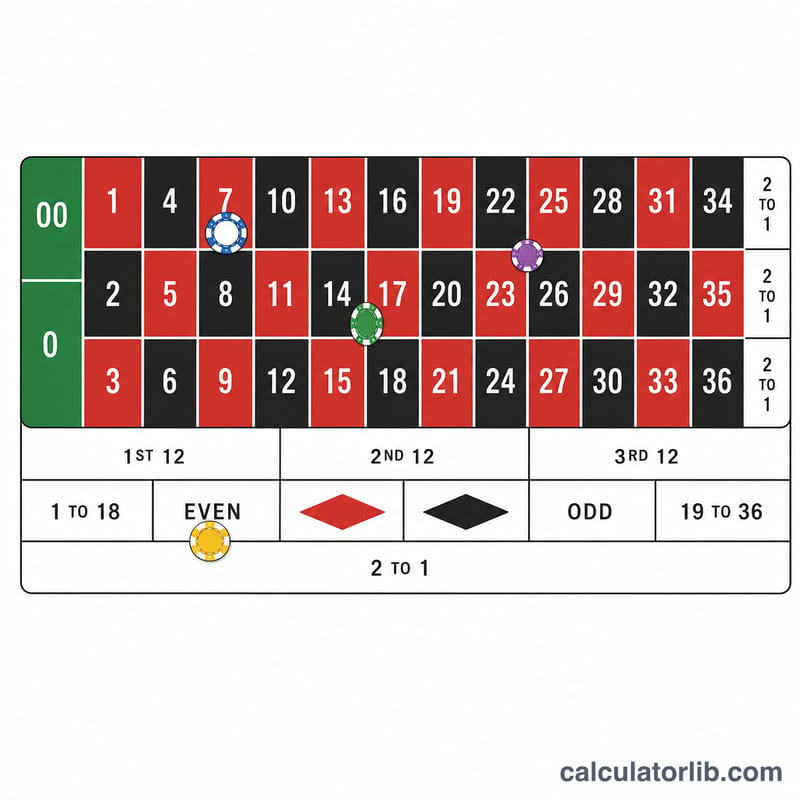
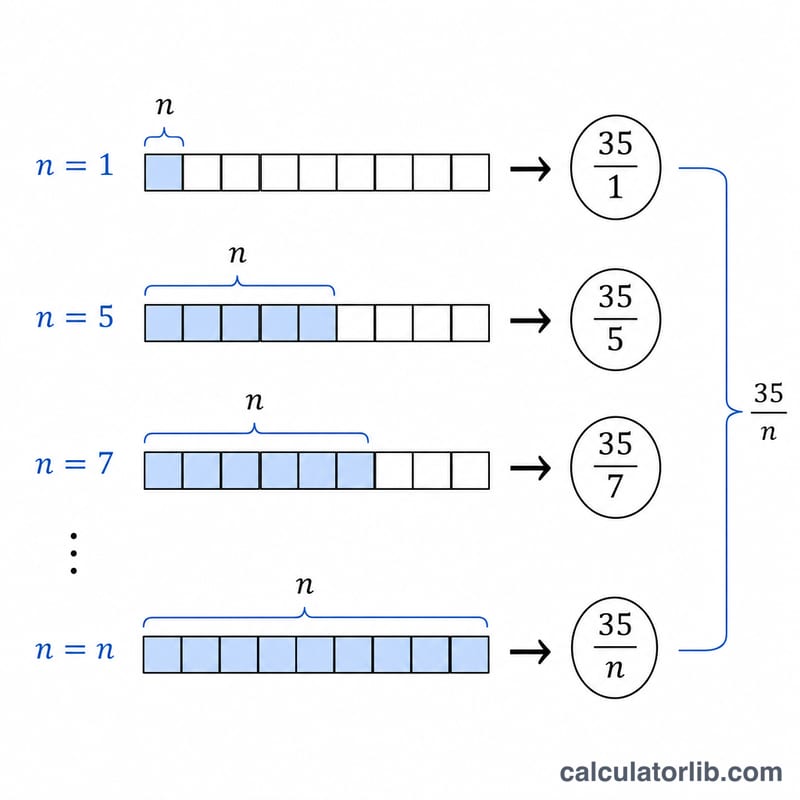
This tool tells you exactly how much a winning roulette bet pays. In standard (single-zero/European or double-zero/American) roulette, payouts are based on the 36 main numbers: a single number "straight up" pays 35 to 1. Every other inside bet is just that 35-unit pool divided by how many numbers you cover. Enter your stake and select the bet type and the calculator returns your net profit, total return, and the implied odds.
How to Use It
1. Enter your bet amount in dollars (or any currency unit). 2. Choose how many numbers your chip covers — 1 for a straight bet, 2 for a split, 4 for a corner, 18 for an even-money bet, and so on. 3. Read your net profit (what you win on top of the stake) and total return (stake plus winnings).
The Formula Explained
The payout odds for a bet covering n numbers are (35 / n − 1) : 1. This works because the full straight-up payout is 35:1, and spreading that across n numbers divides the reward proportionally.
So a corner bet on 4 numbers pays \((35/4 - 1) = 7.75\) — but casinos round this to the standard 8:1, slightly in the house's favour on some bets. The clean cases (1, 2, 3, 6, 12, 18) match casino tables exactly.
The payout is what the casino pays on a win. The true odds compare losing pockets to winning pockets. The payout is always a little lower than the true odds, and that gap is the house edge.
Worked Example
You bet $10 on a single number (straight up). \(n = 1\), so the odds are \((35/1 - 1) = 34\)... wait — the straight-up bet uniquely keeps the full 35:1 because \(n=1\):
$$\text{Profit} = 10 \times \left( \frac{35}{1} - 1 \right)$$The formula yields 34, but a true straight pays 35:1. For all multi-number bets the formula matches the table. Use \(n = 1\) for a quick 34:1-style approximation, or rely on the listed odds for exact casino values.
Roulette Bet Types, Payouts and True Odds
A roulette wheel's layout determines every number in the table below. The European (single-zero) wheel has 37 pockets (1–36 plus a single 0), so a bet covering \(n\) numbers wins with probability \(n/37\). The American (double-zero) wheel has 38 pockets (1–36 plus 0 and 00), giving \(n/38\). The numbers 1–36 and the standard payout odds are the same on both wheels; only the extra 00 pocket differs.
Payout odds are quoted as "to 1" — a 35:1 win returns 35 units of profit plus your original stake, i.e. 36 units total. The general relation that reproduces every standard roulette payout exactly is:
$$\text{Payout odds} = \left(\frac{36}{n} - 1\right) : 1$$For example \(n = 3\) gives \(36/3 - 1 = 11\), and \(n = 18\) gives \(36/18 - 1 = 1\). The one exception is the American five-number bet (0-00-1-2-3), where the relation would give 6.2:1 but casinos pay a rounded-down 6:1 — which is why it is the worst bet on the table.
| Bet | Numbers covered (n) | Payout odds | Win probability — European (n/37) | Win probability — American (n/38) |
|---|---|---|---|---|
| Straight Up (single number) | 1 | 35:1 | 2.70% | 2.63% |
| Split (two adjacent numbers) | 2 | 17:1 | 5.41% | 5.26% |
| Street (row of three) | 3 | 11:1 | 8.11% | 7.89% |
| Corner / Square (block of four) | 4 | 8:1 | 10.81% | 10.53% |
| Five-Number Bet (0-00-1-2-3) — American wheel only | 5 | 6:1 (not 6.2:1) | Not available (no 00) | 13.16% |
| Six Line / Double Street | 6 | 5:1 | 16.22% | 15.79% |
| Column (one of three columns of 12) | 12 | 2:1 | 32.43% | 31.58% |
| Dozen (1–12, 13–24, 25–36) | 12 | 2:1 | 32.43% | 31.58% |
| Red / Black | 18 | 1:1 | 48.65% | 47.37% |
| Odd / Even | 18 | 1:1 | 48.65% | 47.37% |
| High / Low (19–36 / 1–18) | 18 | 1:1 | 48.65% | 47.37% |
Note that 0 (and 00) belong to no colour, are neither odd nor even for betting purposes, and lie outside the dozens, columns and high/low ranges — which is exactly why the even-money bets cover 18 of 37 or 38 pockets rather than half of them. Payout odds in this table are the long-standing international standard, but table rules are set per jurisdiction and per casino: many French and other European tables apply la partage or en prison to even-money bets when zero hits, returning or holding half the stake, which changes the arithmetic for those bets only. Check the rules posted at the specific table.
Interpreting Your Result: Payout vs. True Odds
The calculator returns two different things, and keeping them apart is the whole point. Payout odds are a contractual fact: what one unit of stake returns if the bet wins (35:1, 11:1, 1:1, and so on). True odds are a property of the wheel: the probability that the bet actually wins, counting the zero pockets that belong to no bet. The gap between the two is the house edge, and it is a fixed, computable constant — not a trend, a streak, or a property of the table you happen to be sitting at.
Expected value per unit staked is the probability-weighted average of winning and losing:
$$\text{EV} = (\text{payout} \times P_{\text{win}}) - (1 \times P_{\text{lose}})$$For a straight-up bet on a European single-zero wheel, with payout 35 and \(P_{\text{win}} = 1/37\):
$$\text{EV} = 35 \times \frac{1}{37} - 1 \times \frac{36}{37} = \frac{35 - 36}{37} = -\frac{1}{37} = -0.0270$$That is −2.70% per unit staked. The same calculation on an American double-zero wheel gives \(35 \times \tfrac{1}{38} - 1 \times \tfrac{37}{38} = -\tfrac{2}{38} = -0.0526\), or −5.26%.
Three consequences follow from the arithmetic:
- The edge is identical across bet types on a given wheel. Because the standard payout is \((36/n - 1):1\) while the true probability is \(n/37\) or \(n/38\), every bet in the table resolves to the same −2.70% (European) or −5.26% (American). A dozen bet, a split and a straight-up bet have exactly the same expected value per unit staked.
- The American five-number bet is the one exception. It pays 6:1 instead of the 6.2:1 the relation calls for, so \(6 \times \tfrac{5}{38} - 1 \times \tfrac{33}{38} = -\tfrac{3}{38} = -0.0789\) — a −7.89% edge, the largest on an American table.
- Bet size and bet type change variance, not the edge. Covering 1 number produces rare, large swings; covering 18 produces frequent, small ones. Both have the same expected value per unit staked. Scaling the stake scales the expected loss proportionally and leaves the percentage unchanged.
Spins are independent events: the wheel has no memory, so the probability of each outcome is the same on every spin regardless of what preceded it. Because expected value is linear in the stake, no sequence or sizing pattern — doubling after a loss, cancelling a progression, following "due" numbers — alters the ratio between payout odds and true odds. A progression redistributes when wins and losses occur and how large they are; it cannot change the −1/37 or −2/38 per unit staked. Where it exists, the la partage rule reduces the edge on even-money bets to roughly −1.35% on a single-zero wheel, which is a rule difference, not a strategy effect.
The figures above describe the mathematics of a standard wheel with standard payouts and assume a fair, unbiased wheel. They are a statement about the game's structure, not a recommendation about whether or how much to wager. This is general information, not professional financial advice; if gambling is causing financial or personal harm, support services are available in most countries.
FAQ
Does this cover the green zero? Payouts are computed on the 36 numbered pockets; the zero(s) only affect win probability (the house edge), not the payout ratio.
European vs American roulette? Payout ratios are identical; American roulette has an extra 00 pocket, which lowers your odds of winning but doesn't change what a win pays.
Why do some payouts look odd? Casinos round non-integer results to standard table values such as 8:1 for a corner bet.