
What is a Bill Discount Calculator?
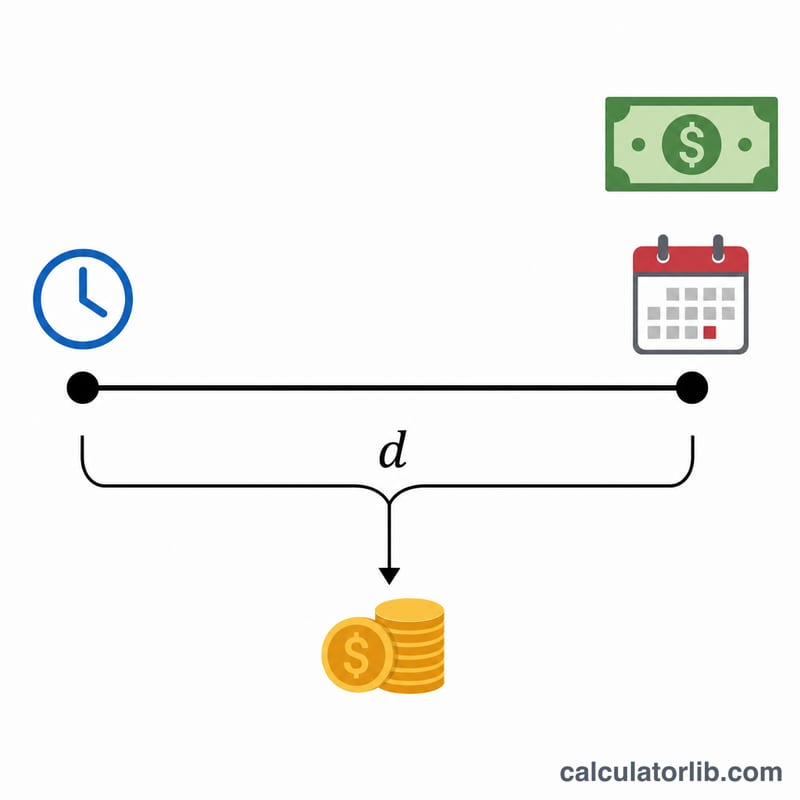
This calculator applies to Japan (currency = Japanese yen, "tegata-waribiki" bill discounting). When the holder of a promissory note or bill of exchange needs cash before the note matures, a bank or finance company will buy ("discount") the note for less than its face value. The difference is the discount charge — effectively interest for the days remaining until maturity. This tool estimates that charge and the net cash you would actually receive.
How to Use It
Enter the bill's face value, the annual discount rate as a percent, the number of days from the discount date until maturity, and any flat administrative or handling fees. Choose how the discount charge is rounded — Japanese practice typically rounds to whole yen, though 10-yen and 100-yen granularities are offered. The calculator returns the discount charge and the net amount after both the charge and fees are deducted.
The Formula Explained
The discount charge is a simple-interest calculation: $$\text{Charge} = \text{Face Value} \times \frac{\text{Rate}}{100} \times \frac{\text{Days}}{365}$$ The annual percentage rate is converted to a fraction, then scaled by the fraction of a year remaining, fixed at a 365-day basis (no leap-year or 360-day adjustment). The result is rounded per your selection, and the net amount is \(\text{Face Value} - \text{Charge} - \text{Fees}\).
Worked Example
Face value 10,000,000 yen, discount rate 6.8%, 60 days to maturity, 1,000 yen in other fees, rounded to the nearest 1 yen. The raw charge is $$10{,}000{,}000 \times 0.068 \times \frac{60}{365} = 111{,}780.82 \text{ yen},$$ rounding to 111,781 yen. Net amount $$= 10{,}000{,}000 - 111{,}781 - 1{,}000 = 9{,}887{,}219 \text{ yen}.$$
Discount Charge Across Scenarios
The discount charge \(D\) for discounting a promissory note in Japan is calculated on a 365-day basis using:
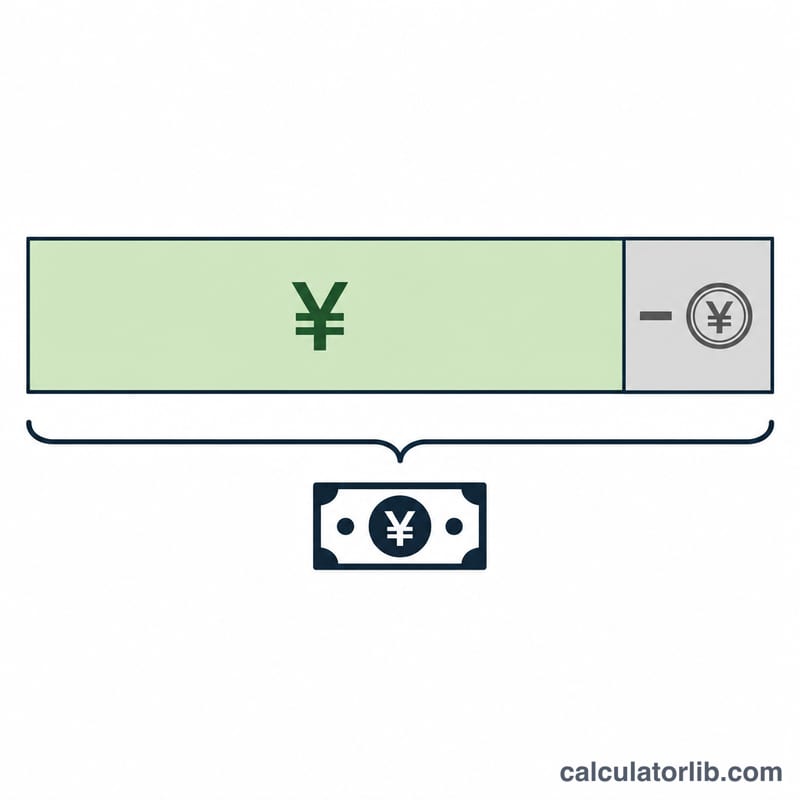
$$D = \text{Face Value} \times \frac{\text{Rate}\,(\%)}{100} \times \frac{\text{Days}}{365}$$The net cash the holder receives is the face value minus this charge (before any separate handling fees). The table below shows the discount charge and net amount across common face values, discount rates, and days to maturity. Figures are rounded to the nearest yen.
| Face Value (¥) | Discount Rate | Days | Discount Charge \(D\) (¥) | Net Amount (¥) |
|---|---|---|---|---|
| 5,000,000 | 3.0% | 30 | 12,329 | 4,987,671 |
| 5,000,000 | 6.8% | 60 | 55,890 | 4,944,110 |
| 5,000,000 | 9.0% | 90 | 110,959 | 4,889,041 |
| 10,000,000 | 3.0% | 30 | 24,658 | 9,975,342 |
| 10,000,000 | 6.8% | 60 | 111,781 | 9,888,219 |
| 10,000,000 | 9.0% | 90 | 221,918 | 9,778,082 |
Note how the charge scales linearly with each input: doubling the face value, the rate, or the number of days roughly doubles the discount charge.
Key Terms Defined
- Promissory note (yakusoku tegata, 約束手形)
- A written, unconditional promise by the issuer (drawer) to pay a fixed sum to the holder on a specified maturity date.
- Bill of exchange (kawase tegata, 為替手形)
- An order instructing a third party (the drawee) to pay a fixed sum to the holder on a stated date; distinct from a promissory note in that payment is ordered rather than directly promised.
- Discount charge (waribiki-ryo, 割引料)
- The interest-like fee deducted when a note is converted to cash before maturity — the \(D\) in the formula above.
- Face value (kingaku, 金額)
- The amount written on the note that will be paid at maturity; the base on which the discount charge is computed.
- Maturity date (manki, 満期)
- The date on which the full face value becomes payable to the holder.
- Discount rate (waribiki-ritsu, 割引率)
- The annualized percentage rate applied by the discounting party (often a bank) to determine the charge.
- Days to maturity
- The number of calendar days between the discounting date and the maturity date; here divided by 365.
- Handling fees (te-suryo, 手数料)
- Separate administrative or collection fees that may be deducted in addition to the discount charge (the "Other Fees" field).
- Tegata-waribiki (手形割引)
- The practice of discounting a bill or note — i.e. selling it to a bank for immediate cash at less than face value.
Interpreting Your Result
The discount charge is interest deducted up front rather than paid at the end. Instead of receiving the full face value at maturity and paying interest later, the holder receives the face value reduced by the charge today.
The net amount is the cash the holder actually receives now — face value minus the discount charge and any handling fees. This is the practical value of converting a future receivable into immediate liquidity.
To gauge the true cost of obtaining funds early, you can view the charge as an effective annualized rate. Because the charge is taken from the face value but the holder only receives the net amount, the effective cost on the cash actually advanced is slightly higher than the quoted discount rate. For example, a ¥10,000,000 note discounted at 9% over 90 days yields a charge of ¥221,918 on net proceeds of ¥9,778,082 — the cost relative to the cash received works out to roughly 9.2% annualized on a simple-interest basis.
Rounding granularity: Japanese bill discounting commonly rounds the final figure to the nearest yen, though some institutions round down (truncate) or round up to a coarser unit. The rounding option you select can shift the final yen figure by a few yen, which matters for reconciliation even when the economic difference is negligible.
This is general information for understanding bill discounting calculations and is not financial advice. Confirm exact rates, day-count conventions, and fees with the discounting institution.
FAQ
Why a 365-day year? Japanese bill-discount charges are conventionally computed on a fixed 365-day basis; this tool does not switch to 360 or 366 days.
What if days is zero? The discount charge is zero and the net amount is simply face value minus other fees.
Can the net amount be negative? Yes — if the discount charge plus fees exceed the face value the result is shown as-is, with no clamping.