
What this calculator does
This discount calculator solves the three-way relationship between a product's list price (the original price), the discount percent (how much is taken off), and the sale price (what you actually pay). Enter any two of these values, choose which one to calculate, and the tool returns the missing value along with the amount saved in dollars. The math is currency-agnostic, so the dollar sign is purely cosmetic — it works for any single currency.
How to use it
Pick the quantity you want to find in the "Calculate:" dropdown (List Price, Discount %, or Sale Price). Fill in the other two fields and submit. The discount is entered as a percent number, so type 40 for 40% (not 0.40). All results are shown to two decimal places.
The formula explained
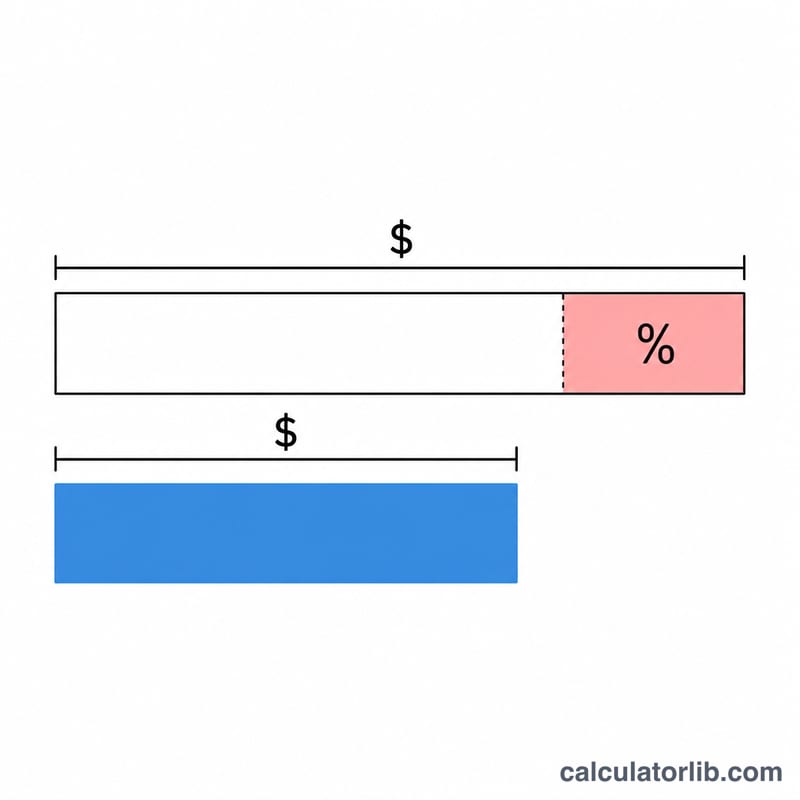
The core identity is $$\text{Sale Price} = \text{List Price} \times \left(1 - \frac{\text{Discount}}{100}\right)$$ Dividing the discount by 100 converts the percent into a fraction. Rearranging this single equation gives every mode:
- Solve for sale: \(S = L \times \left(1 - \frac{D}{100}\right)\)
- Solve for discount: \(D = \frac{L - S}{L} \times 100\)
- Solve for list price: \(L = \frac{S}{1 - \frac{D}{100}}\)
The amount saved is always \(L - S\). Two domain guards apply: the discount mode needs a non-zero list price (otherwise the percentage is undefined), and the list-price mode breaks at a 100% discount (dividing by zero), since a 100% discount makes the sale price zero for any list price.
Worked example
You paid $50 for an item marked 40% off and want the original price. Convert the discount: \(40/100 = 0.40\). Then $$\text{List Price} = \frac{50}{1 - 0.40} = \frac{50}{0.60} = 83.33$$ The amount saved is \(83.33 - 50.00 = 33.33\).
FAQ
Do I enter the discount as 40 or 0.40? Enter it as a whole percent: 40 means 40%.
Can the discount be more than 100%? Mathematically yes, but it is not economically meaningful — it would imply a negative sale price, so treat values above 100% as invalid.
Does the currency matter? No. The calculation only uses ratios and differences, so it works identically for any currency.