
What this calculator does
Jurisdiction: United States. This tool implements the U.S. IRS MACRS (Modified Accelerated Cost Recovery System) straight-line method with the mid-month convention, used to depreciate residential rental and nonresidential real property for federal income tax (reported on IRS Form 4562). It returns your first-year depreciation, the full-year annual amount, the final partial-year amount, and an optional year-by-year schedule. Non-U.S. users should treat this strictly as a U.S. tax reference.
How to use it
Enter the depreciable cost basis — the building (improvement) value only, because land is never depreciable. Choose the IRS recovery period: 27.5 years for residential rental property, 39 years for nonresidential real property placed in service after May 12, 1993, 31.5 for earlier nonresidential property, and 40 for the ADS election. Pick the month and year the property was placed in service, then choose whether to show just the headline expenses or the complete schedule. MACRS assumes zero salvage value, so the entire basis is written down to $0.
The formula explained
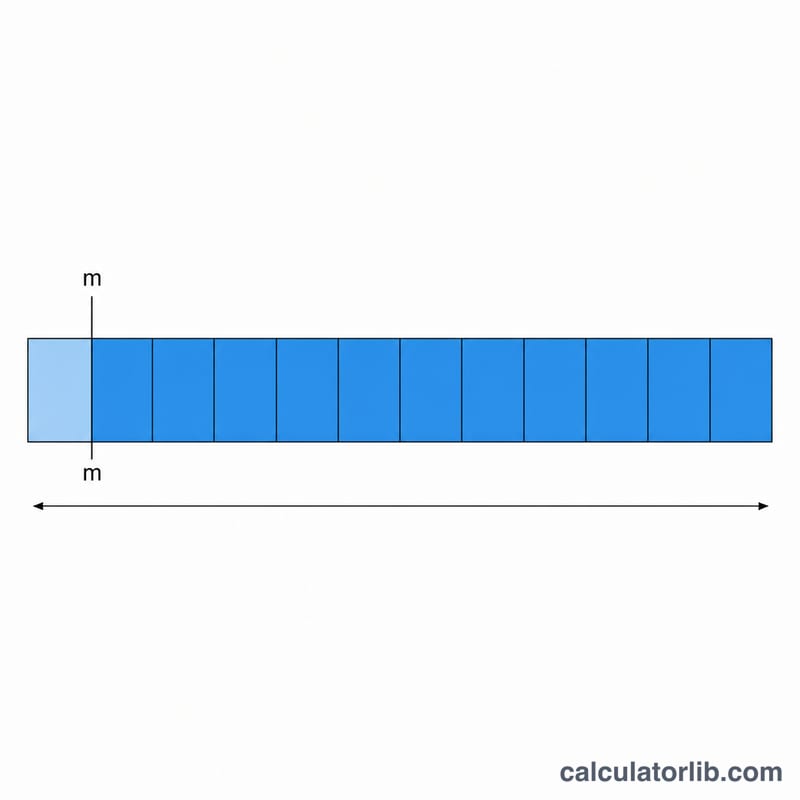
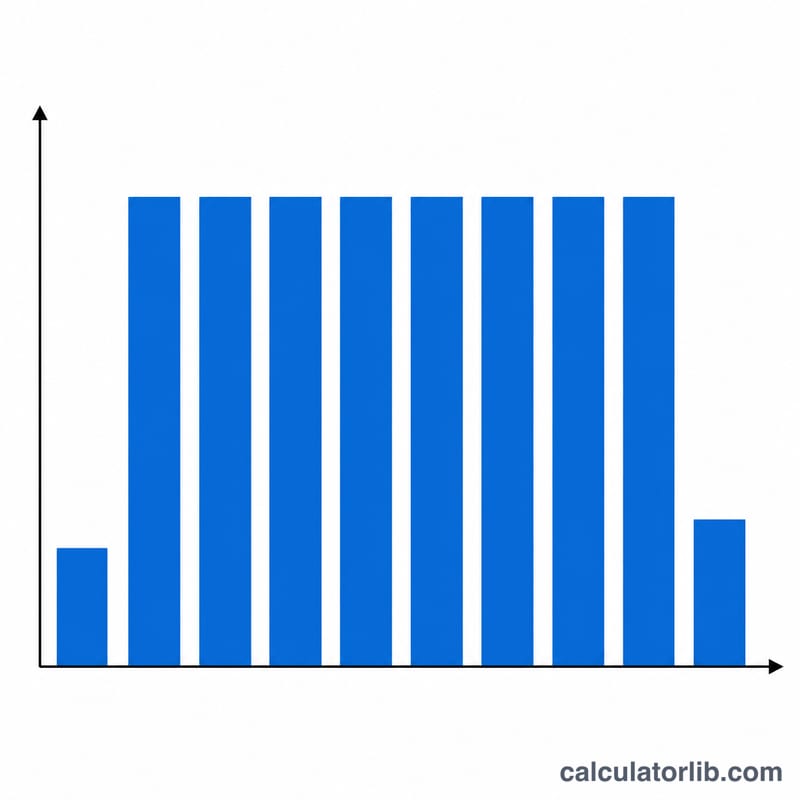
Real property under MACRS is always depreciated straight-line. The full-year deduction is simply \(D = \dfrac{\text{Cost Basis}}{N}\). The mid-month convention treats the property as placed in service at the midpoint of its month, so the first tax year only gets the following fraction of a full year:
$$D_0 = \frac{\text{Cost Basis}}{N} \times \frac{12.5 - m}{12}$$where \(m\) is the month number (1 = January). January yields \(11.5/12\) and December yields \(0.5/12\). Because the first year is partial, depreciation spills into a final partial year; together the two partial years equal one full year, so the schedule spans \(\lceil N \rceil + 1\) calendar years and the amounts sum exactly to the cost basis.
Worked example
Cost basis $275,000, residential rental (27.5 years), placed in service June 2020. Annual full = \(275{,}000 \div 27.5 = \$10{,}000\). First-year fraction = \((12.5 - 6)/12 = 0.541667\), so 2020 depreciation = \(\$10{,}000 \times 0.541667 = \$5{,}416.67\). Years 2021–2046 take $10,000 each (26 years = $260,000), and the final year 2047 takes the leftover $9,583.33. Total = \(5{,}416.67 + 260{,}000 + 9{,}583.33 = \$275{,}000\).
FAQ
Should I include land in the cost basis? No. Subtract land value first; only the building/improvements are depreciable.
Why is even a January start a partial year? The mid-month convention deems the property placed mid-month, so January still gives only \(11.5/12\) of a year, pushing a small amount into a trailing year.
Does declining balance ever apply to real estate? No. Real property under MACRS is always straight-line; only the recovery period changes.