
What Is Straight Line Depreciation?
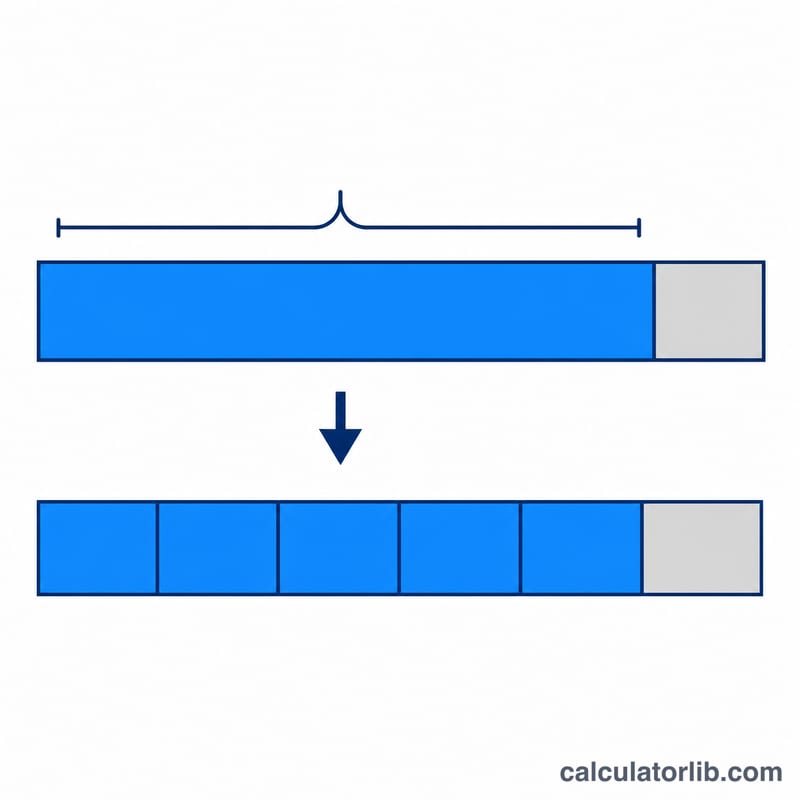
Straight line depreciation is the simplest and most widely used method of spreading the cost of a fixed asset evenly over its useful life. Instead of expensing the full purchase price in the year you buy an asset, you allocate an equal portion to each accounting period. This matches the expense to the periods that benefit from using the asset, giving a clearer picture of profitability.
How to Use This Calculator
Enter three values: the asset cost (the total amount paid to acquire and prepare the asset for use), the salvage value (the estimated resale or scrap value at the end of its life), and the useful life in years. The calculator instantly returns the annual depreciation expense, the depreciable base, the monthly depreciation, and the annual depreciation rate.
The Formula Explained
The core equation is:
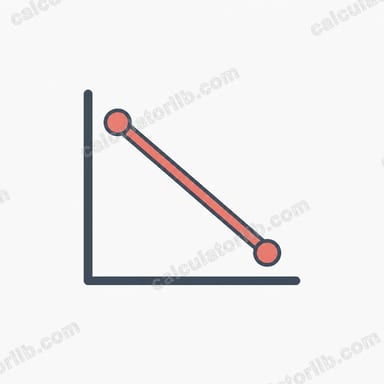
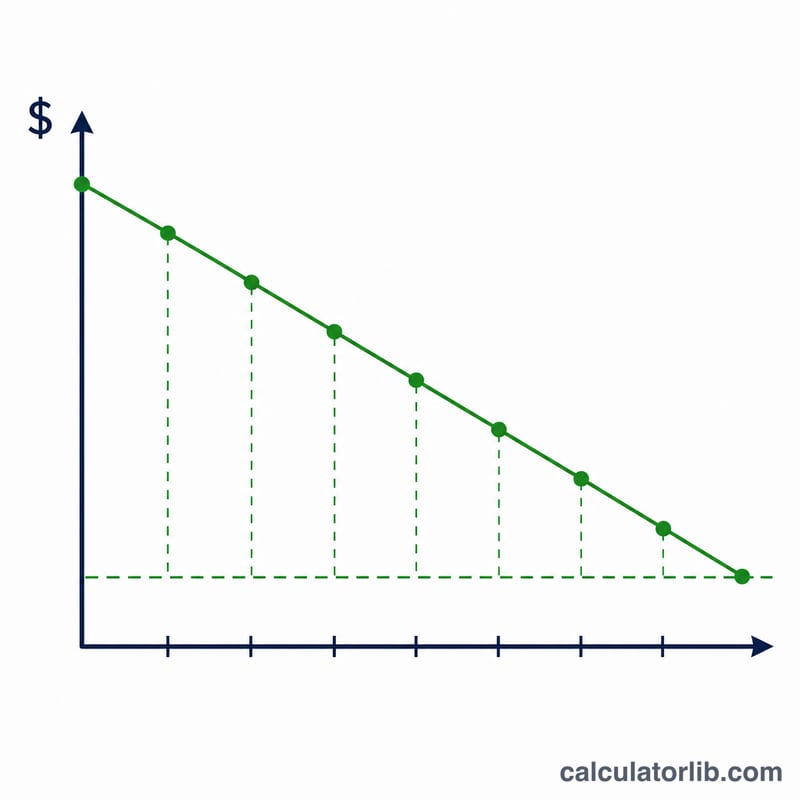
$$\text{Annual Depreciation} = \dfrac{\text{Cost} - \text{Salvage Value}}{\text{Useful Life}}$$The term \((\text{Cost} - \text{Salvage Value})\) is the depreciable base — the total amount that will be written off over time. Dividing it by the number of years gives an identical charge each year, which is why the expense graph forms a straight line. The depreciation rate is simply 100% divided by the useful life.
Worked Example
Suppose a company buys a machine for $10,000, expects to sell it for $1,000 after 5 years. The depreciable base is \(\$10{,}000 - \$1{,}000 = \$9{,}000\). Dividing by 5 years gives an annual depreciation expense of $1,800, or $150 per month. The depreciation rate is \(100\% \div 5 = 20\%\) per year.
$$D = \dfrac{C - S}{n} = \dfrac{\$10{,}000 - \$1{,}000}{5} = \$1{,}800$$$$r = \dfrac{100\%}{n} = \dfrac{100\%}{5} = 20\%$$FAQ
Can salvage value be zero? Yes. If you expect no residual value, enter 0 and the full cost is depreciated.
Does this account for tax rules like MACRS? No. This tool computes pure straight line (book) depreciation. Tax-specific schedules such as the US MACRS system use different rates and conventions.
What if my useful life is in months? Convert to years (e.g., 36 months = 3 years), or use the monthly depreciation figure provided in the results.