
What is the Time and Date Difference Calculator?
This calculator measures the exact amount of time between two moments. Enter a start date and time and an end date and time, and it returns the elapsed duration expressed simultaneously in days, hours, minutes and seconds. It is useful for tracking project durations, work shifts, age in days, countdowns, billing intervals, or any situation where you need a precise gap between two timestamps.
How to use it
Pick the start date and start time, then the end date and end time. The result instantly shows the total difference. If the end is later than the start, the values are positive; if you reverse them, the values are negative, which tells you the order is flipped.
The formula explained
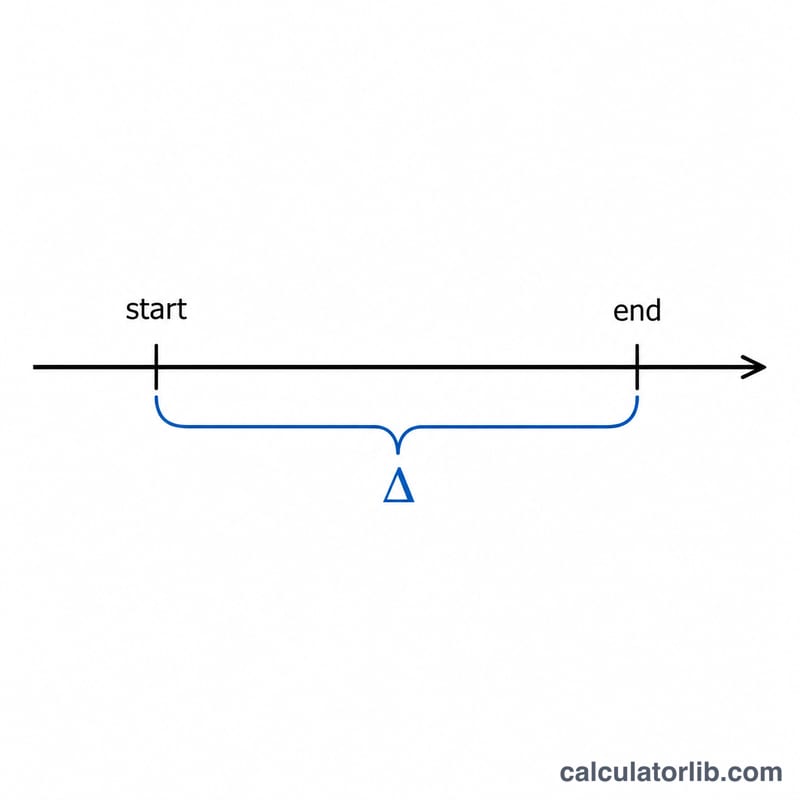
The tool converts both moments into a single timeline value (milliseconds since a fixed reference) and subtracts: $$\text{diff} = \text{end} - \text{start}$$ That raw difference in milliseconds is then divided down: \(\text{seconds} = \text{ms} \div 1000\), \(\text{minutes} = \text{seconds} \div 60\), \(\text{hours} = \text{minutes} \div 60\), and \(\text{days} = \text{hours} \div 24\). Each row of the result is simply the same duration shown in a different unit, so 1.5 days and 36 hours describe the identical span.
Worked example
Start: 2024-01-01 at 09:00. End: 2024-01-08 at 17:30. From Jan 1 to Jan 8 is 7 full days = 168 hours. From 09:00 to 17:30 adds 8.5 hours, giving 176.5 hours total. That equals $$176.5 \div 24 \approx 7.354 \text{ days},$$ \(176.5 \times 60 = 10{,}590\) minutes, and \(635{,}400\) seconds.

FAQ
Does it count both days? No — it measures the gap between the two instants, not an inclusive count of calendar days.
What if the start is after the end? The result becomes negative, signalling that your end time occurs before your start time.
Does it handle leap years? Yes. Because it works on actual calendar instants, leap days and month lengths are accounted for automatically.