
What is uniformly accelerated motion?
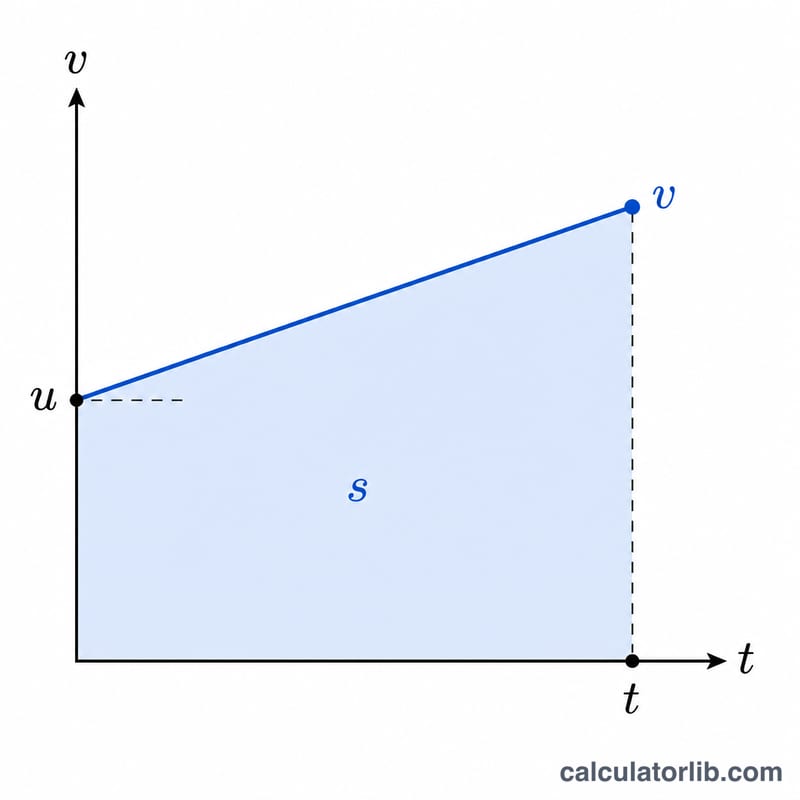
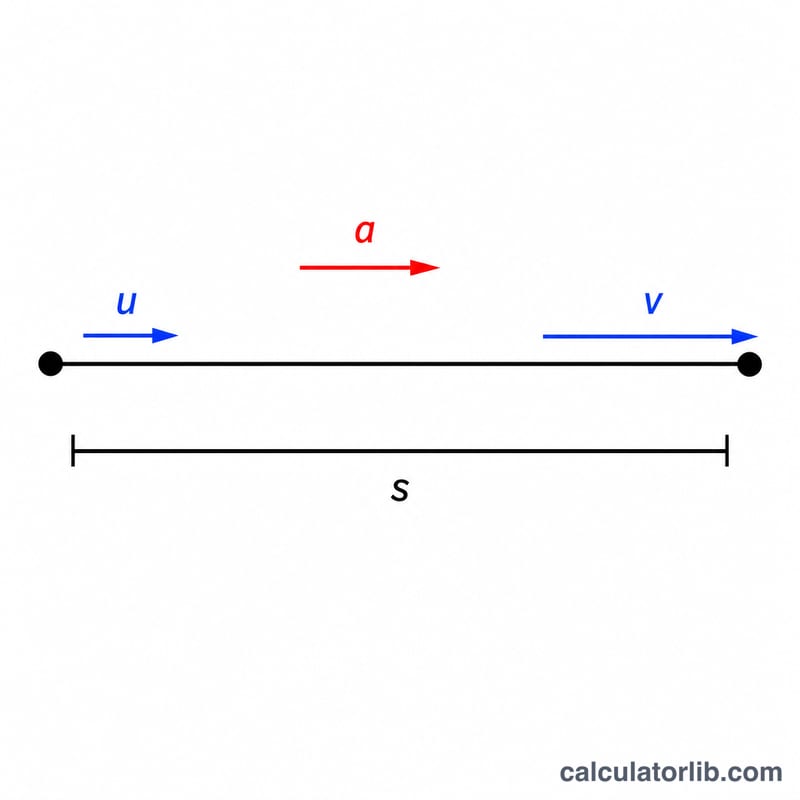
Uniformly accelerated motion describes an object moving in a straight line with a constant acceleration. The motion is fully described by five quantities — initial velocity (\(u\)), final velocity (\(v\)), acceleration (\(a\)), time (\(t\)) and displacement (\(s\)) — linked by the classic SUVAT equations of kinematics. This calculator takes the three inputs \(u\), \(a\) and \(t\) and returns the final velocity, displacement and the value of \(v^2\).
How to use it
Enter the initial velocity in metres per second, the constant acceleration in metres per second squared, and the elapsed time in seconds. The calculator instantly outputs the final velocity (\(v\)), the displacement (\(s\)) and \(v^2\) (useful when chaining further kinematics). Use a negative acceleration to model deceleration, and use \(a = 9.81\) for objects in free fall near Earth's surface.
The formulas explained
The three equations used are: $$v = u + a \cdot t$$ (velocity grows linearly with time), $$s = u \cdot t + \tfrac{1}{2} \cdot a \cdot t^2$$ (displacement combines the steady part \(u \cdot t\) with the accelerating part \(\tfrac{1}{2} \cdot a \cdot t^2\)), and $$v^2 = u^2 + 2 \cdot a \cdot s$$ (a time-free relation between velocities and displacement). These hold only when acceleration is constant.
Worked example
A car starts at \(u = 10\) m/s and accelerates at \(a = 2\) m/s² for \(t = 5\) s. Final velocity $$v = 10 + 2 \times 5 = 20 \text{ m/s}.$$ Displacement $$s = 10 \times 5 + \tfrac{1}{2} \times 2 \times 5^2 = 50 + 25 = 75 \text{ m}.$$ And $$v^2 = 10^2 + 2 \times 2 \times 75 = 100 + 300 = 400 \text{ m}^2/\text{s}^2,$$ which equals \(20^2\), confirming the result.
FAQ
Can I use other units? The math is unit-agnostic, but be consistent — if you use feet and seconds, the answers come out in feet and feet/second.
What if acceleration is zero? The equations still work: \(v = u\), \(s = u \cdot t\), giving simple constant-velocity motion.
How do I model deceleration? Enter a negative acceleration value, e.g. \(-3\) m/s², to slow the object down.