
What this calculator does
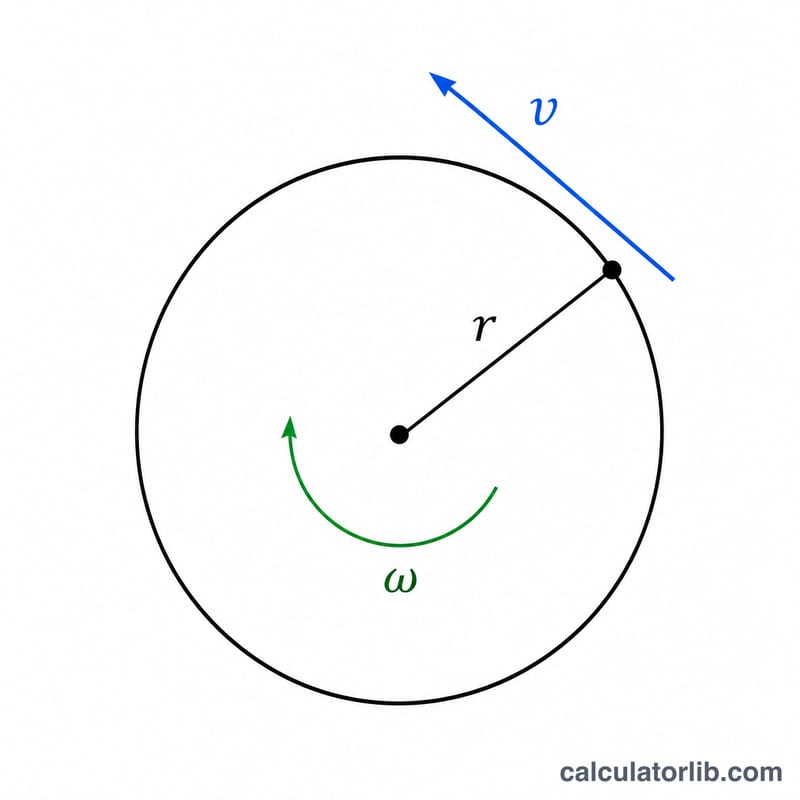
This tool converts a rotation speed in revolutions per minute (RPM) and a radius into the linear (tangential) speed of a point on the edge of the rotating object, along with the angular velocity in radians per second. It works for any spinning object — a wheel, a turntable, a fan blade, a grinding disc, or a satellite in circular orbit.
How to use it
Enter the radius (the distance from the center of rotation to the point of interest, in meters) and the rotation speed in RPM. The calculator returns the linear speed in m/s, the angular velocity in rad/s, and the circumference of the circular path.
The formula explained
One full revolution moves a rim point a distance equal to the circumference, \(2\pi r\). The number of revolutions per second is \(\text{RPM} \div 60\), so the linear speed is:
$$v = 2\pi r \cdot \frac{\text{RPM}}{60}$$
Because angular velocity \(\omega = 2\pi \cdot \frac{\text{RPM}}{60}\) radians per second, this is equivalent to the classic relation \(v = \omega r\). The two forms always agree.
Worked example
A wheel of radius 0.5 m spins at 60 RPM. Revolutions per second = \(60/60 = 1\). Angular velocity \(\omega = 2\pi \times 1 \approx 6.2832\) rad/s. Linear speed \(v = \omega \times r = 6.2832 \times 0.5 \approx 3.1416\) m/s. The rim point travels one full circumference (\(2\pi \times 0.5 \approx 3.1416\) m) every second.
FAQ
What is the difference between linear and angular velocity? Angular velocity (\(\omega\)) measures how fast the angle sweeps, in rad/s, and is the same everywhere on a rigid body. Linear velocity (\(v\)) measures actual speed through space and grows with radius: \(v = \omega r\).
Can I use different units? Keep radius in meters for an answer in m/s. To use centimeters, convert to meters first (divide by 100), or treat the output in the matching unit.
How do I get RPM from linear speed? Rearrange: \(\text{RPM} = \frac{60 \cdot v}{2\pi r}\). Larger radius means lower RPM for the same speed.