
What is the speed of sound?
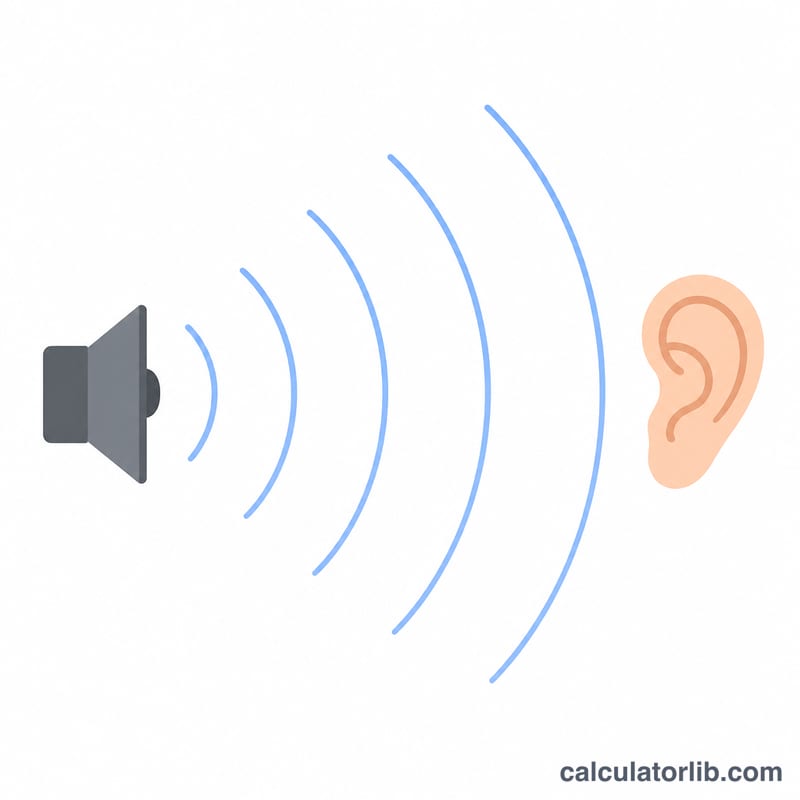
The speed of sound is how fast a sound wave travels through a medium. In dry air it depends almost entirely on temperature: warmer air molecules move faster and transmit pressure waves more quickly. This calculator estimates the speed of sound in air from the air temperature you enter and reports the result in meters per second, kilometers per hour, and miles per hour.
How to use the calculator
Enter the air temperature in degrees Celsius and the calculator instantly returns the speed of sound. Temperatures can be negative (for cold conditions) or above room temperature. The conversions to km/h and mph make it easy to compare with vehicle or aircraft speeds.
The formula explained
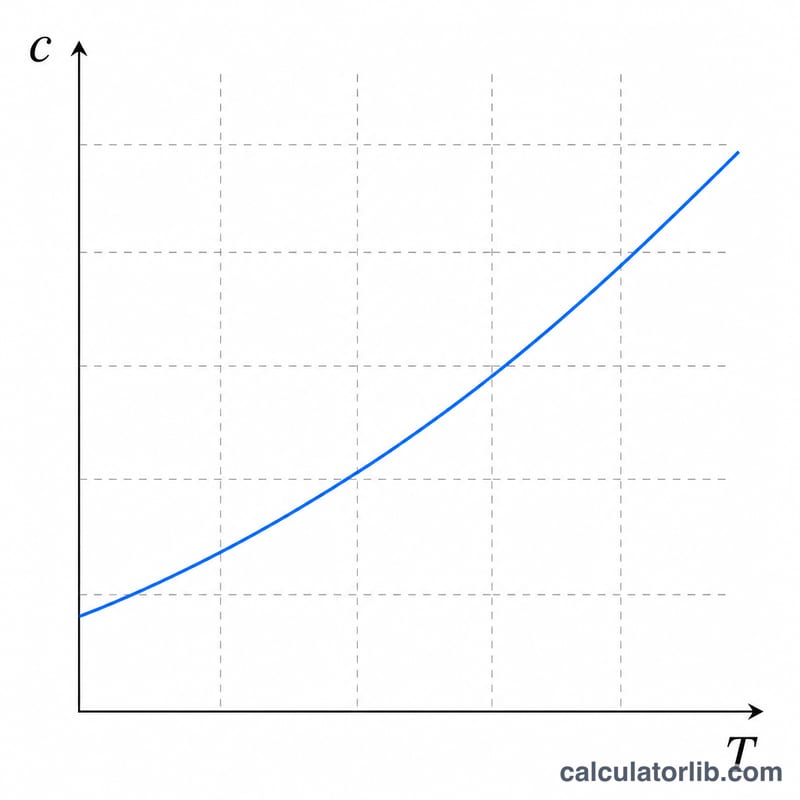
This tool uses the approximation $$c = 331.3 \cdot \sqrt{1 + \frac{T}{273.15}}$$ where \(c\) is the speed of sound in m/s and \(T\) is the temperature in °C. The constant 331.3 m/s is the speed of sound at 0 °C, and 273.15 converts the Celsius temperature into a ratio relative to absolute zero. A common quick approximation is \(c \approx 331.3 + 0.606 \cdot T\).
Worked example
At 20 °C: \(\text{ratio} = 1 + 20/273.15 = 1.07322\); \(\sqrt{1.07322} = 1.03597\); $$c = 331.3 \times 1.03597 \approx 343.2 \text{ m/s}$$ That equals about 1,235.6 km/h or 767.8 mph — the familiar room-temperature speed of sound.
FAQ
Does humidity change the result? Slightly. Humid air is a little less dense, raising the speed by a few m/s, but temperature is by far the dominant factor, so this dry-air formula is accurate for most purposes.
Why does sound travel faster when it is hot? Higher temperature means faster-moving molecules, so pressure disturbances pass between them more rapidly.
What is the speed of sound at 0 °C? Exactly 331.3 m/s by this formula — the freezing-point reference value.