
What this calculator does
When an old appliance still works, replacing it with a more energy-efficient model only makes financial sense if the electricity it saves eventually pays back the purchase and disposal costs. This calculator compares those two paths over a 10-year horizon and tells you the exact payback period in years. It is a generic, currency-neutral tool: enter prices and electricity rate in whatever currency you use.
How to use it
Enter the purchase price of the efficient appliance, any recycling, disposal or delivery cost, the annual power consumption (kWh per year) of both your current and the new model, and your electricity unit price per kWh. The calculator returns your initial cost, the annual electricity-cost savings, the payback period, and a year-by-year cumulative comparison so you can see exactly when "replace" becomes cheaper than "keep".
The formula explained
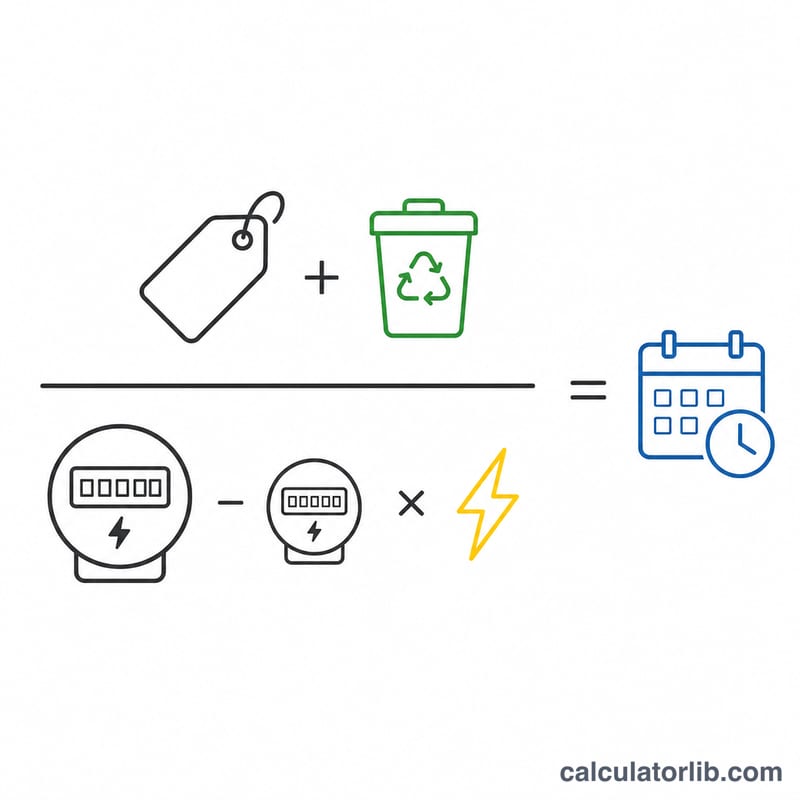
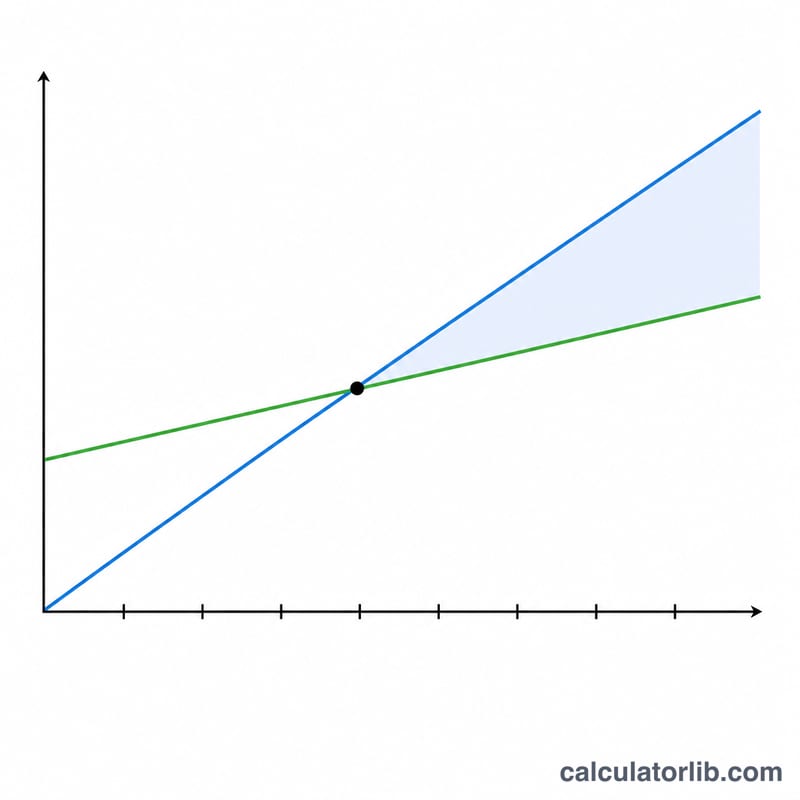
Initial cost = price + recycling cost. Annual savings = (current kWh - new kWh) x rate. The payback period is simply Initial cost / Annual savings. For each year n, cumulative net savings = annual savings x n - initial cost; break-even is the first year that value reaches zero or above.
$$\text{Payback (years)} = \frac{\text{Price} + \text{Recycling Cost}}{\left(\text{Current kWh/yr} - \text{New kWh/yr}\right) \times \text{Rate}}$$
Worked example
Price 125000, recycling 3672, so initial cost = 128672. Current model uses 650 kWh/year and the new one 255 kWh/year at a rate of 28 per kWh. Annual savings = \((650 - 255) \times 28 = 11060\) per year. Payback = \(128672 / 11060 \approx 11.63\) years, so it is recovered in year 12. After 10 years the net position is \(11060 \times 10 - 128672 = -18072\), meaning the replacement has not yet paid for itself within a decade.
$$\text{10-Year Net} = \left[\left(\text{Current kWh/yr} - \text{New kWh/yr}\right) \times \text{Rate} \times 10\right] - \left(\text{Price} + \text{Recycling Cost}\right)$$
FAQ
What if the new appliance uses the same or more power? Then annual savings is zero or negative and there is no payback; the tool reports "No payback".
Does it account for inflation or rising electricity prices? No, it assumes a constant electricity rate. Rising rates would shorten the payback period.
Why 10 years? Ten years is a typical appliance lifespan window, but the same per-year formula extends to any number of years.