
What Is the Appliance Amperage Calculator?
This tool tells you how many amps (amperes) an electrical appliance draws based on its power rating in watts and the supply voltage. Knowing the current draw helps you choose the right circuit breaker, fuse, extension cord, or wire gauge, and avoid overloading a circuit. It works for any voltage system — 120 V (North America), 230 V (Europe), 240 V (large appliances), or any other value you enter.
How to Use It
Enter the appliance's power in watts (found on the nameplate or label, often written as "W") and the supply voltage in volts. The calculator instantly returns the current draw in amps. If your appliance lists power in kilowatts, multiply by 1,000 first (e.g. 1.5 kW = 1500 W).
The Formula Explained
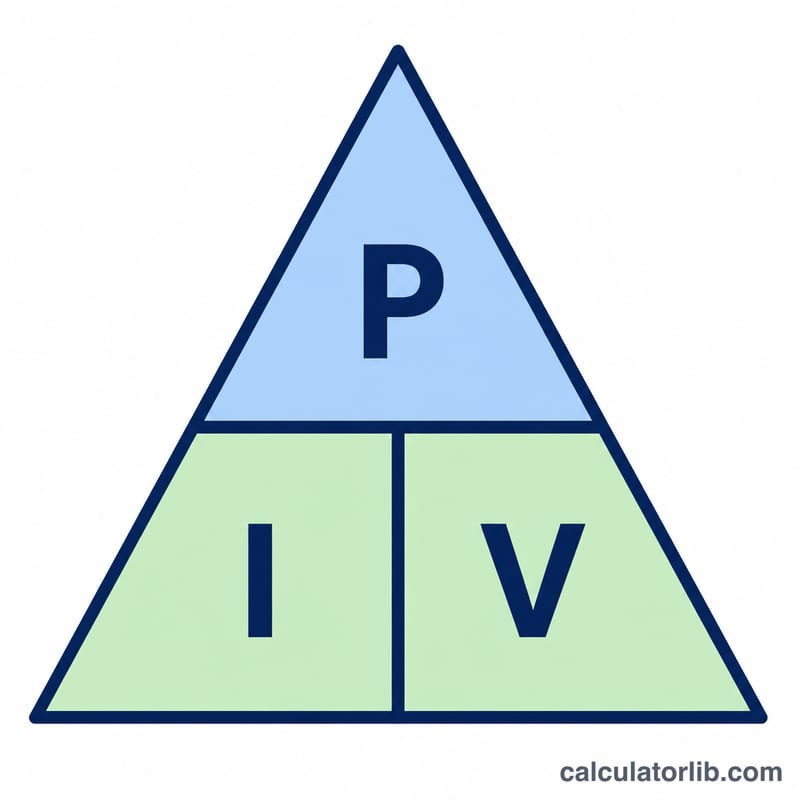
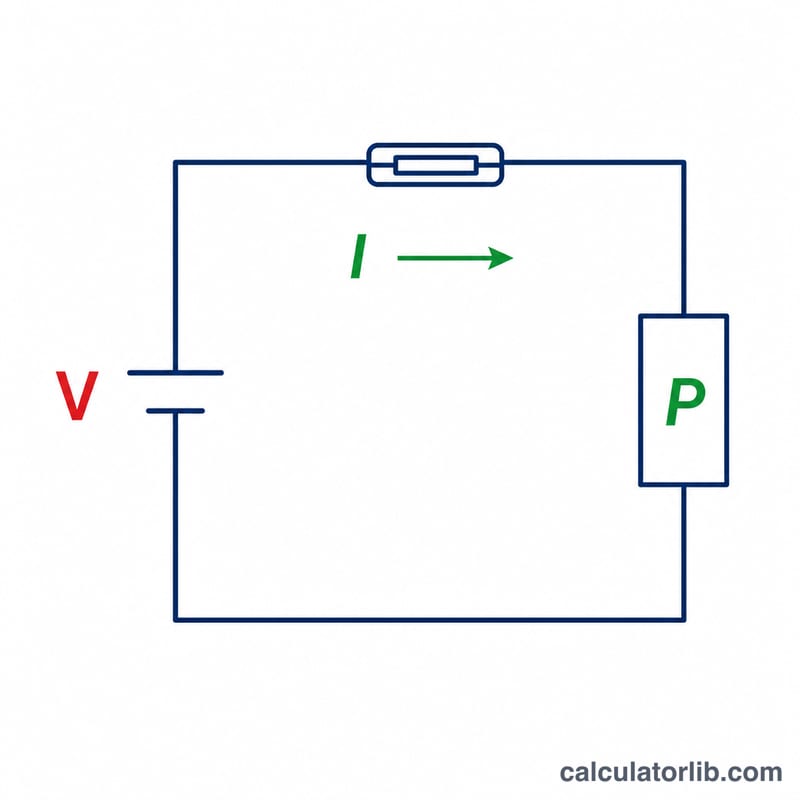
The calculation uses Ohm's power law for a purely resistive load: $$I = \frac{P}{V}$$ where \(I\) is current in amperes, \(P\) is power in watts, and \(V\) is voltage in volts. Dividing watts by volts gives the steady-state current the device pulls. Motors and reactive loads may briefly draw more at startup and have a power factor below 1, so treat the result as the nominal running current.
Worked Example
A 1500-watt space heater plugged into a 120-volt outlet draws $$I = \frac{1500}{120} = 12.5 \text{ amps}$$ On a standard 15-amp circuit this leaves little headroom, which is why running two such heaters on one circuit trips the breaker.
Wire Gauge & Breaker Size by Amperage
Once you know an appliance's current draw, the conductor must be sized so its ampacity meets or exceeds the breaker protecting it. The table below lists common copper conductors and the standard breaker sizes they support for typical residential branch circuits. Values reflect the NEC 60°C/75°C ampacity columns (NEC Table 310.16) as commonly applied to dwelling wiring; aluminum conductors carry less and require larger gauges.
| Copper AWG | Typical Ampacity | Standard Breaker | Common Use |
|---|---|---|---|
| 14 AWG | 15 A | 15 A | Lighting, general receptacles |
| 12 AWG | 20 A | 20 A | Kitchen/bath receptacles, small appliances |
| 10 AWG | 30 A | 30 A | Electric dryer, water heater, A/C |
| 8 AWG | 40 A | 40 A | Electric range, EV charger |
| 6 AWG | 55 A | 50 A | Large range, subpanel feeder |
The breaker is sized to protect the wire, never to exceed its ampacity. For very long runs, increase the gauge to limit voltage drop even if the ampacity rule alone would allow a smaller wire.
Sizing Circuits Safely From Your Result
Your calculated amperage is the starting point — building a safe circuit requires several adjustments on top of it.
- Apply the 80% continuous-load rule. A circuit running 3+ hours continuously should be loaded to no more than 80% of the breaker rating. Divide your appliance amps by 0.8 to find the minimum breaker. For example, a 32 A EV charger needs at least \(32 \div 0.8 = 40\) A of breaker capacity.
- Round up to the next standard breaker size. Standard sizes are 15, 20, 30, 40, 50, 60 A, etc. Always select the next size at or above your adjusted current.
- Match the wire gauge to the breaker. Use the table above so the conductor's ampacity meets or exceeds the breaker rating — a 40 A breaker needs 8 AWG copper, not 10 AWG.
- Account for motor startup surge. Compressors, pumps, and large motors briefly draw 3–6× their running current. Use circuits and breakers rated for the inrush, and follow the appliance's listed minimum circuit ampacity (MCA) and maximum overcurrent protection (MOCP).
- Consider power factor for inductive loads. For motors and many AC units the real power (W) and apparent power (VA) differ, so actual current can exceed the simple watts ÷ volts figure. Use the nameplate amps when provided.
- Check voltage drop on long runs. Keep drop under about 3% on a branch circuit; upsize the conductor for runs over roughly 50–100 ft.
This is general educational information, not professional advice. Electrical work is governed by the National Electrical Code and local amendments and can be hazardous. Always confirm sizing with the appliance documentation and have a licensed electrician perform and inspect the installation.
FAQ
What size breaker do I need? A continuous load should not exceed 80% of the breaker rating. A 12.5 A appliance ideally runs on a 20 A circuit.
Why is my measured current different? Inductive loads (motors, compressors) have a power factor under 1, so real amps can be higher than this resistive estimate.
Can I use this for DC? Yes — \(I = P / V\) holds for DC and resistive AC loads alike.