
What is an elastic collision?
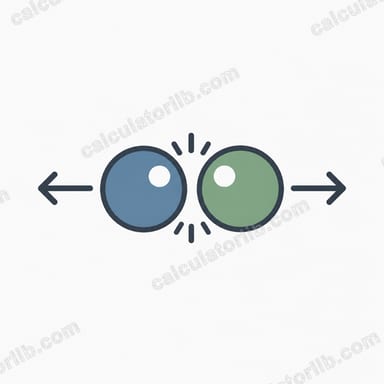
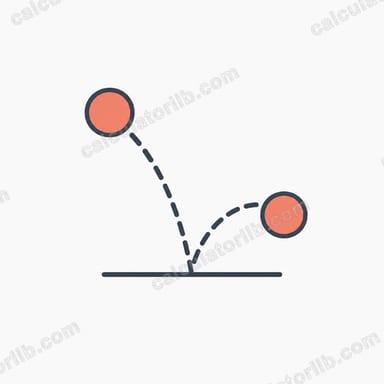
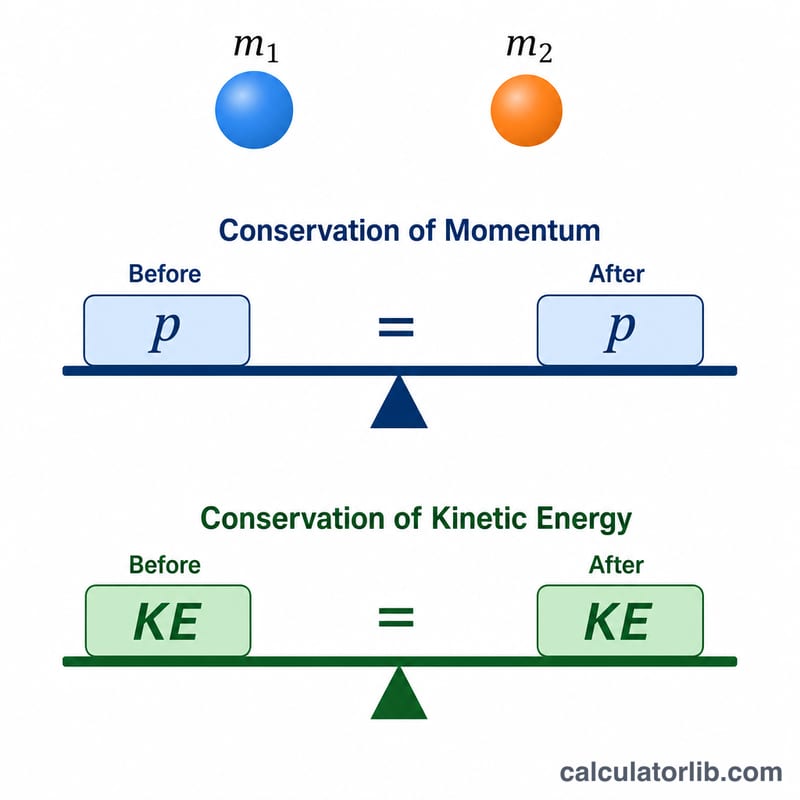
An elastic collision is one in which both total momentum and total kinetic energy are conserved. In one dimension, two objects approach along the same line, collide, and bounce apart with new velocities determined entirely by their masses and initial velocities. This calculator solves the standard 1D elastic-collision equations to return both final velocities instantly.
How to use the calculator
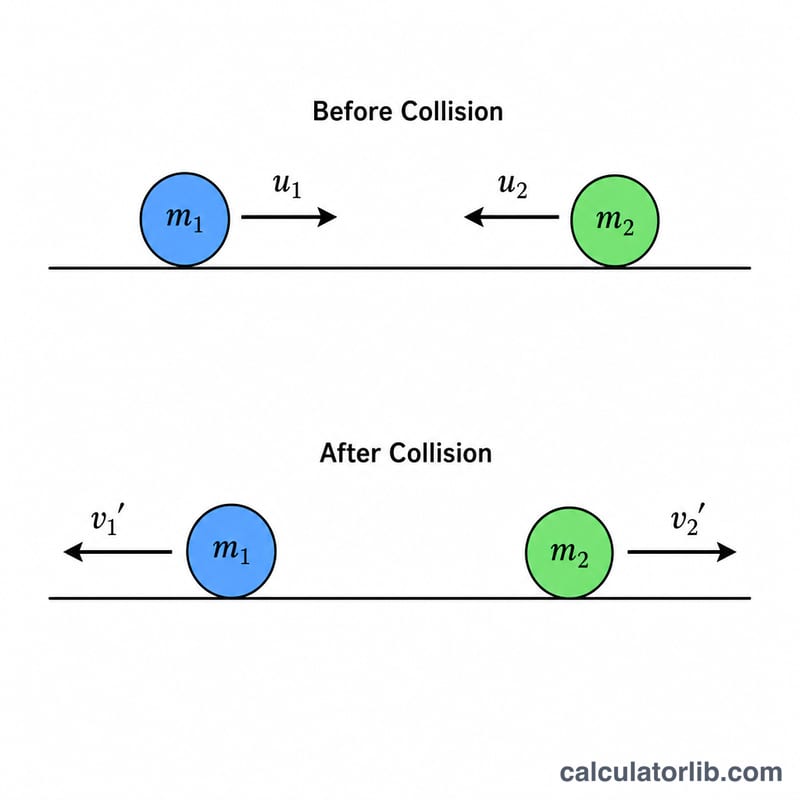
Enter the mass and initial velocity of each object. Use a positive value for motion in one direction (say, to the right) and a negative value for motion in the opposite direction. The calculator returns \(v_1'\) and \(v_2'\), the velocities right after impact. A negative result means that object now moves to the left.
The formula explained
The two governing equations are:
$$v_1' = \frac{(\text{m}_1 - \text{m}_2)\,\text{u}_1 + 2\,\text{m}_2\,\text{u}_2}{\text{m}_1 + \text{m}_2}$$ $$v_2' = \frac{(\text{m}_2 - \text{m}_1)\,\text{u}_2 + 2\,\text{m}_1\,\text{u}_1}{\text{m}_1 + \text{m}_2}$$These are derived by simultaneously solving conservation of momentum (\(\text{m}_1 \text{u}_1 + \text{m}_2 \text{u}_2 = \text{m}_1 v_1' + \text{m}_2 v_2'\)) and conservation of kinetic energy. Note the symmetric structure: swapping the subscripts 1 and 2 in one equation gives the other.
Worked example
Suppose \(\text{m}_1 = 2\) kg moving at \(\text{u}_1 = 5\) m/s strikes \(\text{m}_2 = 3\) kg moving at \(\text{u}_2 = -2\) m/s. Then \(\text{m}_1 + \text{m}_2 = 5\).
$$v_1' = \frac{(2-3)\cdot 5 + 2\cdot 3\cdot(-2)}{5} = \frac{-5 - 12}{5} = -3.4 \text{ m/s}$$$$v_2' = \frac{(3-2)\cdot(-2) + 2\cdot 2\cdot 5}{5} = \frac{-2 + 20}{5} = 3.6 \text{ m/s}$$Object 1 reverses direction while object 2 speeds forward.
FAQ
What if both masses are equal? For equal masses the objects simply exchange velocities, a classic result of elastic collisions.
Can a mass be very large? Yes — a very heavy object barely changes velocity, while the light object bounces back at nearly twice the heavy object's speed relative to it.
Does this work for 2D collisions? No. This tool assumes motion along a single straight line. Two-dimensional collisions require vector components and additional angle information.