
What Is a Perfectly Inelastic Collision?
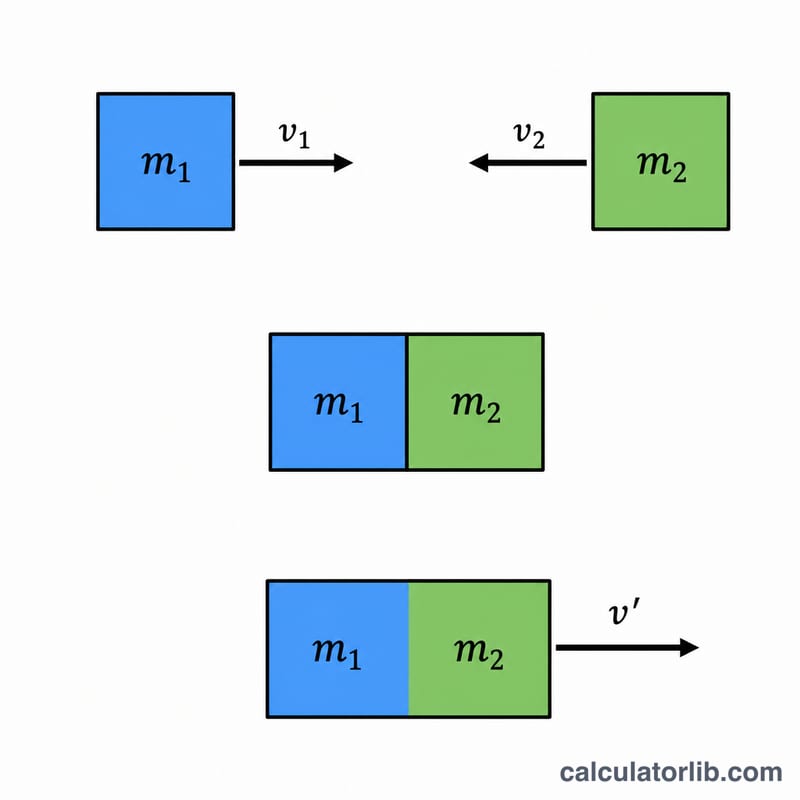
A perfectly inelastic collision is one in which two objects collide and then move together as a single combined mass afterwards. Momentum is always conserved, but kinetic energy is not — some energy is converted into heat, sound, and permanent deformation. This calculator finds the final common velocity of the joined objects along with the total momentum and the kinetic energy lost during impact.
How to Use It
Enter the mass and velocity of each object. Use positive velocities for objects moving in one direction and negative values for the opposite direction. The calculator returns the shared final velocity, the conserved total momentum, the initial and final kinetic energy, and how much kinetic energy was dissipated.
The Formula Explained
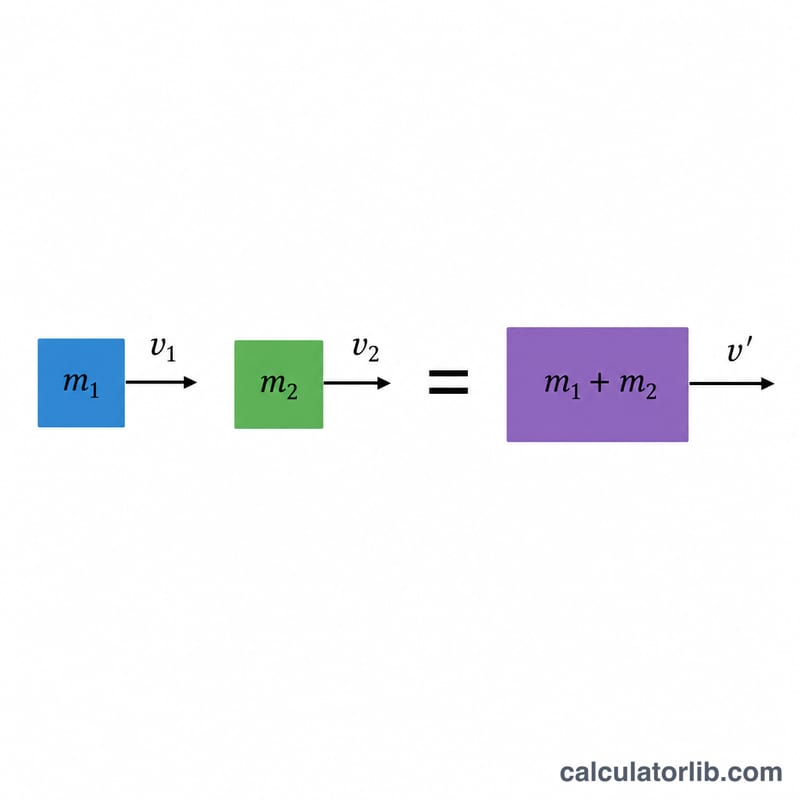
By conservation of momentum, the total momentum before equals the total momentum after: \(m_1 v_1 + m_2 v_2 = (m_1 + m_2)v'\). Solving for the common velocity gives
$$v' = \frac{m_1 v_1 + m_2 v_2}{m_1 + m_2}.$$The kinetic energy lost is the difference between the summed initial kinetic energies and the kinetic energy of the combined mass moving at \(v'\).
Worked Example
A 2 kg cart moving at 3 m/s strikes a stationary 1 kg cart (\(v_2 = 0\)) and they couple together. The final velocity is
$$v' = \frac{2 \cdot 3 + 1 \cdot 0}{2 + 1} = \frac{6}{3} = 2 \text{ m/s}.$$Initial KE = \(\tfrac{1}{2} \cdot 2 \cdot 3^2 = 9\) J; final KE = \(\tfrac{1}{2} \cdot 3 \cdot 2^2 = 6\) J, so 3 J of kinetic energy is lost in the collision.
FAQ
Is momentum always conserved? Yes — in any collision with no external forces, total momentum is conserved, even when kinetic energy is not.
Why is kinetic energy lost? In an inelastic collision energy goes into deforming the objects, generating heat, and producing sound, so the final kinetic energy is lower than the initial.
What if the objects move in opposite directions? Enter one velocity as negative. The signed sum of momenta determines both the magnitude and direction of the final velocity.