What Is the Energy Cost per kWh Calculator?
This calculator tells you exactly how much you pay for each kilowatt-hour (kWh) of electricity. Utility bills often bundle energy charges, delivery fees, and taxes together, so the headline rate on your plan may not reflect what you actually pay. By dividing your total bill by the energy you consumed, you get your true effective rate — useful for comparing suppliers, budgeting, or estimating appliance running costs.
How to Use It
Enter two numbers: your total electricity bill in dollars and the energy used in kWh for the same billing period (both appear on your statement). The calculator returns your effective rate per kWh in dollars and in cents. The cents figure is handy because most published tariffs are quoted in cents per kWh.
The Formula Explained
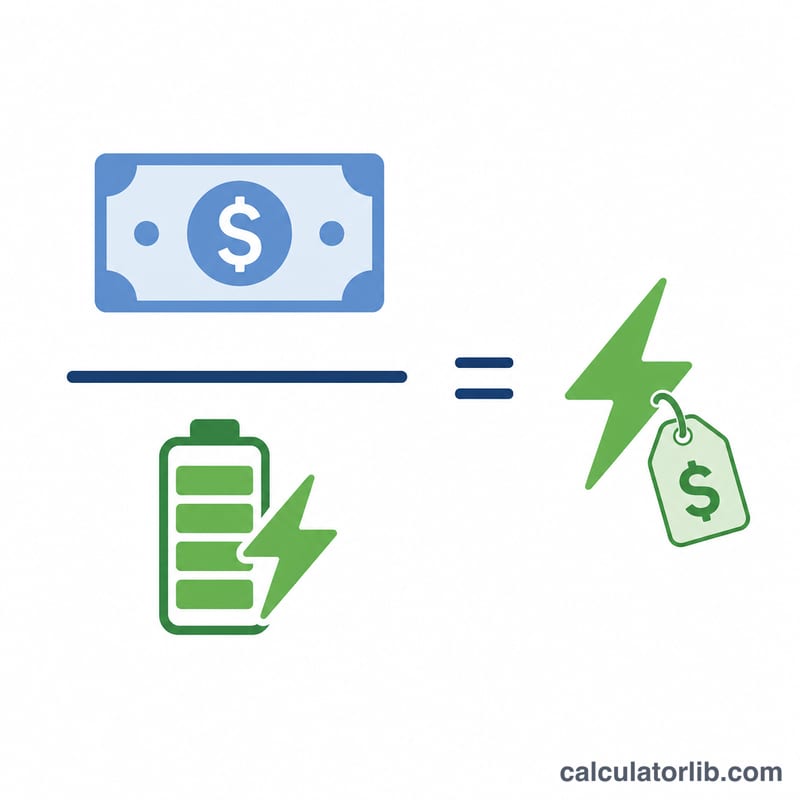
The math is simple division: $$\text{Rate} = \frac{\text{Total Bill (\$)}}{\text{Energy Used (kWh)}}$$. Because the total bill already includes every fee and tax, the result is your all-in effective price. Multiply by 100 to convert dollars per kWh into cents per kWh.
Worked Example
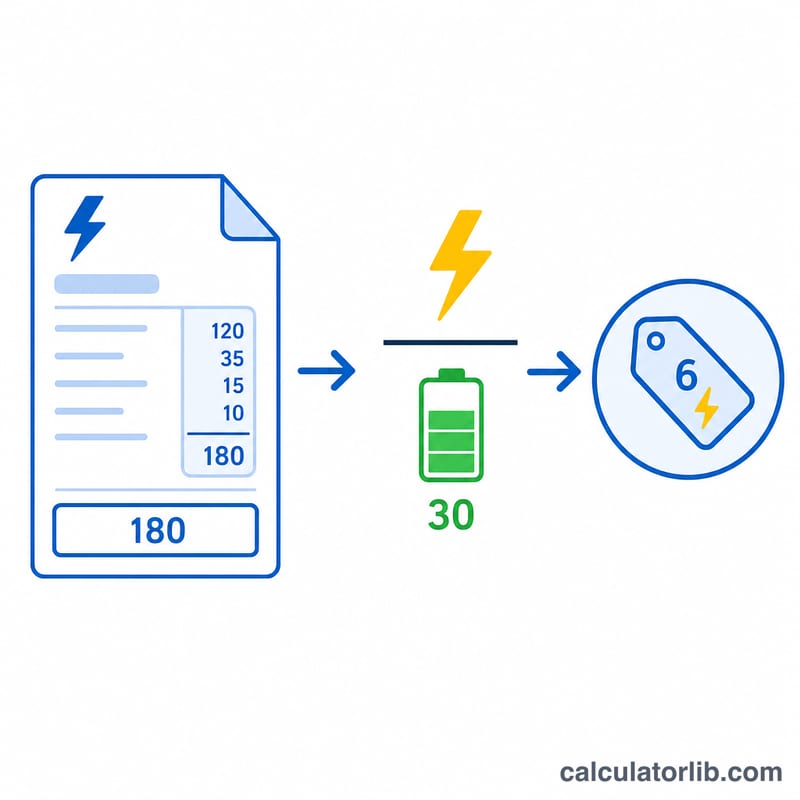
Suppose your monthly bill is $150 and you used 1,000 kWh. Your rate is $$150 \div 1000 = \$0.15 \text{ per kWh}$$ or 15 cents per kWh. If a competitor advertises 12 ¢/kWh, you could be overpaying — though always check whether fixed fees are included.
Typical Average Electricity Rates for Comparison
Once you have divided your bill by your kWh, it helps to see where that number sits against published averages. The figures below are United States annual average retail prices for 2023, as reported by the U.S. Energy Information Administration (EIA) in its Electric Power Monthly / Electric Power Annual series. They are all-in averages: generation, transmission, distribution and fixed customer charges are blended into a single cents-per-kWh figure, which is exactly the kind of number this calculator produces.
| Region (sector) | Average price (US cents/kWh) | Source & data year |
|---|---|---|
| United States — residential (national average) | ≈ 16.0 | U.S. EIA, 2023 annual average |
| United States — commercial (national average) | ≈ 12.7 | U.S. EIA, 2023 annual average |
| Hawaii — residential (highest state) | ≈ 42 | U.S. EIA, 2023 annual average |
| California — residential | ≈ 29 | U.S. EIA, 2023 annual average |
| New York — residential | ≈ 23 | U.S. EIA, 2023 annual average |
| Texas — residential | ≈ 14.5 | U.S. EIA, 2023 annual average |
| Louisiana — residential (among lowest states) | ≈ 12 | U.S. EIA, 2023 annual average |
For context outside the United States, Eurostat reports household electricity prices for the European Union including all taxes and levies; the EU average in 2023 was roughly 29 euro-cents per kWh (note: euro-cents, not US cents, and Eurostat publishes separately for each half-year). Many other countries publish their own regulated or surveyed averages, so compare your result with the source that covers your own country.
Rates change. Fuel costs, rate cases, seasonal tariffs and taxes move these averages every year — and in some markets every month. Treat the values above as rough comparison anchors for the stated year, and check the current figure directly from the EIA (for the US), Eurostat (for the EU) or your national regulator before drawing conclusions.
FAQ
Why is my calculated rate higher than my plan's rate? Bills include delivery charges, connection fees, and taxes on top of the energy rate, so the effective per-kWh cost is usually higher.
Where do I find kWh used? Look for "kWh" or "usage" on your electricity statement; it's the difference between your start and end meter readings.
Can I use this to estimate appliance costs? Yes. Multiply an appliance's kWh consumption by your rate per kWh to estimate its running cost.