
What Is a Wake Window?
A wake window is the length of time a baby can comfortably stay awake between sleeps before becoming overtired. Wake windows grow as a baby matures: a newborn may only manage 45–75 minutes awake, while a toddler can handle five hours or more. Timing naps to a baby's natural wake window helps them fall asleep faster and sleep more soundly.
How to Use This Calculator
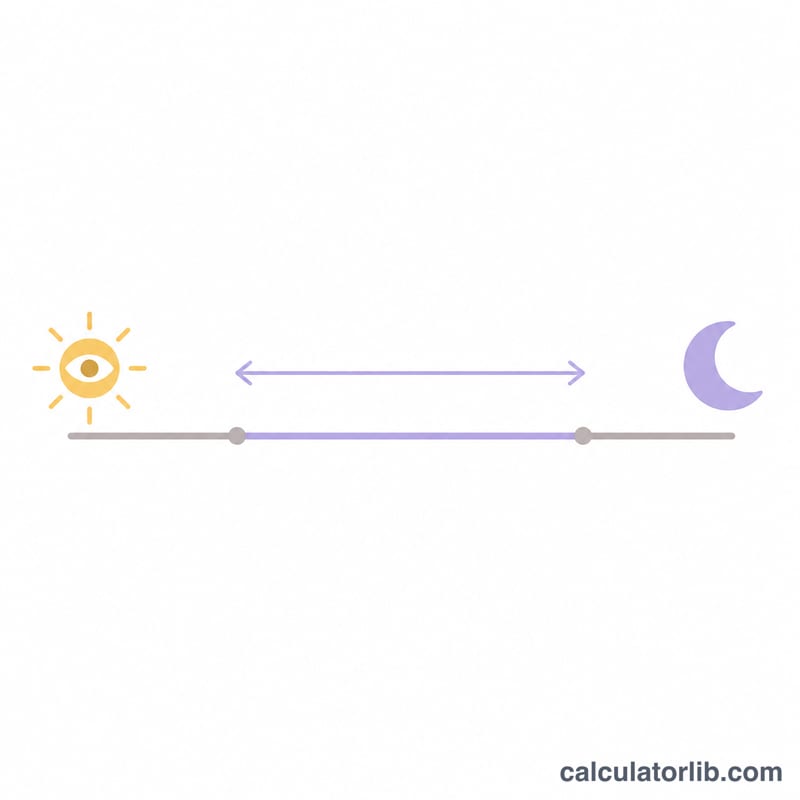
Select your baby's age range, then enter the time they last woke up (using a 24-hour clock — for example 7:00 AM is hour 7, minute 0). The calculator applies a typical wake window for that age and adds it to the wake-up time to estimate the next ideal nap or bedtime. Use it as a flexible guide, watching your baby's sleepy cues (yawning, rubbing eyes, staring) as the real signal.
The Formula
The math is simple: Next Nap = Last Wake Time + Wake Window. Internally the clock time is converted to minutes after midnight, the age-based wake window (in minutes) is added, and the result wraps within a 24-hour day.
$$\text{Next Nap (min from midnight)} = \left( 60 \times \text{Wake Hour} + \text{Wake Minute} + W \right) \bmod 1440$$ $$\text{where}\quad \left\{ \begin{aligned} W &= \text{wake window by } \text{Age} \\ &= \{60, 90, 120, 150, 180, 210, 270, 330\}\ \text{min} \end{aligned} \right.$$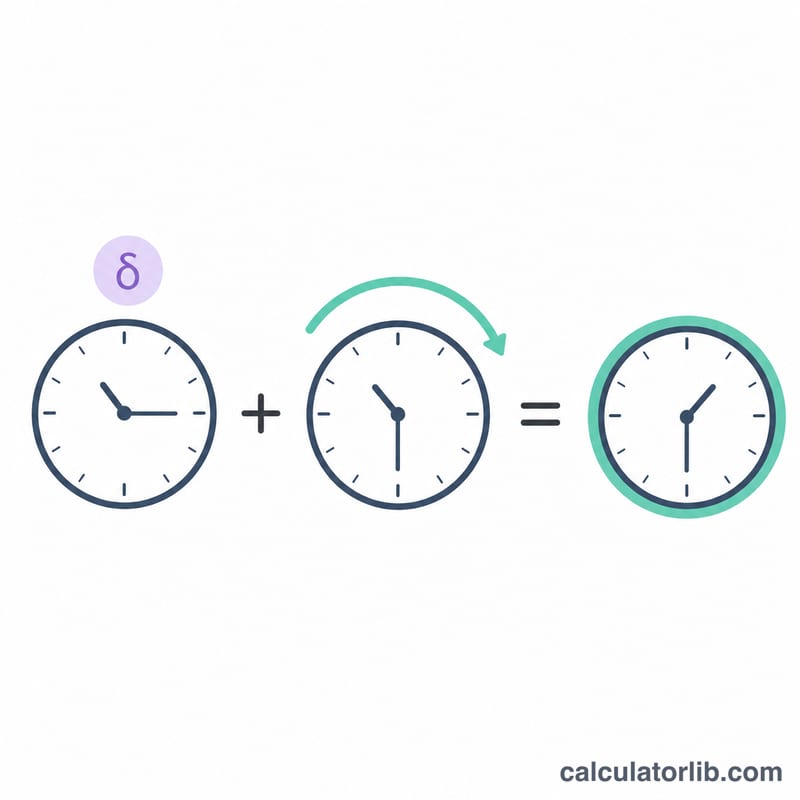
Worked Example
A 6-month-old wakes at 7:00 AM. The typical wake window at 6 months is about 150 minutes (2.5 hours). \( 7\!:\!00 + 2\text{ hours } 30\text{ minutes} = \) 9:30 AM for the first nap of the day.
FAQ
Are these wake windows exact? No — every baby is different. The values are midpoints of common age ranges and should be adjusted to your child.
What if my baby seems tired earlier? Follow the cues. Put them down sooner rather than risk an overtired meltdown.
Does this work for bedtime too? Yes. The last wake window of the day often leads into bedtime, so the same calculation applies.