
What Is Book Value Per Share?
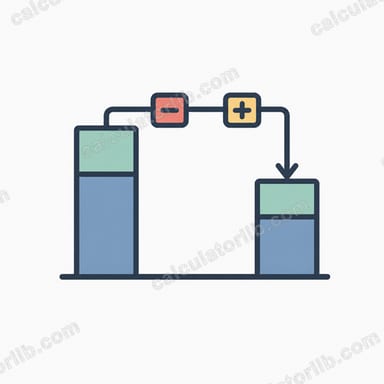
Book Value Per Share (BVPS) measures the amount of common shareholders' equity backing each outstanding share of a company. It represents the per-share value of a company based on its balance sheet — what common shareholders would theoretically receive per share if all assets were liquidated at their recorded book value and all liabilities and preferred claims were settled.
How to Use This Calculator
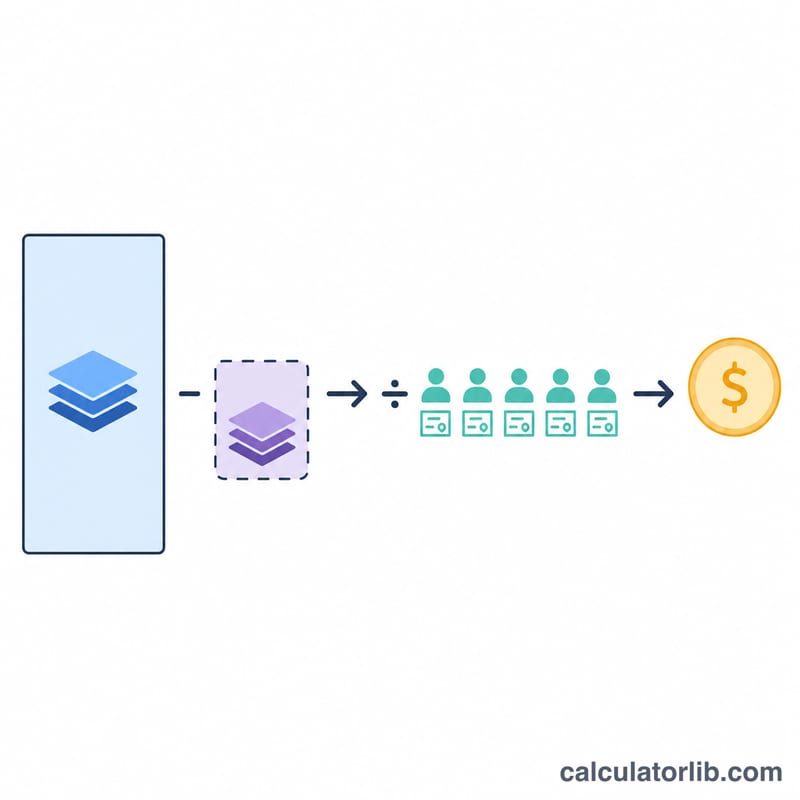
Enter three figures from the company's balance sheet: total shareholders' equity, any preferred equity (the claim that ranks ahead of common stock — enter 0 if none), and the number of common shares outstanding. The calculator subtracts preferred equity from total equity to get equity available to common shareholders, then divides by the share count to give BVPS.
The Formula Explained
The formula is BVPS = (Total Equity − Preferred Equity) / Shares Outstanding. Preferred equity is removed because preferred shareholders have a senior claim on the company's net assets. Dividing the remaining "common equity" by shares outstanding gives the book value attributable to each common share.
Worked Example
Suppose a company has total shareholders' equity of $5,000,000, preferred equity of $500,000, and 900,000 common shares outstanding. Common equity = $5,000,000 − $500,000 = $4,500,000. BVPS = $4,500,000 / 900,000 = $5.00 per share. If the stock trades above $5, investors are paying a premium to book value; below $5, a discount.
Interpreting Your BVPS Result
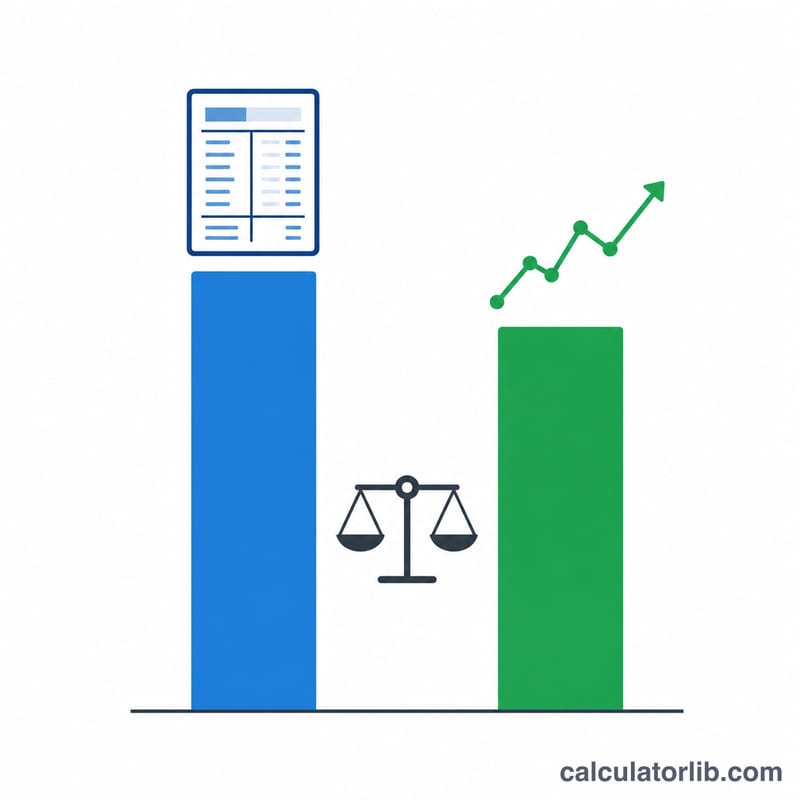
Book Value Per Share (BVPS) represents the per-share value of a company's common equity according to its balance sheet. On its own the number is most useful when compared with the company's market price per share, a comparison formalized in the price-to-book (P/B) ratio:
$$\text{P/B} = \frac{\text{Market Price per Share}}{\text{BVPS}}$$When the market price is below BVPS the P/B ratio is less than 1, meaning the market values the company at less than the accounting value of its net assets. When the price is above BVPS the P/B ratio is greater than 1, meaning the market assigns value beyond the recorded equity — often reflecting expected future earnings, brand strength, or growth prospects. For example, a stock trading at $30 with a BVPS of $20 has a P/B ratio of 1.5.
Industry matters a great deal. Asset-heavy industries such as banking, insurance, manufacturing, real estate, and utilities tend to carry tangible assets on the balance sheet that are reasonably reflected in equity, so BVPS and P/B are widely watched there. Asset-light businesses such as software, consulting, and consumer brands derive most of their value from intangible assets — intellectual property, customer relationships, and brand — that are not fully captured in book equity, so they routinely trade at high P/B multiples that say little about over- or under-valuation.
Limitations. BVPS rests on historical cost accounting: many assets are recorded at their original purchase price less depreciation rather than current market value, so book equity can understate (or occasionally overstate) the true economic value of a company's assets. Internally generated intangibles such as a developed brand or proprietary technology are generally not recorded as assets at all, while acquired goodwill can inflate equity. Share repurchases, write-downs, and accounting choices all affect the figure.
A negative BVPS occurs when liabilities (plus any preferred claims) exceed total assets, typically the result of accumulated deficits — sustained losses that have eroded retained earnings below zero. It can also follow large debt-funded buybacks or special dividends. A negative result makes the P/B ratio meaningless and signals that, on a book basis, common shareholders have no residual equity.
This section is factual information only and is not investment advice.
BVPS Across Different Scenarios
The table below shows how BVPS responds to changes in total equity, preferred claims, and share count. BVPS is computed as (Total Equity − Preferred Equity) ÷ Common Shares Outstanding.
| Scenario | Total Equity | Preferred Equity | Common Shares | BVPS |
|---|---|---|---|---|
| No preferred stock | $50,000,000 | $0 | 5,000,000 | $10.00 |
| Large preferred claim | $50,000,000 | $20,000,000 | 5,000,000 | $6.00 |
| High share count | $50,000,000 | $0 | 25,000,000 | $2.00 |
| Buyback reduces shares (equity also falls by cash used) | $45,000,000 | $0 | 4,000,000 | $11.25 |
| Accumulated deficit (negative equity) | -$8,000,000 | $0 | 5,000,000 | -$1.60 |
Notice that two companies with identical $50M total equity can report very different BVPS depending on preferred claims and share count. The buyback row illustrates a common effect: repurchasing shares uses cash (lowering total equity) but reduces the denominator more sharply, so BVPS can rise even though equity fell.
Key Terms & Definitions
- Total Shareholders' Equity
- The residual interest in a company's assets after deducting all liabilities, equal to assets minus liabilities. On the balance sheet it includes paid-in capital, retained earnings, and any preferred equity, less treasury stock.
- Preferred Equity
- The portion of equity attributable to preferred shareholders, who hold a claim on assets and dividends ahead of common shareholders. It is subtracted in the BVPS formula so that the result reflects only what belongs to common shareholders.
- Common Equity
- Total shareholders' equity minus preferred equity — the book value belonging to common stockholders. This is the numerator of the BVPS calculation.
- Shares Outstanding
- The number of common shares currently held by all shareholders, including institutional investors and company insiders, but excluding treasury shares the company has repurchased. This is the denominator in BVPS.
- Book Value
- The value of an asset, liability, or the whole company's equity as recorded on the balance sheet under accounting rules, generally based on historical cost less depreciation or amortization, rather than current market value.
- Market Value Per Share
- The current trading price of one common share in the stock market, set by supply and demand. Comparing it with BVPS produces the price-to-book ratio.
- Price-to-Book (P/B) Ratio
- The market price per share divided by BVPS. A ratio below 1 means the stock trades below its book value; above 1 means investors pay a premium to recorded equity.
FAQ
Is a higher BVPS always better? Not necessarily. BVPS is most useful compared with the market price (price-to-book ratio) and against peers in the same industry.
How does BVPS differ from market value per share? BVPS comes from accounting records (historical cost), while market value reflects what investors are willing to pay today, including future growth expectations.
Should I include preferred shares in shares outstanding? No. Use only common shares outstanding, since preferred equity is already subtracted in the numerator.