

What Is Earnings per Share?
Earnings per share (EPS) measures how much net profit a company generates for each outstanding share of its common stock. It is one of the most widely watched figures in fundamental analysis because it lets investors compare profitability across companies and over time on a per-share basis. This calculator computes basic EPS, the most common version reported on income statements.
How to Use This Calculator
Enter three values: the company's net income for the period, any preferred dividends declared (these are subtracted because they are not available to common shareholders), and the weighted average shares outstanding during the period. The calculator returns EPS in dollars per share along with the earnings available to common shareholders.
The Formula Explained
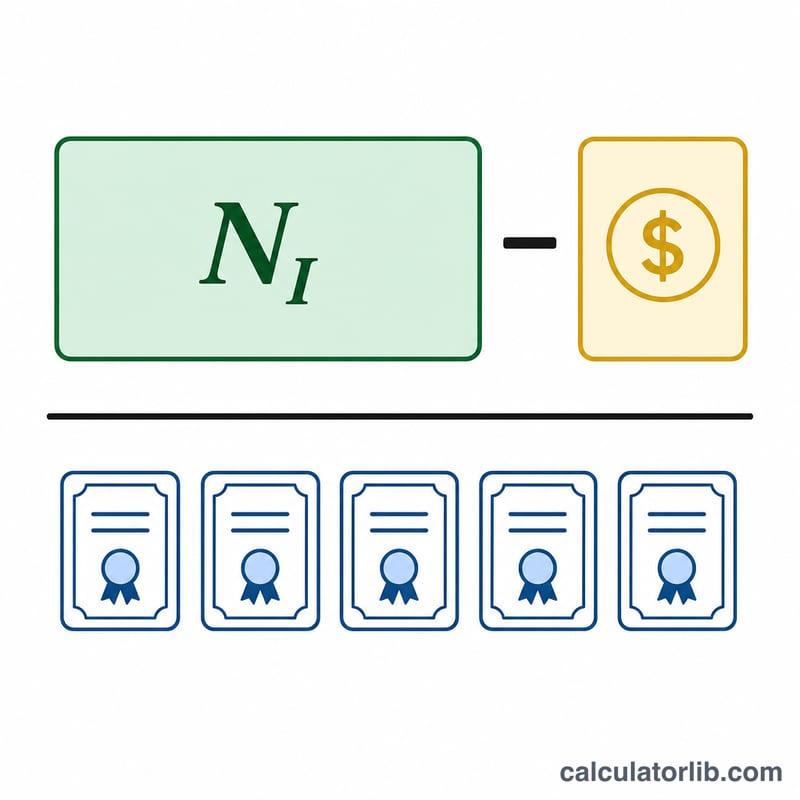
$$\text{EPS} = \frac{\text{Net Income} - \text{Preferred Dividends}}{\text{Weighted Avg. Shares}}$$ Subtracting preferred dividends isolates the profit that belongs to common shareholders. Using the weighted average share count—rather than the period-end count—accounts for shares issued or repurchased during the period, giving a fairer per-share figure.
Worked Example
Suppose a company reports net income of $1,000,000, pays $50,000 in preferred dividends, and had a weighted average of 500,000 common shares outstanding. $$\text{EPS} = \frac{1{,}000{,}000 - 50{,}000}{500{,}000} = \frac{950{,}000}{500{,}000} = \$1.90 \text{ per share}$$

FAQ
What is the difference between basic and diluted EPS? Basic EPS uses only shares currently outstanding, while diluted EPS also includes potential shares from options, warrants, and convertible securities. This tool calculates basic EPS.
Why subtract preferred dividends? Preferred shareholders have first claim on dividends, so that portion of income isn't available to common shareholders and is removed from the numerator.
Is a higher EPS always better? A higher EPS generally signals greater profitability per share, but it should be compared with peers and against the share price (via the P/E ratio) for proper context.