
What Is the Price Per Share Calculator?
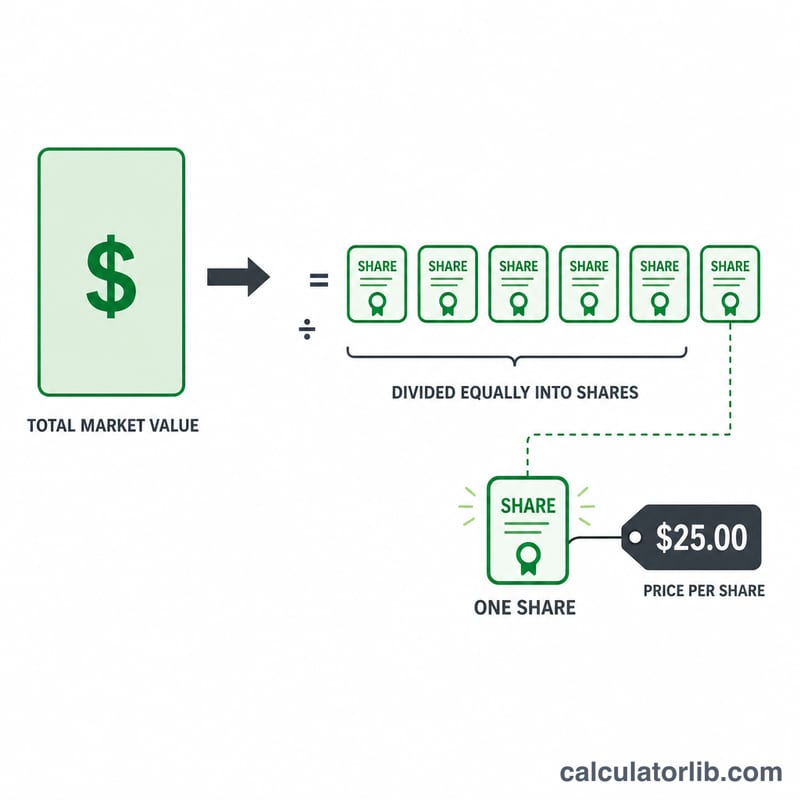
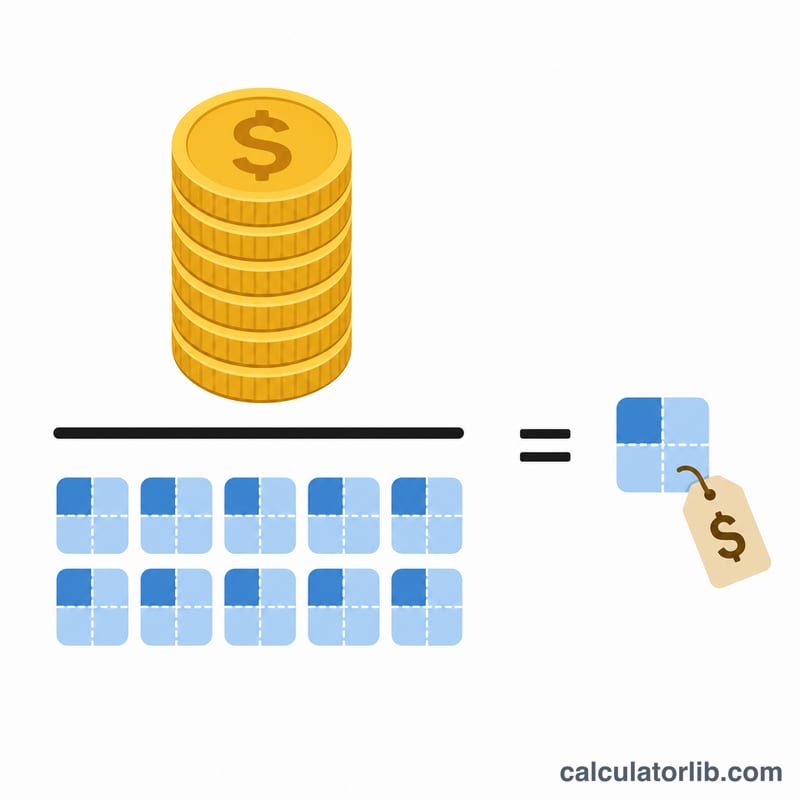
The Price Per Share Calculator determines the market value of a single share of a company's stock. It works by dividing the company's total market capitalization by the number of shares currently outstanding. This is a universal financial formula that applies to publicly traded companies in any market.
How to Use It
Enter two values: the company's market capitalization (the total dollar value of all its shares) and the total number of outstanding shares. The calculator instantly returns the implied price of one share. This is handy for sanity-checking a quoted stock price, valuing a private company, or modeling a new share issuance.
The Formula Explained
The relationship is simple and exact:
$$\text{Price Per Share} = \frac{\text{Market Capitalization}}{\text{Number of Outstanding Shares}}$$
Market capitalization is itself defined as price per share multiplied by shares outstanding, so rearranging gives the price. If shares are zero the price is undefined, so the calculator guards against division by zero.
Worked Example
Suppose a company has a market capitalization of $1,000,000,000 and 50,000,000 shares outstanding. The price per share is $$\$1{,}000{,}000{,}000 \div 50{,}000{,}000 = \$20.00$$ per share. If the same company instead had only 25,000,000 shares, each share would be worth \(\$40.00\).
FAQ
What is market capitalization? It is the total market value of a company's equity — the price of one share times the number of shares outstanding.
Should I use outstanding or float shares? Use total shares outstanding for standard market cap. Free-float shares give a different, smaller base used in some index weightings.
Does this account for preferred shares? The basic calculation treats all outstanding shares equally. For companies with multiple share classes, use the relevant class's share count and value.