
What this calculator does
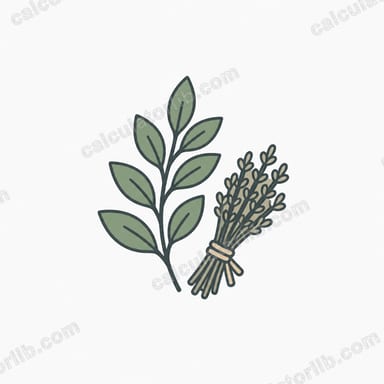
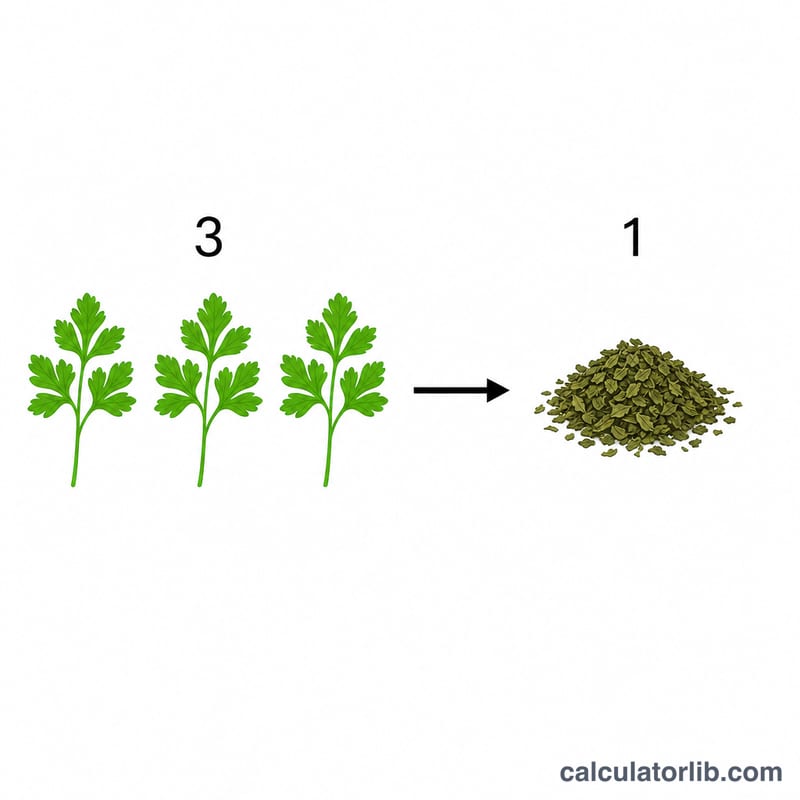
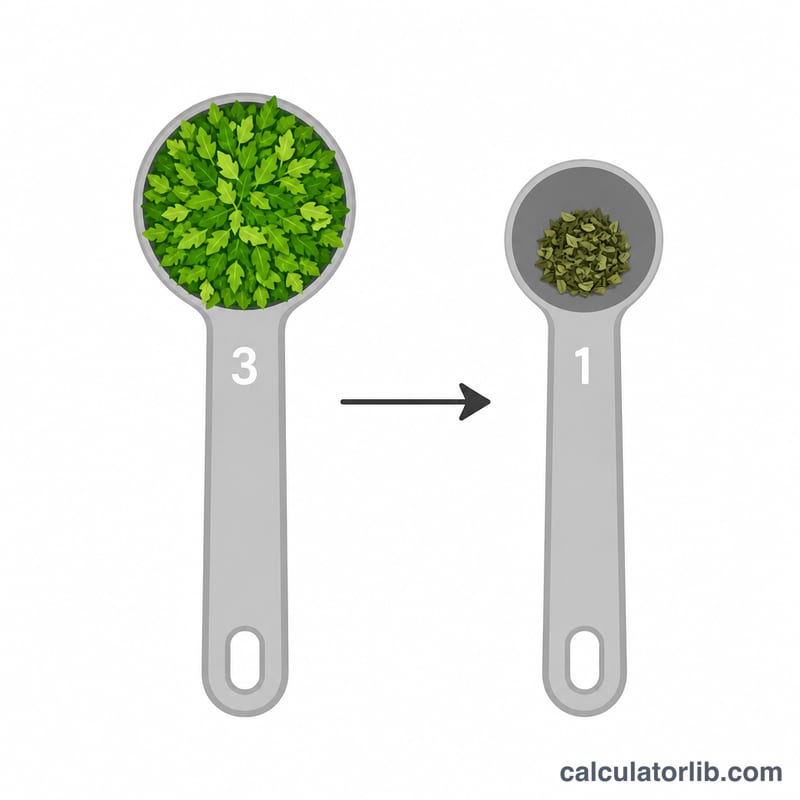
Recipes often list fresh herbs while your pantry only has the dried version (or vice versa). Because drying removes water and concentrates flavor, dried herbs are far more potent than the same volume of fresh. This calculator applies the widely used culinary rule of thumb — a 3:1 ratio — to tell you how much dried herb to use in place of fresh.
How to use it
Enter the amount of fresh herb your recipe calls for, choose a unit (tablespoons, teaspoons, cups, or grams), and read off the dried equivalent. The result tells you roughly how much dried herb to substitute so the seasoning strength stays the same.
The formula
The conversion is simply:
$$\text{Dried Amount} = \frac{\text{Fresh Amount}}{3}$$This reflects the common kitchen guideline that 1 part dried herb has about the same flavor intensity as 3 parts fresh herb. It works in either direction: to go from dried back to fresh, multiply by 3.
Worked example
Suppose a recipe asks for 3 tablespoons of fresh basil but you only have dried. Divide: \(3 \div 3 = 1\). So you would use about 1 tablespoon of dried basil. For 6 teaspoons of fresh thyme, \(6 \div 3 = 2\) teaspoons of dried thyme.
FAQ
Is the 3:1 ratio exact? No — it is a practical estimate. Some delicate herbs (parsley, chives) lose more flavor when dried, so you may want a little extra; robust herbs (oregano, rosemary) are very strong dried, so start with slightly less and taste.
Can I convert dried to fresh? Yes. Reverse the math by multiplying the dried amount by 3.
Does it work with weights? The ratio is volume-based, but it is a reasonable starting point for grams too. Always taste and adjust.