
What Is the Coffee Kick Calculator?
The Coffee Kick Calculator estimates how much caffeine is still circulating in your body a given number of hours after you drank it. It uses exponential decay based on caffeine's average elimination half-life of about 5.7 hours — meaning roughly half of any dose is cleared every 5.7 hours. This helps you understand whether that late-afternoon espresso might still be affecting your sleep.
How to Use It
Enter your initial caffeine dose in milligrams (a typical brewed coffee has 80–120 mg, an espresso shot about 63 mg, an energy drink 80–160 mg). Then enter how many hours have passed since you consumed it. The calculator returns the milligrams still in your system, how much has been eliminated, and the percentage remaining.
The Formula Explained
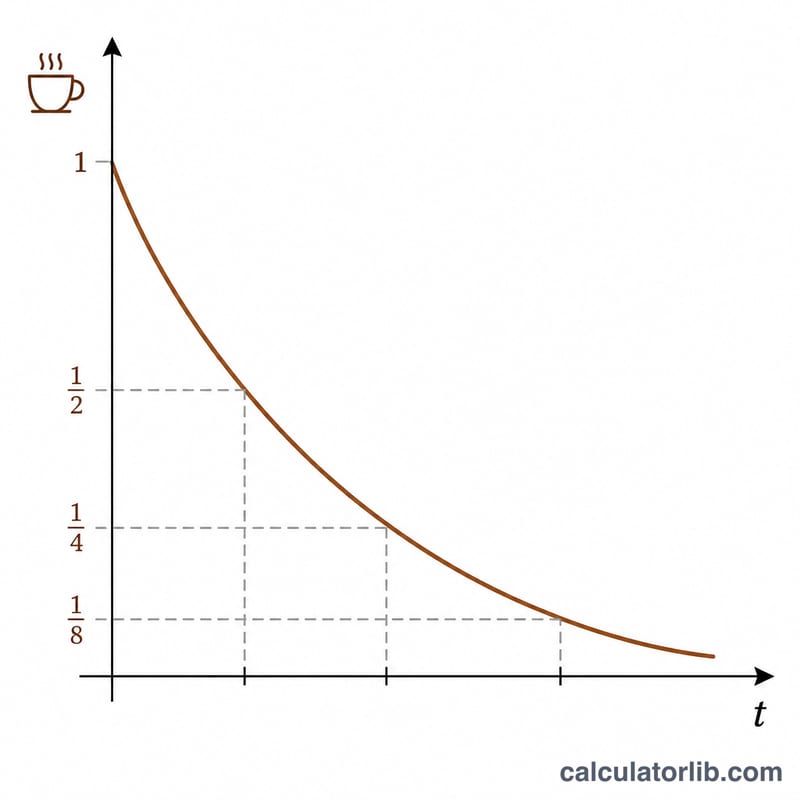
Caffeine follows first-order pharmacokinetics, so its concentration decays exponentially:
$$C = \text{Dose (mg)} \times \left(\frac{1}{2}\right)^{\frac{\text{Hours}}{5.7}}$$
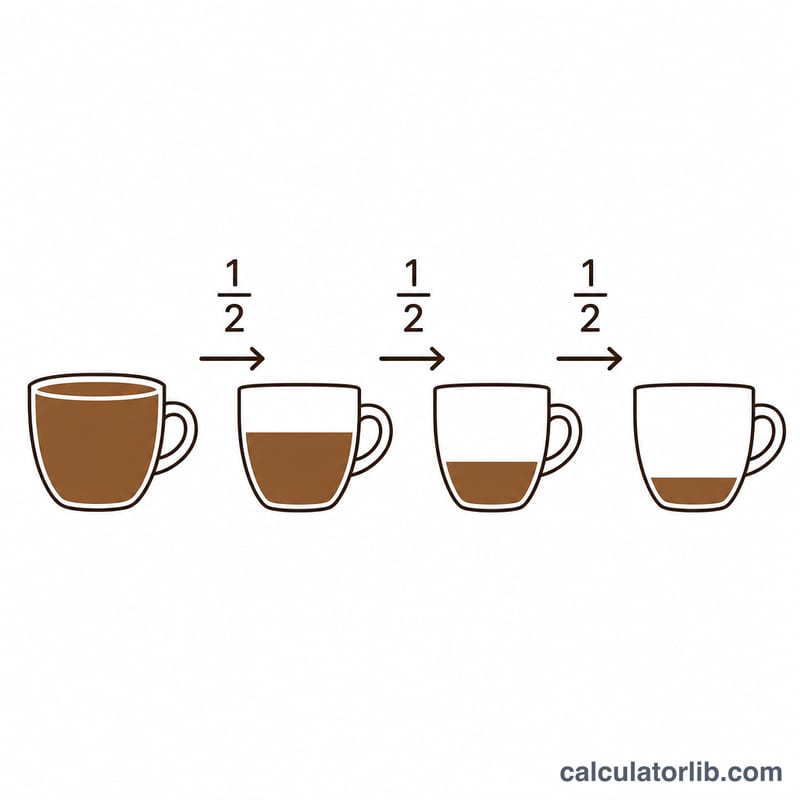
Here t is the elapsed time in hours and 5.7 is the assumed half-life. After one half-life (\(5.7\,\text{h}\)) half the caffeine remains; after two half-lives (\(11.4\,\text{h}\)) a quarter remains, and so on.
Worked Example
Suppose you drink a coffee with 200 mg of caffeine and check back 5.7 hours later. The exponent is \(5.7/5.7 = 1\), so $$\text{Remaining} = 200 \times \left(\frac{1}{2}\right)^{1} = 100\ \text{mg}$$ Half of the original dose is gone, and 50% remains.
FAQ
Is 5.7 hours always accurate? No — caffeine half-life varies widely (roughly 3–9 hours) depending on genetics, liver function, pregnancy, smoking, and medications. This tool uses 5.7 hours as a healthy-adult average.
How long until caffeine is basically gone? After about 5 half-lives (~28 hours) less than ~3% remains, which is generally considered negligible.
Does this replace medical advice? No. It is an educational estimate, not a clinical or diagnostic tool.