
What Is the Alcohol Dilution Calculator?
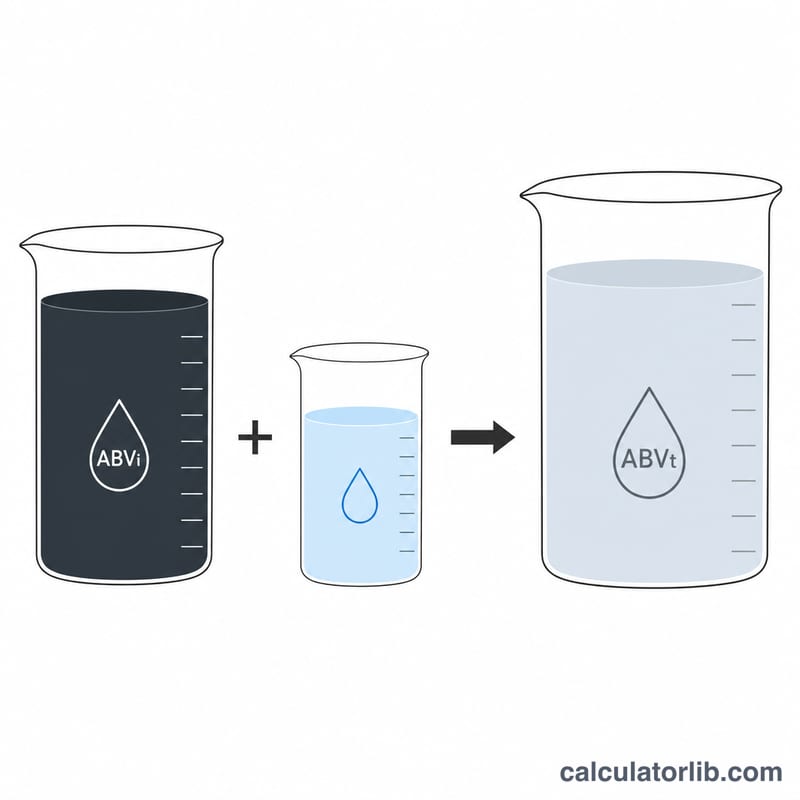
This tool tells you exactly how much water to add to a spirit or alcoholic liquid to lower it from its current strength to a desired target strength (ABV — alcohol by volume). It's commonly used by home distillers proofing down high-proof spirits, bartenders batching cocktails, and anyone cutting a strong liquor to a milder drinking strength. The math relies on the fact that the amount of pure alcohol stays constant — only water is added.
How to Use It
Enter three values: the initial volume of your alcohol (in millilitres), its current ABV percentage, and the target ABV you want to reach. The calculator returns the volume of water to add, the resulting final volume, and the amount of pure alcohol in the batch. Note that mixing alcohol and water causes a slight volume contraction, so real-world results may differ by 1–3% — measure final strength with a hydrometer for precision.
The Formula Explained
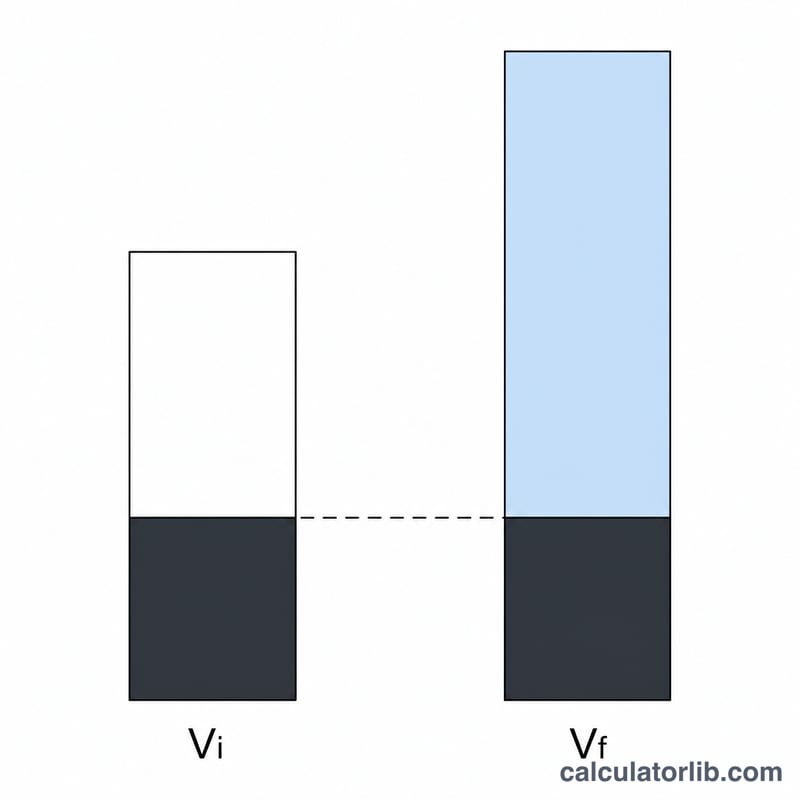
Because alcohol is conserved, \(V_i \times ABV_i = V_f \times ABV_t\). Solving for the added water \(W = V_f - V_i\) gives:
$$\text{Water to Add} = V_i \times \left(\frac{ABV_i}{ABV_t} - 1\right)$$
If the target ABV is equal to or higher than the initial ABV, no water can lower it, so the result is zero.
Worked Example
You have 750 mL of a 40% ABV vodka and want to dilute it to 20% ABV. $$\text{Water to add} = 750 \times \left(\frac{40}{20} - 1\right) = 750 \times (2 - 1) = 750 \text{ mL}$$ The final volume becomes 1,500 mL, and the pure alcohol content is \(750 \times \frac{40}{100} = 300\) mL throughout.
Common Spirit ABV Reference Values
Alcohol by volume (ABV) is the percentage of pure ethanol in a beverage by volume. In the United States, proof is exactly twice the ABV, so a 40% ABV spirit is 80 proof. The table below lists typical ABV values for common spirits and the strengths you might dilute toward.
| Spirit / Target | Typical ABV | US Proof (2 × ABV) |
|---|---|---|
| Neutral grain spirit | 95% | 190 proof |
| Cask-strength whiskey | 55–65% | 110–130 proof |
| Standard whiskey, vodka, rum, gin | 40% | 80 proof |
| EU minimum spirit strength | 37.5% | 75 proof |
| Bottled-strength liqueurs | 15–30% | 30–60 proof |
| Lower drinking-strength target | 20% | 40 proof |
To convert a given ABV to US proof, simply double it — for example, 40% ABV equals 80 proof. The dilution formula assumes ideal mixing; in practice ethanol and water contract slightly when combined, so real-world final volume is marginally less than the simple sum.
FAQ
Why is my real strength slightly off? Alcohol and water contract when mixed, so true final volume is a touch less than the simple sum — always confirm with a hydrometer.
Can I use ounces instead of mL? Yes — the ratio is unit-independent, so the "water to add" will come out in whatever volume unit you entered.
What if target ABV is higher than initial? You cannot raise ABV by adding water; the calculator returns zero water to add.