
What Is ABV and Proof?
Alcohol by Volume (ABV) is the standard worldwide measure of how much pure alcohol is in a beverage, expressed as a percentage of total volume. "Proof" is an older measure of alcohol content still widely used in the United States, especially on spirits labels. This calculator uses the US definition, where proof is exactly double the ABV. (Note: the historical UK proof system was different, with 100 UK proof equal to about 57.1% ABV, so this tool applies to US proof.)
How to Use This Calculator
Enter the ABV percentage shown on your bottle or recipe and the calculator instantly returns the equivalent US proof. For example, a typical vodka at 40% ABV is 80 proof. Simply type the percentage value (without the % sign) and read the result.
The Formula Explained
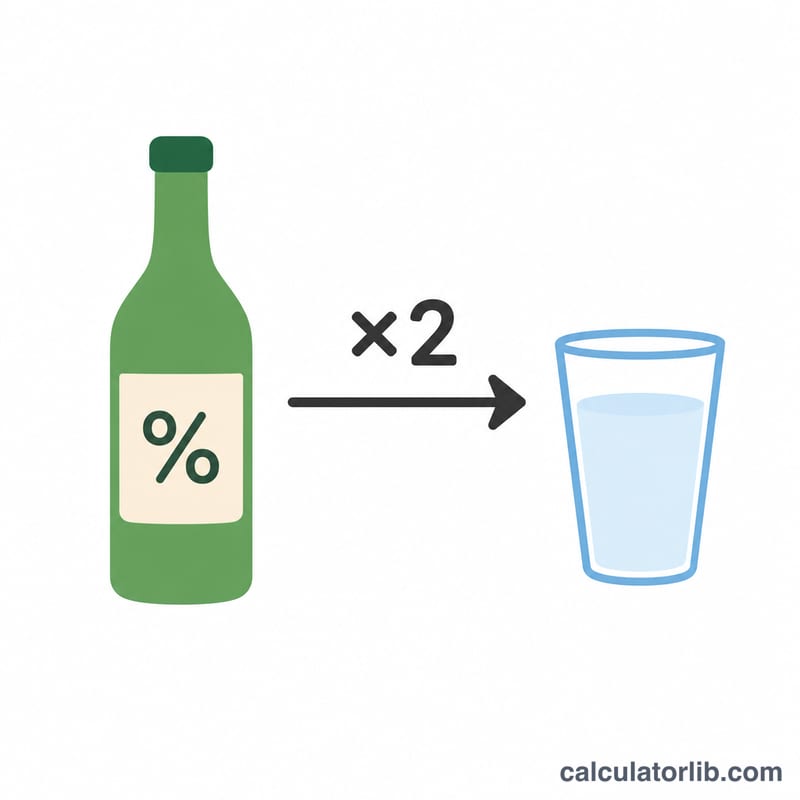
The conversion is wonderfully simple. In the US system:
$$\text{Proof} = \text{ABV} \times 2$$
So if a whiskey is 45% ABV, multiply 45 by 2 to get 90 proof. To reverse the calculation, divide the proof by 2 to recover the ABV.
Worked Example
Suppose you have a bottle of overproof rum labeled 57.5% ABV. Multiply 57.5 by 2 to get 115. The rum is therefore 115 proof. This high figure is why such rums are flammable and often used for cocktails like the Mai Tai.
$$\text{Proof} = 57.5 \times 2 = 115$$
Common ABV to US Proof Values
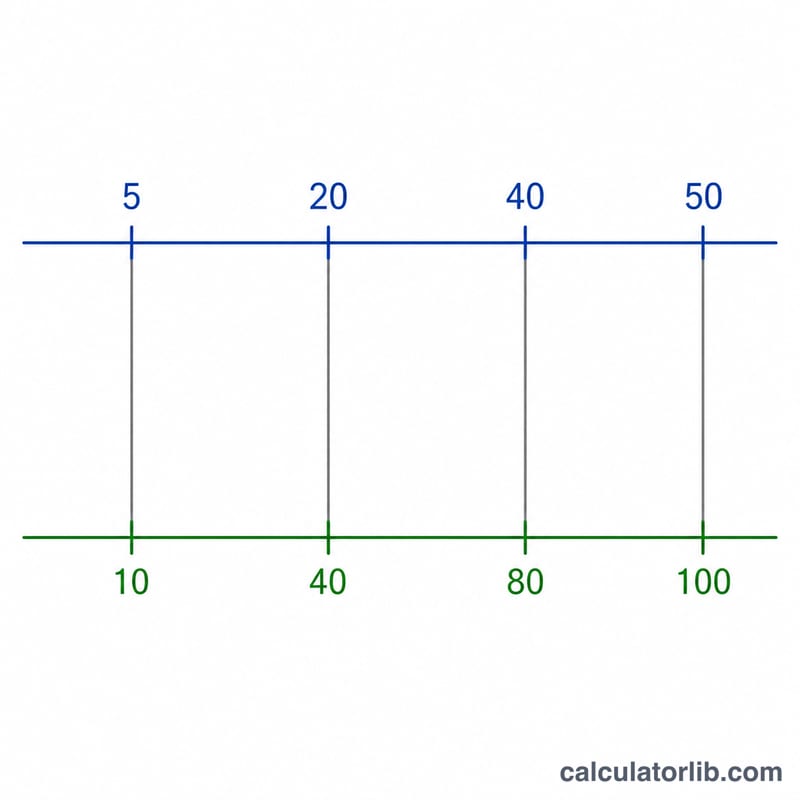
In the United States, proof is defined as exactly twice the alcohol by volume (ABV) percentage: \(\text{Proof} = 2 \times \text{ABV}\). So a spirit at 40% ABV is 80 proof. The table below lists typical beverages, their approximate ABV, and the corresponding US proof.
| Beverage | ABV (%) | US Proof |
|---|---|---|
| Light beer | 4 | 8 |
| Table wine | 12 | 24 |
| Fortified wine (port, sherry) | 18 | 36 |
| Liqueur | 20–30 | 40–60 |
| Vodka, whiskey, gin, rum | 40 | 80 |
| Bottled-in-bond spirit | 50 | 100 |
| Overproof rum | 57.5 | 115 |
| Pure ethanol | 100 | 200 |
To go the other direction, simply divide proof by 2 to recover ABV (for example, 80 proof ÷ 2 = 40% ABV).
US Proof vs UK (Historical) Proof
The United States and the United Kingdom historically used different proof scales. The US system is simple: \(\text{US Proof} = 2 \times \text{ABV}\). The older British system defined 100° proof as a spirit containing about 57.15% ABV, so UK proof is approximated by \(\text{UK Proof} \approx \dfrac{\text{ABV}}{0.571}\). The UK abolished its proof system in 1980 in favour of plain ABV, but the figures still appear on vintage labels.
| ABV (%) | US Proof (ABV × 2) | UK Proof (ABV ÷ 0.571) |
|---|---|---|
| 40 | 80 | 70.1 |
| 50 | 100 | 87.6 |
| 57.1 | 114.2 | 100.0 |
| 75 | 150 | 131.3 |
| 100 | 200 | 175.1 |
Notice that at roughly 57.1% ABV the UK scale reads 100° proof while the US scale reads about 114 proof — this is why the same bottle can show very different proof numbers depending on the country of origin.
Frequently Asked Questions
Is proof the same in every country? No. The US uses \(\text{proof} = 2 \times \text{ABV}\). The historical UK system used a different ratio (100 UK proof ≈ 57.1% ABV), and most of the world now uses ABV alone. This tool gives US proof.
What is 100 proof in ABV? 100 US proof equals 50% ABV.
Can ABV be over 100%? No. ABV maxes out at 100% (pure ethanol), which equals 200 US proof.