
What this calculator does
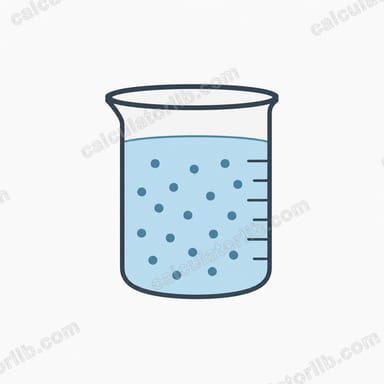
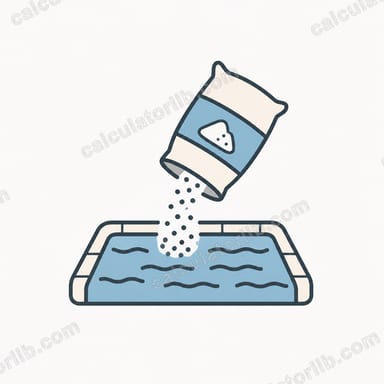
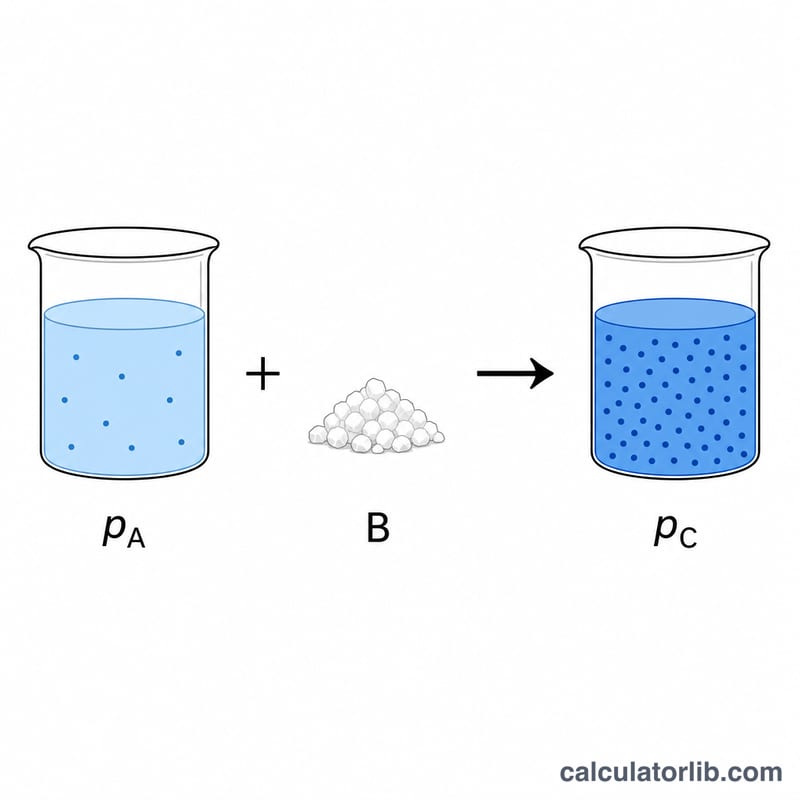
This tool solves the classic "concentration word problem" (in Japanese elementary math, nodozan): you have an existing salt-water solution and want to make it stronger by stirring in more pure salt. Given the starting solution's mass and its mass-percent salt concentration, plus the concentration you want to reach, it tells you exactly how many grams of pure salt to add — and reports the final solution's total mass and salt content. The chemistry (mass-percent of a solute in solution) is universal, so the result is valid anywhere; only the labels are translated from Japanese.
How to use it
Enter the mass of solution A in grams, its current concentration as a percentage, and the target concentration you want the final solution C to have. The target must be higher than the starting concentration (you can only raise it by adding salt) and below 100%. Press calculate to see the salt to add.
The formula explained
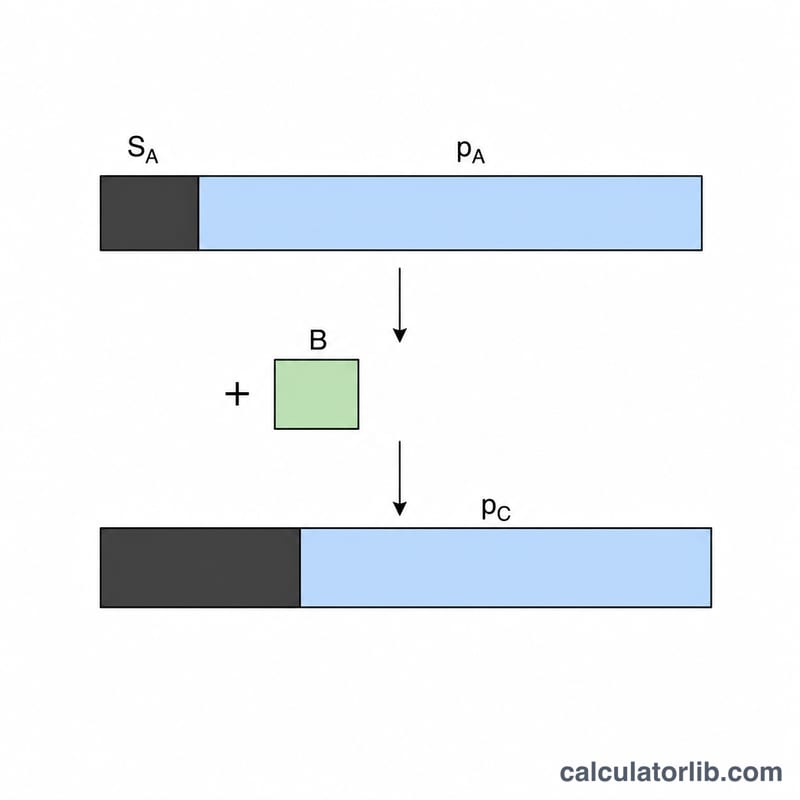
The salt already in A is \(S_A = A \times \frac{p_A}{100}\). The final mix must satisfy \(\frac{S_A + B}{A + B} = \frac{p_C}{100}\). Solving for the added salt B gives
$$B = S_A \times \frac{\frac{p_C}{p_A} - 1}{1 - \frac{p_C}{100}}$$The final mass is \(A + B\) and the final salt is \(S_A + B\).
Worked example
Start with 200 g of 10% salt water and target 20%. Salt in A = \(200 \times 0.10 = 20\) g. Salt to add =
$$20 \times \frac{\frac{20}{10} - 1}{1 - 0.20} = 20 \times \frac{1}{0.8} = 25 \text{ g}$$Final mass = \(200 + 25 = 225\) g; final salt = \(20 + 25 = 45\) g. Check: \(\frac{45}{225} = 0.20 = 20\%\).
FAQ
Why must the target be higher than the current concentration? Adding pure salt can only increase concentration; to lower it you would add water instead, which this tool does not do.
Why can't I reach 100%? A finite solution can approach but never reach 100% salt by adding salt — the formula divides by \((1 - \frac{p_C}{100})\), which is zero at 100%, giving an infinite answer.
What if the starting concentration is 0%? Pure water has no salt, so the ratio \(\frac{p_C}{p_A}\) is undefined; the tool guards against this case.