What is the triangle scale factor?
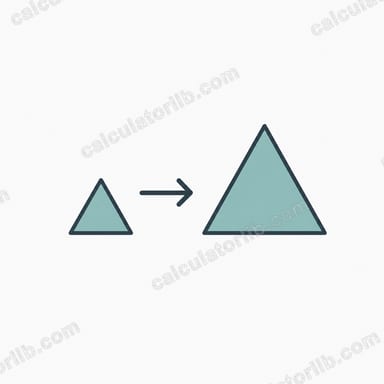
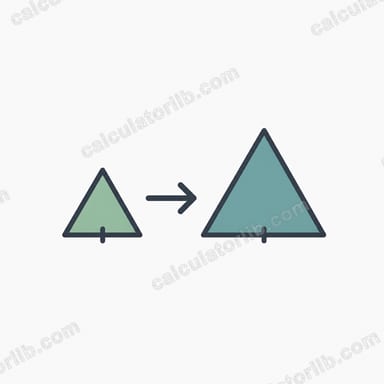
When two triangles are similar, they have the same shape but different sizes. The scale factor (\(k\)) is the constant ratio between every pair of corresponding sides. If you know one matching pair of sides, you know the scale factor for the entire figure — and you can find any missing side.

How to use this calculator
Enter a side of the first triangle and its corresponding side on the second triangle. The calculator divides the second by the first to get \(k\). Optionally enter another side from Triangle 1 to instantly see its scaled length on Triangle 2. The tool also reports the area scale factor, which is \(k^{2}\).
The formula explained
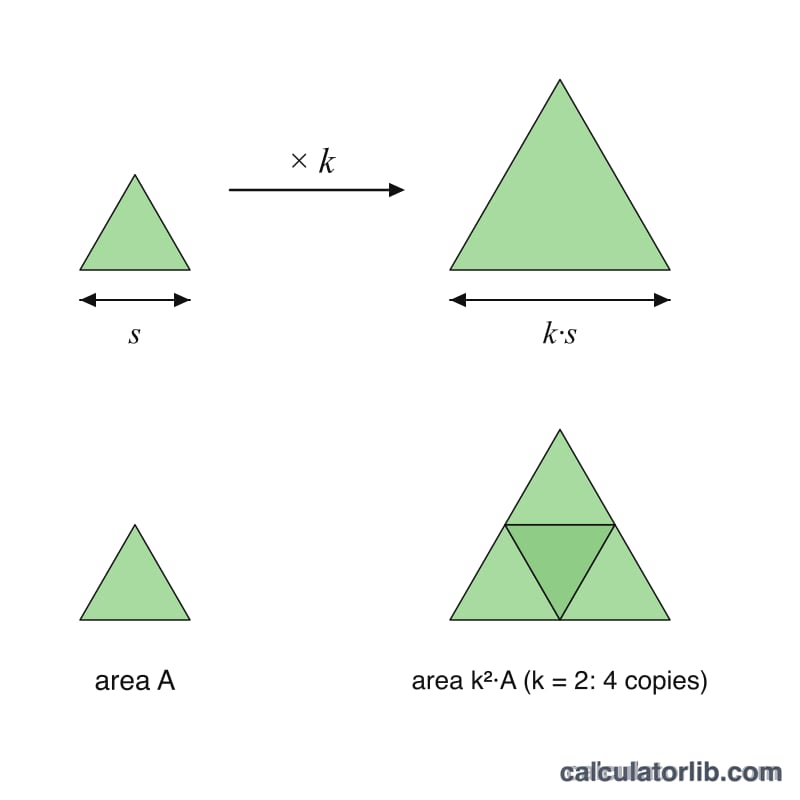
The core relationship is $$k = \frac{\text{Side (Triangle 2)}}{\text{Side (Triangle 1)}}$$ A factor greater than 1 means an enlargement; between 0 and 1 means a reduction. Because area grows with the square of length, areas of similar triangles relate by \(k^{2}\), while perimeters relate by \(k\) itself.
Worked example
Suppose a triangle has a 4 cm side that corresponds to a 6 cm side on a larger similar triangle. Then $$k = 6 \div 4 = \textbf{1.5}$$ Another side measuring 5 cm on the small triangle becomes $$5 \times 1.5 = \textbf{7.5 cm}$$ and the larger triangle's area is \(1.5^{2} = \mathbf{2.25}\) times bigger.
How Scale Factor Changes Lengths, Perimeter and Area
For two similar triangles with scale factor \(k\) (Triangle 1 to Triangle 2), every length, including each side, the perimeter, the heights and the medians, is multiplied by \(k\). The area is multiplied by \(k^2\). The table uses a sample side of 4 cm and a base triangle with an area of 6 cm².
| Scale factor k | Length / perimeter ratio (k) | Area ratio (k²) | Effect | 4 cm side becomes | 6 cm² area becomes |
|---|---|---|---|---|---|
| 0.5 | 0.5 | 0.25 | Reduction | 2 cm | 1.5 cm² |
| 1 | 1 | 1 | Congruent (same size) | 4 cm | 6 cm² |
| 1.5 | 1.5 | 2.25 | Enlargement | 6 cm | 13.5 cm² |
| 2 | 2 | 4 | Enlargement | 8 cm | 24 cm² |
| 3 | 3 | 9 | Enlargement | 12 cm | 54 cm² |
| 10 | 10 | 100 | Enlargement | 40 cm | 600 cm² |
Calculations: \(4 \times 1.5 = 6\) and \(6 \times 1.5^2 = 6 \times 2.25 = 13.5\). Doubling the sides (\(k=2\)) quadruples the area, and tripling them (\(k=3\)) multiplies it by 9.
Interpreting Your Scale Factor
- k > 1: Triangle 2 is an enlargement of Triangle 1. Every side is longer by the factor k.
- 0 < k < 1: Triangle 2 is a reduction of Triangle 1. Every side is shorter.
- k = 1: the triangles are congruent, with the same size and shape.
Inverse relationship: the scale factor from Triangle 2 back to Triangle 1 is \(1/k\). For example, if the sides grow by \(k = 2\) going from Triangle 1 to Triangle 2, they shrink by \(1/2 = 0.5\) going the other way. The area factors are \(k^2\) and \(1/k^2\) respectively.
Worked example: a side of 4 cm in Triangle 1 corresponds to a side of 6 cm in Triangle 2. Then \(k = \dfrac{6}{4} = \) 1.5. A 10 cm side in Triangle 1 becomes \(10 \times 1.5 = 15\) cm, and the area is multiplied by \(1.5^2 = 2.25\).
Checking that the triangles are similar (the scale factor is only meaningful if they are):
- AA (angle-angle): two pairs of corresponding angles are equal. The third pair must then be equal too.
- SAS (side-angle-side): two pairs of sides are in the same ratio, and the included angles between those sides are equal.
- SSS (side-side-side): all three pairs of sides have the same ratio, \(\dfrac{a_2}{a_1} = \dfrac{b_2}{b_1} = \dfrac{c_2}{c_1} = k\).
Use corresponding sides. Corresponding sides lie opposite equal angles. When the triangles are in the same orientation, that means shortest to shortest and longest to longest. Pairing the wrong sides gives an incorrect k.
FAQ
Which side do I divide by which? Put the original (reference) triangle's side as side₁ and the target triangle's matching side as side₂. \(k > 1\) enlarges, \(k < 1\) shrinks.
Does the scale factor apply to angles? No. Similar triangles keep identical angles regardless of size; only lengths scale.
How do areas scale? Multiply the original area by \(k^{2}\). If sides triple (\(k = 3\)), area becomes 9 times larger.