
What this calculator does
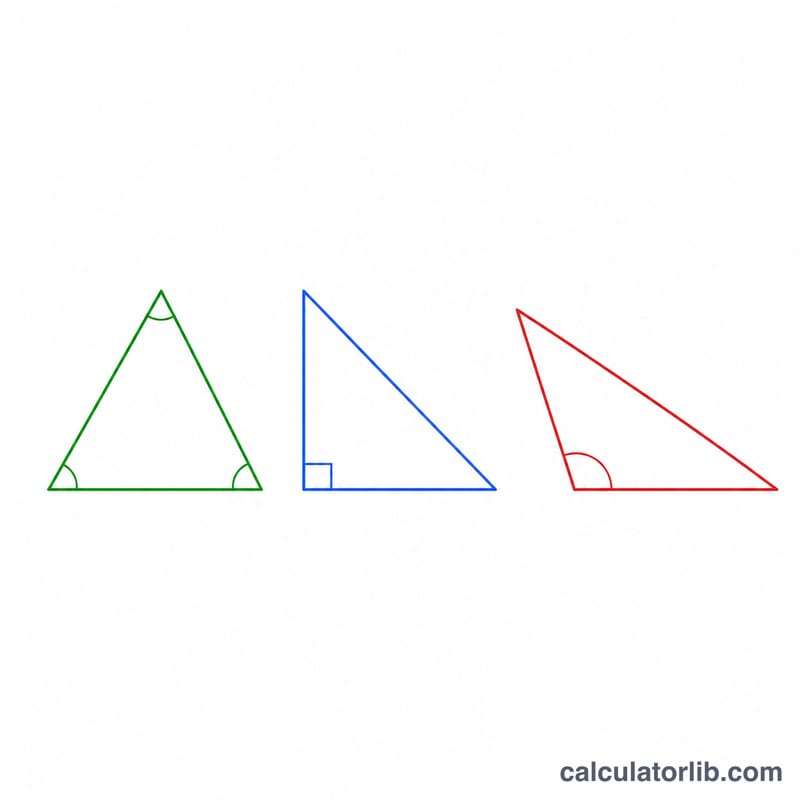
The Triangle Classification Calculator tells you whether a triangle is acute, right, or obtuse using only the three side lengths. It is based on the converse of the Pythagorean theorem, so you do not need to know any angles — just measure or read off the three sides.
How to use it
Enter the three side lengths (a, b, c) in any order and in any consistent unit. The calculator automatically identifies the longest side, checks that the three lengths actually form a valid triangle, and then classifies the largest angle. Order does not matter — the tool sorts the sides internally.
The formula explained
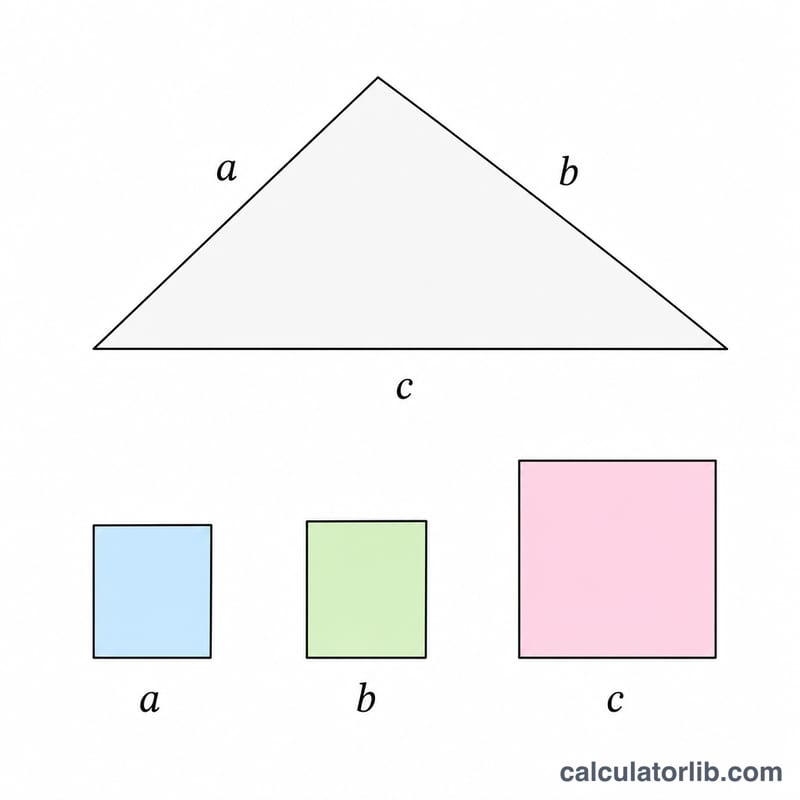
Label the longest side c and the other two a and b. The largest angle always sits opposite the longest side. Compare the square of the longest side to the sum of the squares of the other two:
$$\text{Compare } c_{\max}^2 \text{ vs } a^2+b^2: \quad \begin{cases} c_{\max}^2 = a^2+b^2 & \text{Right} \\ c_{\max}^2 < a^2+b^2 & \text{Acute} \\ c_{\max}^2 > a^2+b^2 & \text{Obtuse} \end{cases}$$
If \(c^2 < a^2 + b^2\) the largest angle is below 90°, so the triangle is acute. If \(c^2 = a^2 + b^2\) the largest angle is exactly 90° — a right triangle (Pythagoras). If \(c^2 > a^2 + b^2\) the largest angle exceeds 90°, making it obtuse.
The sides must also satisfy the triangle inequality: the two shorter sides must add up to more than the longest, otherwise no triangle exists.
Worked example
Take sides 3, 4 and 5. The longest is 5, so \(c^2 = 25\) and \(a^2 + b^2 = 9 + 16 = 25\). Since \(25 = 25\), this is a classic right triangle. Change the longest side to 6: now \(c^2 = 36 > 25\), so the triangle becomes obtuse.
FAQ
Does the order of the sides matter? No. The calculator finds the longest side automatically, so you can enter them in any order.
What if the sides cannot form a triangle? If any side is zero or negative, or if the two shorter sides do not sum to more than the longest, the result is flagged as invalid.
Can an equilateral or isosceles triangle be right or obtuse? An equilateral triangle is always acute (all 60° angles). Isosceles triangles can be acute, right, or obtuse depending on the side lengths.