
What is the Pythagoras Triangle Calculator?
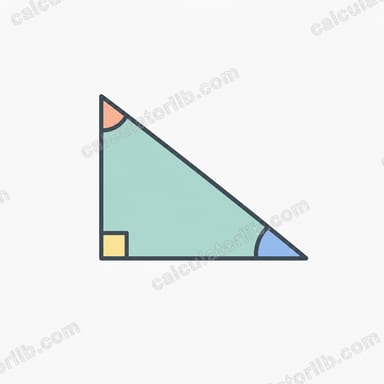
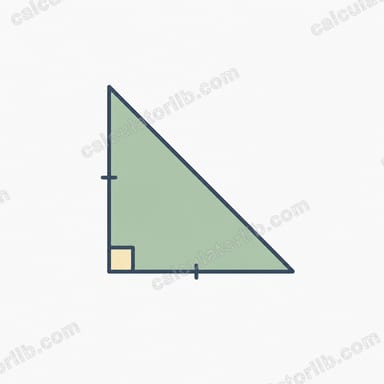
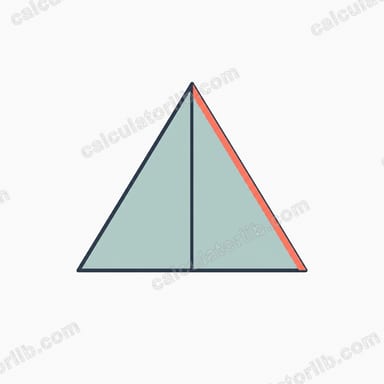
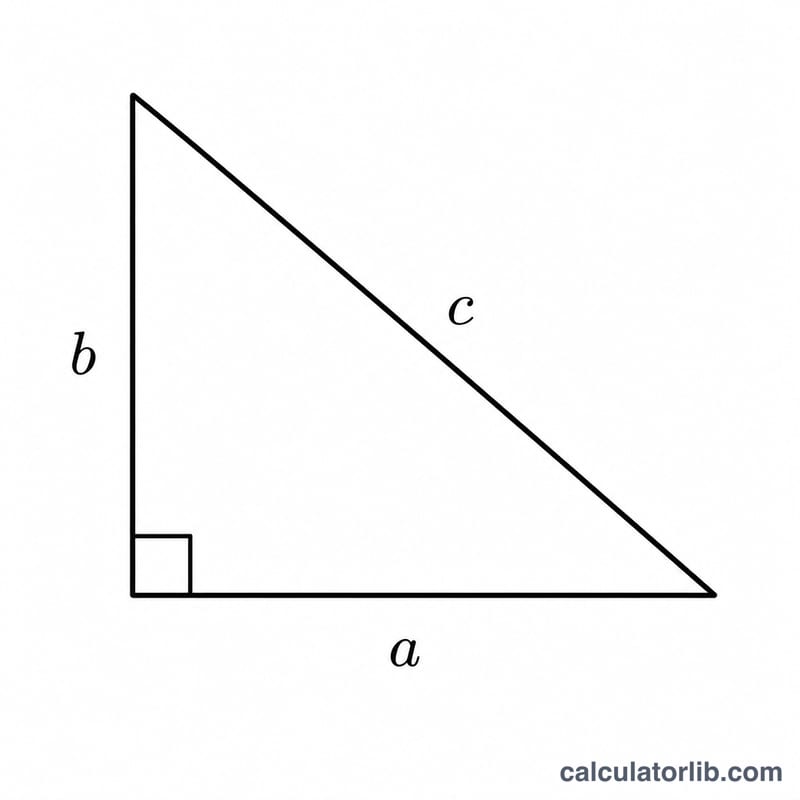
This calculator applies the Pythagorean theorem to a right-angled triangle. Given the lengths of the two shorter sides (the legs, a and b), it instantly computes the hypotenuse c — the side opposite the right angle. It also reports the triangle's area and perimeter. The tool is universal: it works for any unit (cm, m, inches) as long as both sides use the same unit.
How to use it
Enter the length of side a and side b, then read the result. The two inputs are the legs adjacent to the 90° corner. The output hypotenuse is always the longest side of the triangle.
The formula explained
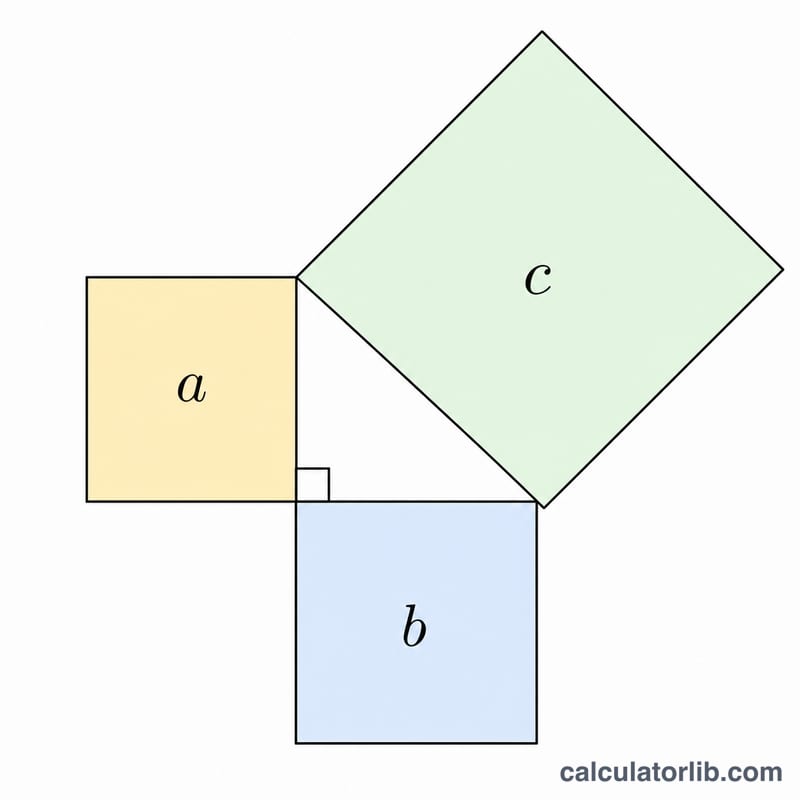
The Pythagorean theorem states that in a right triangle, the square of the hypotenuse equals the sum of the squares of the other two sides: \(a^2 + b^2 = c^2\). Solving for the hypotenuse gives \(c = \sqrt{a^2 + b^2}\). The area uses \(A = \tfrac{1}{2} \cdot a \cdot b\) because the two legs are perpendicular, and the perimeter is simply \(a + b + c\).
Worked example
For a triangle with legs a = 3 and b = 4:
$$c = \sqrt{3^2 + 4^2} = \sqrt{9 + 16} = \sqrt{25} = 5$$This is the classic 3-4-5 right triangle. Its area is \(\tfrac{1}{2} \times 3 \times 4 = 6\) and its perimeter is \(3 + 4 + 5 = 12\).
FAQ
Which sides do I enter? Enter the two legs that meet at the right angle. The calculator finds the hypotenuse for you.
Does it work in feet or inches? Yes — any unit works, just keep both inputs in the same unit. The result will be in that same unit.
What if I know the hypotenuse and one leg? This tool solves for the hypotenuse. To find a missing leg instead, use the rearranged formula \(a = \sqrt{c^2 - b^2}\).