What Is the Quarter Circle Perimeter Calculator?
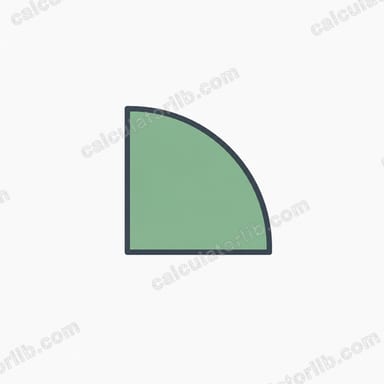
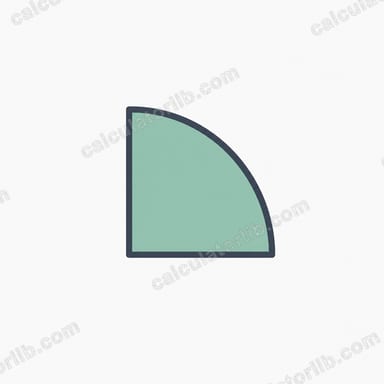
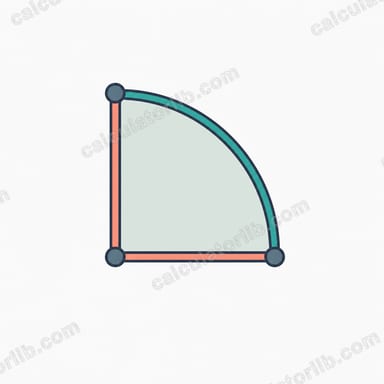
A quarter circle is one-fourth of a full circle — a pie-slice shape bounded by two straight radii and one curved arc. This calculator finds the total distance around that shape (its perimeter) from a single input: the radius. It is a universal geometry tool that works in any unit system, as long as you stay consistent.
How to Use It
Enter the radius r of the quarter circle and press calculate. The tool returns the full perimeter along with a breakdown of the curved arc length and the combined length of the two straight radii, so you can see exactly how the total is composed.
The Formula Explained
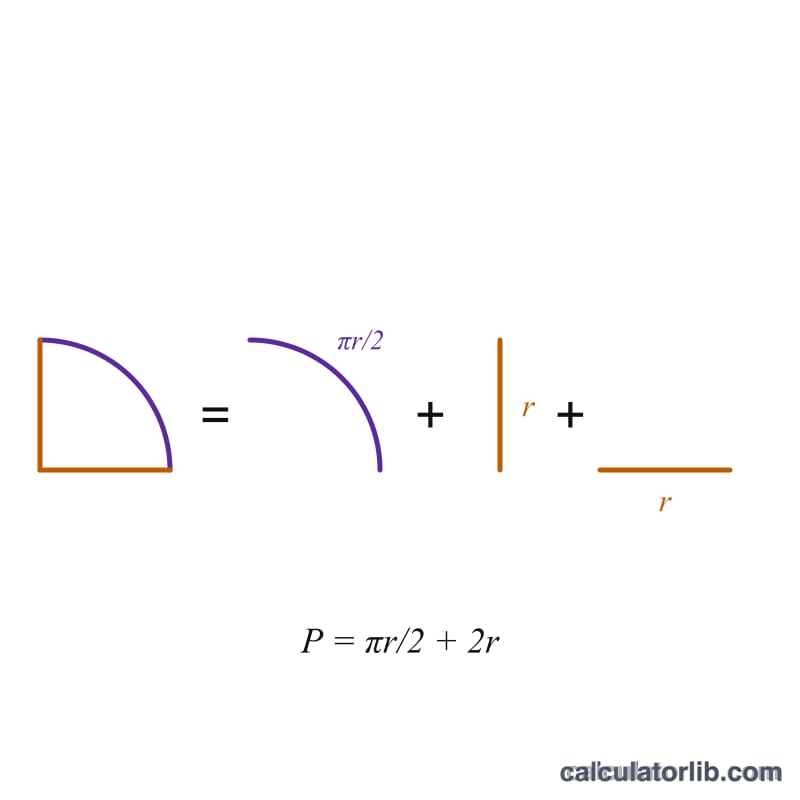
The perimeter of a quarter circle has two parts. The curved edge is a quarter of the full circumference: \(2\pi r \div 4 = \pi r/2\). The two straight edges are each equal to the radius, contributing \(2r\). Adding them gives:
$$P = \frac{\pi r}{2} + 2r$$

Worked Example
Suppose the radius is 10. The arc length is \(\pi \times 10 \div 2 \approx 15.71\). The two straight radii add \(2 \times 10 = 20\). The perimeter is therefore \(15.71 + 20 \approx 35.71\) units. Notice the straight portion is larger here because a quarter arc is relatively short.
Constants Used in the Calculation
The quarter circle perimeter combines a curved arc with two straight radii. Only a few constants are needed, and all of them follow from π.
| Constant | Approximate value | Role in the formula |
|---|---|---|
| π | ≈ 3.14159265 | Ratio of a circle's circumference to its diameter |
| π/2 | ≈ 1.5708 | Arc length per unit of radius for a 90° arc |
| 2 | exactly 2 | Two straight edges, each equal to the radius |
| π/2 + 2 | ≈ 3.5708 | Combined factor: perimeter = 3.5708 × radius |
Why the arc is one quarter of the circumference
A full circle has circumference \(C = 2\pi r\). A quarter circle covers 90° out of 360°, so its arc is \(\frac{1}{4}\) of that circumference:
$$\text{Arc} = \frac{1}{4} \cdot 2\pi r = \frac{\pi r}{2}$$
Adding the two straight edges (each of length \(r\)) gives the full perimeter:
$$P = \frac{\pi r}{2} + 2r = r\left(\frac{\pi}{2} + 2\right) \approx 3.5708\,r$$
Effect of rounding π
Using π ≈ 3.14 instead of 3.14159265 slightly changes the result. With 3.14, the factor π/2 becomes 1.57 and the combined factor becomes 3.57, versus 3.5708 with the more precise value. For a radius of 10, the perimeter is about 35.708 with the precise π and 35.70 with 3.14, a difference of roughly 0.008. The gap grows in proportion to the radius, so it matters only for large or high-precision work.
FAQ
Does the perimeter include the two straight edges? Yes. The perimeter of a quarter circle is the closed boundary, so it includes both radii plus the arc — not just the curved part.
What if I only want the arc length? Use the breakdown row labelled "Arc length"; it shows \(\pi r/2\) by itself.
What units does it use? Any consistent unit. If you enter the radius in centimeters, the perimeter is in centimeters; for inches, the result is in inches.