
What it does
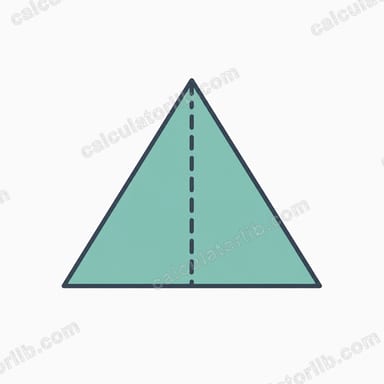
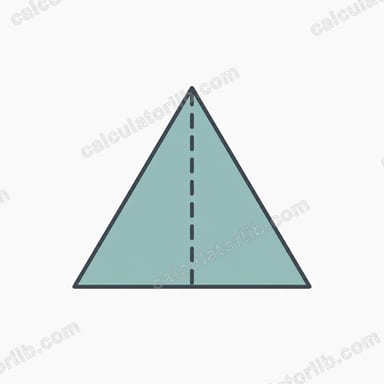
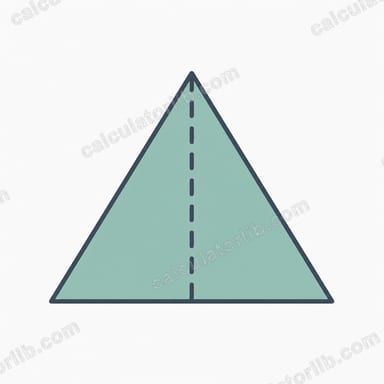
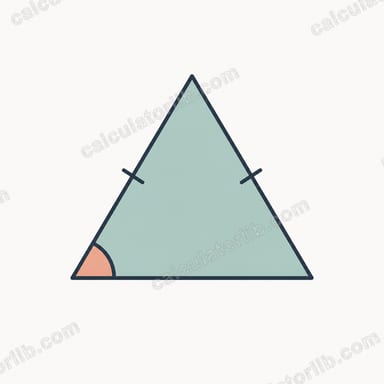
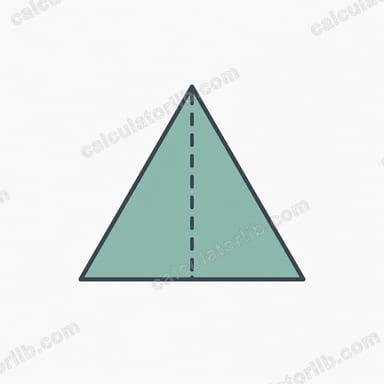
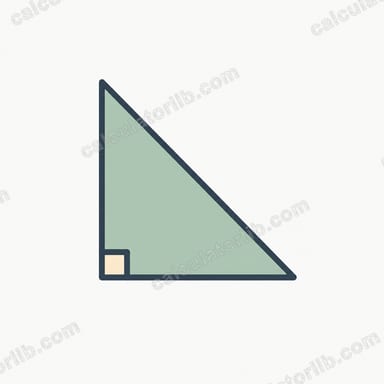
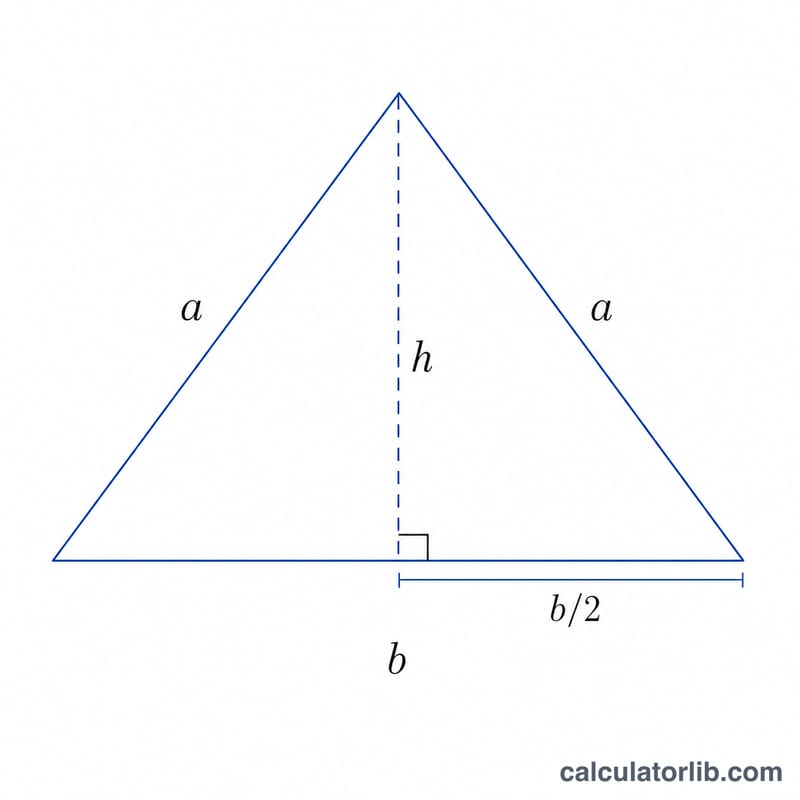
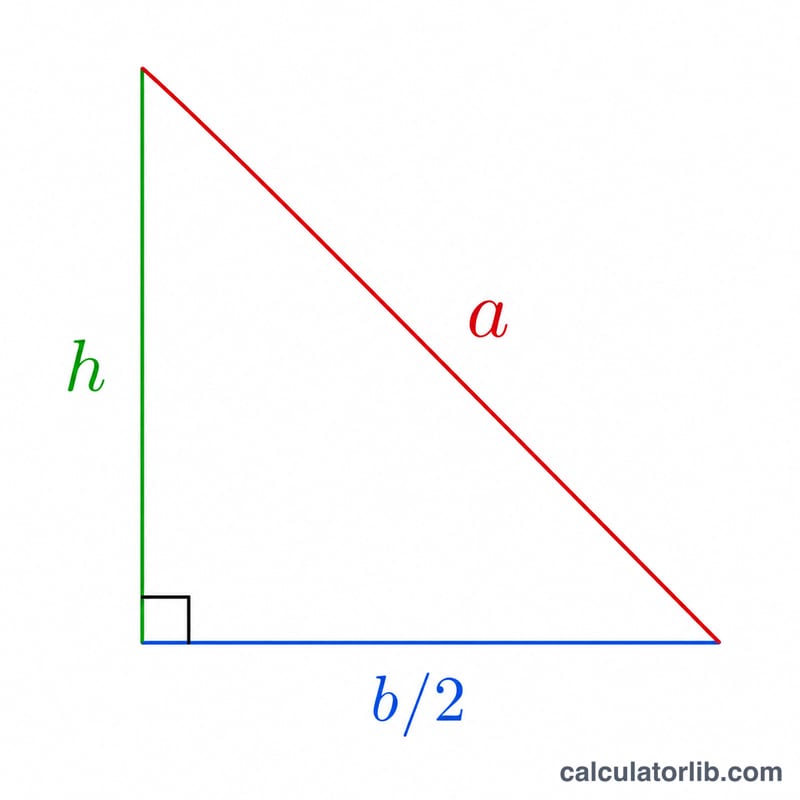
This calculator finds the length of the two equal legs (a) of an isosceles triangle when you know its base (b) and its vertical height (h). An isosceles triangle has two sides of equal length; the height drawn from the apex to the base splits the base into two equal halves, forming two right triangles. Each leg is the hypotenuse of one of those right triangles.
How to use it
Enter the base length and the height in the same units (cm, m, inches — anything, as long as they match). The calculator returns the leg length, plus the perimeter and area as a bonus. All outputs share the unit you used for input (area is in square units).
The formula explained
Because the height bisects the base, each right triangle has legs of h and b/2. By the Pythagorean theorem, the equal side is $$a = \sqrt{h^{2} + \left(\frac{b}{2}\right)^{2}}$$ The perimeter is then \(P = b + 2a\), and the area of the whole triangle is \(A = \tfrac{1}{2} \times b \times h\).
Worked example
Suppose the base b = 6 and the height h = 4. Half the base is 3, so $$a = \sqrt{4^{2} + 3^{2}} = \sqrt{16 + 9} = \sqrt{25} = 5$$ The perimeter is \(6 + 2\times5 = 16\), and the area is \(\tfrac{1}{2} \times 6 \times 4 = 12\).
FAQ
Is the height the same as a side? No. The height is the perpendicular distance from the apex to the base, not one of the triangle's sides.
What units does the result use? The same units you entered. If base and height are in cm, the leg is in cm and area is in cm².
Can I use this for an equilateral triangle? Yes — an equilateral triangle is a special isosceles triangle, but you must supply its correct height (\(h = b\sqrt{3}/2\)).