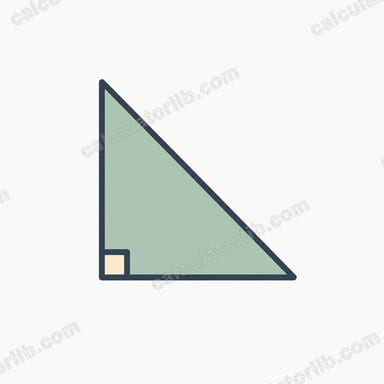
What Is an Isosceles Right Triangle?
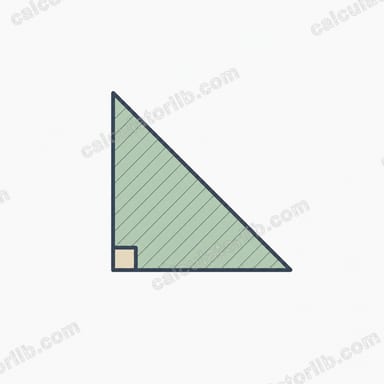
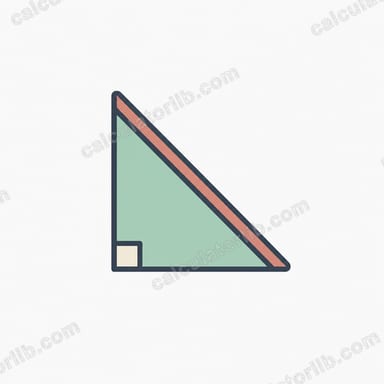
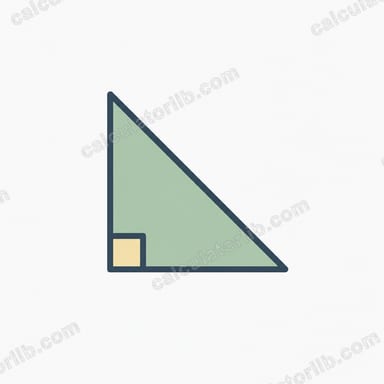
An isosceles right triangle is a triangle that has one 90° angle and two equal legs. Because the two legs are the same length, the other two angles are both 45°, which is why it is often called a 45-45-90 triangle. It is one of the most useful special triangles in geometry, trigonometry, and construction.

How to Use This Calculator
Simply enter the length of one leg (a) — the two legs are equal, so a single value defines the whole triangle. The calculator instantly returns the hypotenuse, the area, and the perimeter. Use any consistent unit (cm, m, inches); the outputs will be in the same linear unit, and the area will be in that unit squared.
The Formulas Explained
For a leg length a:
Hypotenuse: Using the Pythagorean theorem, \(c^2 = a^2 + a^2 = 2a^2\), so $$c = a\sqrt{2}.$$
Area: The legs serve as base and height, so $$A = \tfrac{1}{2} \times a \times a = \frac{a^2}{2}.$$
Perimeter: Add all three sides: $$P = a + a + a\sqrt{2} = 2a + a\sqrt{2}.$$

Worked Example
Suppose \(a = 5\). The hypotenuse is $$5 \times \sqrt{2} \approx 7.0711.$$ The area is $$5^2 \div 2 = 12.5.$$ The perimeter is $$(2 \times 5) + 7.0711 = 17.0711.$$ So a triangle with 5-unit legs has a hypotenuse of about 7.07 units, an area of 12.5 square units, and a perimeter of about 17.07 units.
Comparing Results When the Leg Length Changes
For an isosceles right triangle with equal legs \(a\), the hypotenuse is \(c = a\sqrt{2}\), the area is \(A = \frac{a^{2}}{2}\) and the perimeter is \(P = 2a + a\sqrt{2}\). The table compares a base leg of 4 with legs of twice and three times that length (all lengths in the same unit; areas in that unit squared). Values are rounded to three decimals where needed.
| Scenario | Leg a | Hypotenuse c = a√2 | Area A = a²/2 | Perimeter P = a(2 + √2) | |
|---|---|---|---|---|---|
| a | 4 | 5.657 | 8 | 13.657 | |
| 2a | 8 | 11.314 | 32 | 27.314 | |
| 3a | 12 | 16.971 | 72 | 40.971 |
How the values scale
- Hypotenuse (linear): doubling the leg doubles the hypotenuse (5.657 → 11.314), and tripling it triples it (→ 16.971), because \(c\) is proportional to \(a\).
- Perimeter (linear): \(P = a(2+\sqrt{2})\) is also proportional to \(a\), so it grows ×2 and ×3 (13.657 → 27.314 → 40.971).
- Area (quadratic): with leg \(ka\), the area is \(\frac{(ka)^{2}}{2} = k^{2}\cdot\frac{a^{2}}{2}\). For \(k=2\) the area is ×4 (8 → 32), and for \(k=3\) it is ×9 (8 → 72).
Check: for \(a = 8\), \(A = \frac{8^{2}}{2} = \frac{64}{2} = 32\); for \(a = 12\), \(A = \frac{12^{2}}{2} = \frac{144}{2} = 72\).
FAQ
What angles does it have? One right angle (90°) and two equal angles of 45° each.
Why is the hypotenuse a√2? Because both legs are equal, the Pythagorean theorem simplifies to \(c = \sqrt{2a^2} = a\sqrt{2}\).
Can I find the leg from the hypotenuse? Yes — divide the hypotenuse by \(\sqrt{2}\) (or multiply by \(\tfrac{\sqrt{2}}{2}\)) to get the leg length.