
What this tool does
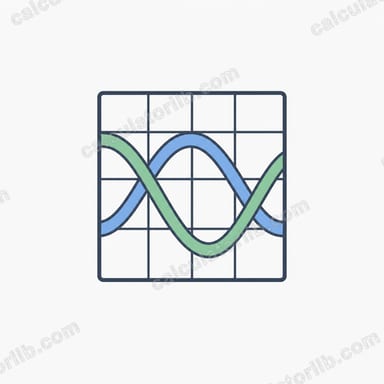
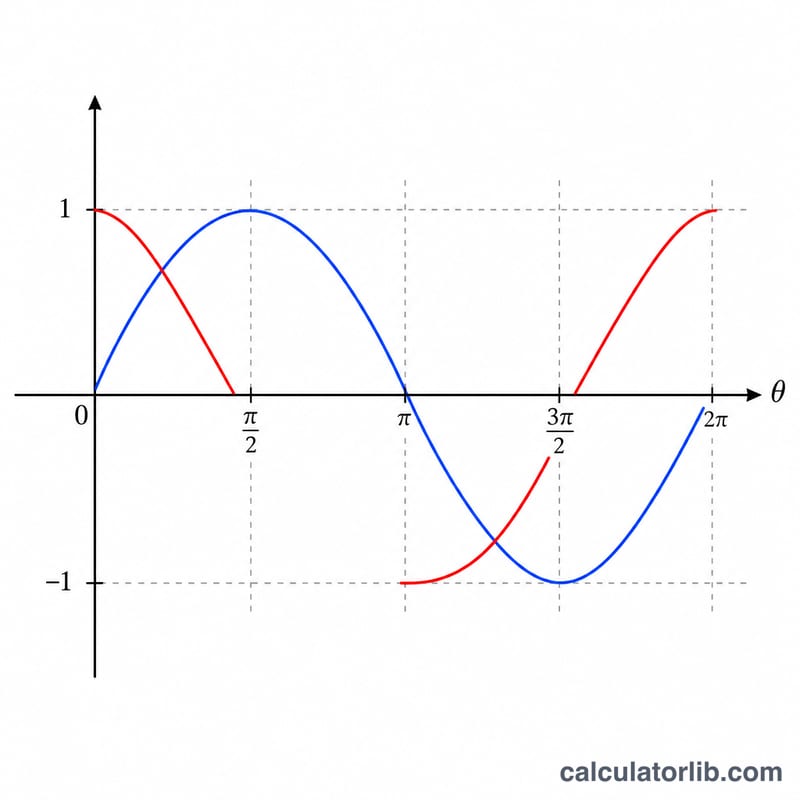
This trigonometric function table calculator produces the values of sine, cosine and tangent for a sequence of angles. You choose a starting angle, an ending angle and a step (increment), all measured in degrees, and the tool lists one row per stepped angle showing \(\sin\theta\), \(\cos\theta\) and \(\tan\theta\). It also draws the sine and cosine curves over the chosen range so you can see how the two waves rise and fall. It is a pure-math tool and works identically everywhere — no country or unit assumptions beyond the degree input.
How to use it
Enter the start angle (the first row), the end angle (the last angle of the range) and the increment, which is the gap between consecutive rows. For example a start of 0, an end of 360 and a step of 2 produces angles 0, 2, 4, …, 360. The increment must be greater than zero. To limit page size the table generates at most 361 rows; if your range and step would create more, it stops at 361.
The formula explained
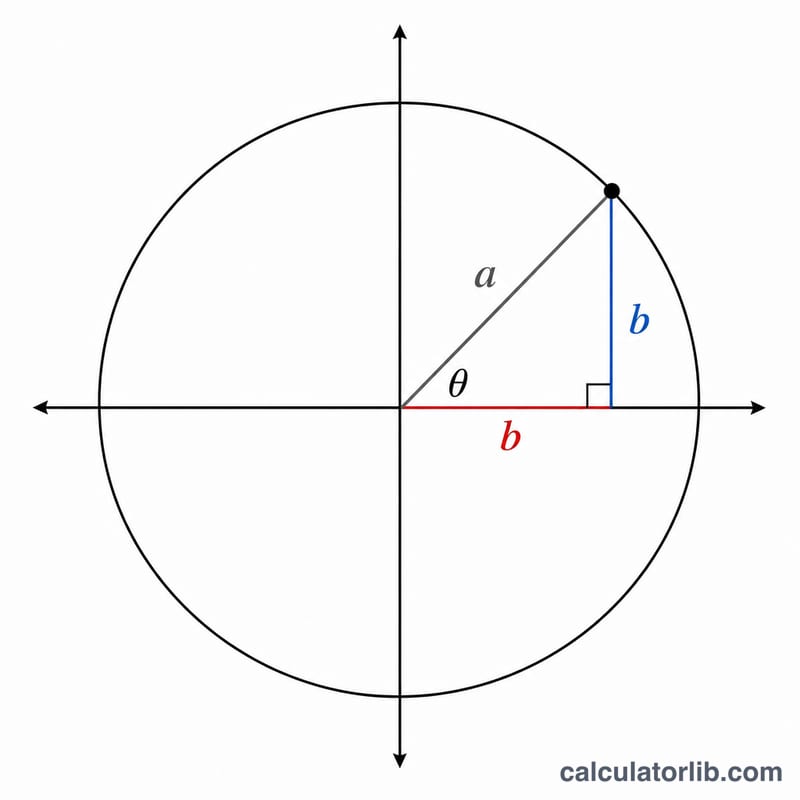
For every angle a in degrees the tool first converts to radians using $$r = a \times \frac{\pi}{180}$$ because the math library expects radians. Then \(\sin\theta = \sin(r)\), \(\cos\theta = \cos(r)\), and \(\tan\theta = \sin(r) / \cos(r)\). Tangent has no value when \(\cos\theta = 0\) — that happens at 90°, 270°, 450° and other odd multiples of 90°. Because floating-point cos of 90° is a tiny non-zero number, the tool flags any angle where \(|\cos|\) is below \(1\mathrm{e}{-12}\) and prints "undefined" instead of an enormous number.
Worked example
With start = 0°, end = 90°, increment = 30° the table has four rows. At 0°: \(\sin 0\), \(\cos 1\), \(\tan 0\). At 30°: \(\sin 0.5\), \(\cos 0.866025\), \(\tan 0.577350\). At 60°: \(\sin 0.866025\), \(\cos 0.5\), \(\tan 1.732051\). At 90°: \(\sin 1\), \(\cos 0\), tan undefined. The graph shows sine rising from 0 to 1 while cosine falls from 1 to 0.
FAQ
Why is tan blank or "undefined" at 90°? Because \(\tan = \sin/\cos\) and \(\cos(90\degree) = 0\), so the division is undefined (a vertical asymptote).
Can I use negative angles or angles above 360°? Yes. The trig functions are periodic, so any real angle is valid.
Why isn't tangent graphed? Tangent shoots to infinity near its asymptotes, which would distort a fixed-scale plot, so only sin and cos are drawn while tan stays in the table.